Makes sense. Such a shame 
Thanks for letting us see the email.
Covid was an extraordinarily tough time for businesses and even for a lot which survived many will be feeling the effects for years. And behind all this of course are many human stories and resulting family problems which we never hear of. It’s life I know but tough all the same.
Running a business (especially a small one) can be really challenging and often there is little if any support around when things start going south. And I don’t just mean financial support.
Sometimes after a reset though we come back stronger than before. I wish him well.
6 Likes
Out of curiosity, how is the email from Fulcrum related to this thread about the state of Honeycomb Aeronautics?
4 Likes
The Fulcrum was the only other yoke in the honeycomb price range ( albeit aimed at a different market, people that already had a home cockpit and wanted a professional yoke without switchgear). Both were good products just aimed at different users. Everything else was either far cheaper and in many cases toy like or instead was double or triple the price.
So the choice has been buy a Honeycomb or pay 50% more for a Fulcrum with more movement, especially in pitch, potentially swappable handles for different aircraft and solid metal construction with no plastic and no bungee straps, but 50% dearer, bigger bulkier heavier and no switchgear.
That was the choice. There was nothing else in that price range between cheap yokes and super expensive stuff like Brunner and Virtual Fly. The Fulcrum or the Honeycomb was the choice.
SO … the fact that the only competition to Honeycomb in that price range went broke and why seems very relevant to a discussion on why Honeycomb may also be having issues.
5 Likes
Honeycomb’s customer service was massively lacking as well… Cancelling all UK orders of the Bravo with just an email saying “order cancelled” with barely any notice probably didn’t do them any favours for starters, I for one wouldn’t have had anything to do with them from that point regardless of how good their products allegedly were. Based on others comments in this thread, it seems that they had very little respect for their customers anywhere else too, and barely communicated with them in any way, shape, or form - companies that treat their customers like that don’t deserve to stay in business, it seems Honeycomb found that out the hard way.
3 Likes
Fair enough. I was just curious how we were twisting these two together. At least Fulcrum provided some form of communication, an explanation, and a glimmer of hope. I’d be mildly happier if Nicki Repenning would send a “Ha! Joke’s on you! You’re out $389.00 US for those Charlie Peddles you’re never going to get” email.
2 Likes
Yeah but I am reasonably sure that‘s not the reason they are gone. Customer service normally isn‘t that hot an issue with a company that is basically alone on the market in its price range, especially if there aren‘t any massive problems with the product itself and when the product often is in short supply (meaning more people really want to buy it than the manufacturer is able to accomodate). Sure there is some moaning and the occasional public outcry, but most will suck it up and be content with the product. Companies normally fold if their profit margin is too low, if noone buys their products any more or if someone in management is syphening off more money for himself or other purposes (R&D, investment in other companies, etc) than the company can deal with. Or of course a mixturebof those reasons. In this case the second option is clearly out. Since the Charlie rudder pedals hadn‘t come along very well, I lean to option number 3.
There are lots of other reasons why businesses fail. Insufficient long term capital base, insufficient working capital/cash flow, supply chain issues, bad leadership/project management etc etc. The list goes on.
Less than stellar customer service certainly won’t help either. With limited information I guess we can only speculate.
Their customer service has like 2 people, legit. I’ve had nothing but horrible experiences from them. They make some of the best and affordable flight gear, but if you need any repairs or warranty, you are out of luck. I’m not sure how they mass produced so many units, made so much money, but can’t afford to have a support staff.
Question is how many people they have (had) in total? I doubt it’s a lot. Maybe 5-10. From what I understand they only design the stuff, have it produced in China and shipped directly to local distributors. That’s why COVID hit them so hard because of all the problems with getting access to parts, factories lowering their output and issues with international shipping.
Having such a low (relatively) volume of sales is also why it’s hard for them to secure a factory line for a price that makes sense for them. Hence the issues with producing anything new like the Charlie or Tango Foxtrot. They can design it, but producing it in volume with the required quality and price is hard.
Could make sense. Wondered why the premises looked more like offices than manufacturing facilities.
If the products were also produced offsite too without maybe any direct/overseeing control it might also go some way to explaining why there were issues with repairs/customer service too.
If it was produced in the Bay Area I doubt it would have been priced like it was 
Appreciate this is no indictation as to whether Honeycomb are in any way still up and running, but Aerosoft in Europe are running a sale on Honeycomb products right now:
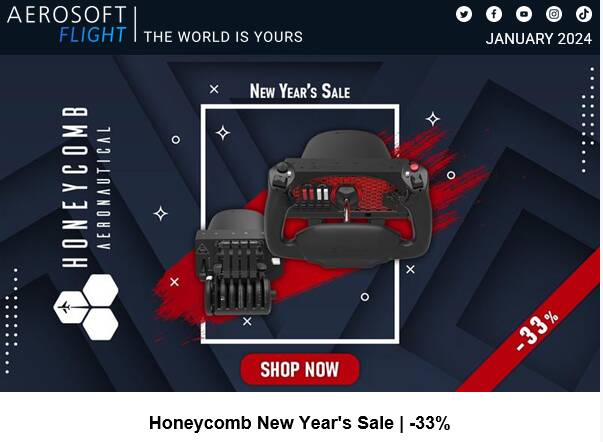
And on the webiste they are showing as in stock and ready to ship today.
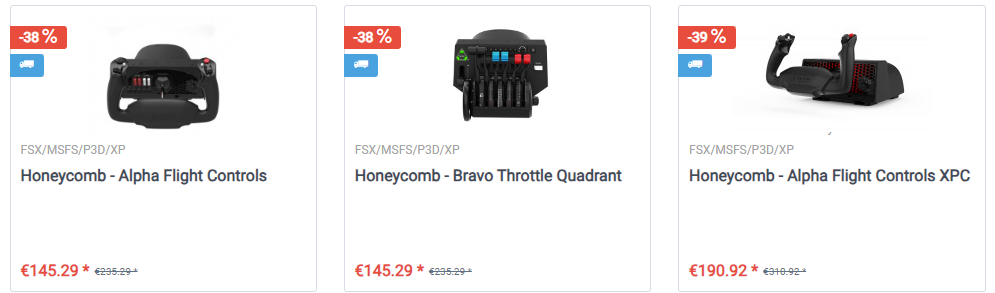
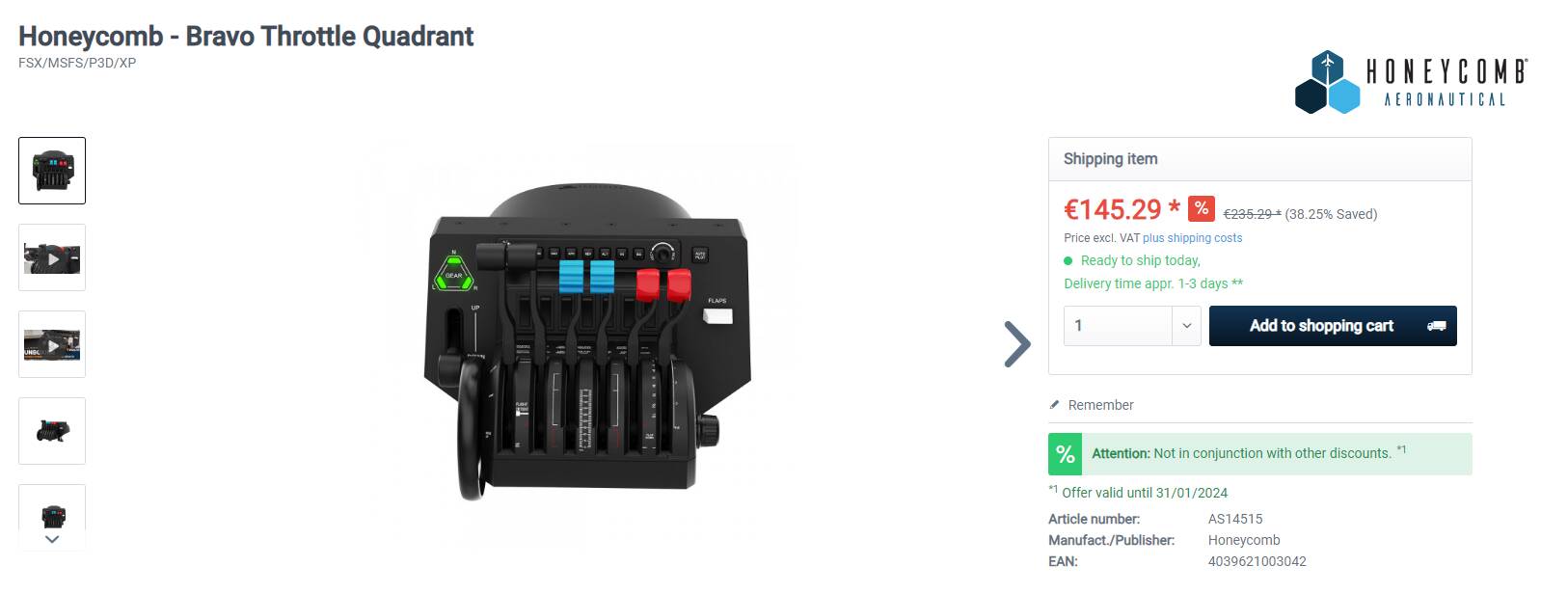
Maybe they are trying to get rid of their stock before word spreads in wider circle that the producer is bankrupt and there will be no RMAs nor continued support?
2 Likes
WTF? In Germany it’s 189.99. That’s 17,- more than 145.29 plus VAT …
I’d advise caution with websites saying they have stock. I am in Australia and couldn’t find a supplier that still had stock. The closest I could find was a company in New Zealand that stated on their website they had three left. I paid for one but then they immediately changed their website to “ETA 2 weeks”. I am pursuing a refund now but I think some firms are still advertising they have them but really they just will put you on back order.
Is it too much to wish for the Just In Time and drop-ship business/supply chain models to go away?
1 Like
Just got a strange and lengthy email from Honeycomb titled “ Time to tell Everyone what is going on with Honeycomb and the Charlie Rudder Pedals. Part 1”. It sounds fishy and if you have anything on preorder from Honeycomb I suspect your money is gone. The website is no longer working.
In case someone is not on the mailing list:
Honeycomb Aeronautical
I am writing this letter to explain the current situation and provide some clarity about what has been going on with Honeycomb and to offer you my sincere apology if you have been caught up in this in any way. I’m not trying to make any excuses or deny my responsibility for what happened. I should have paid more attention to what was going on and acted sooner. I have no one but myself to blame for that. To fully understand how we have ended up where we are, I need to start at the beginning…
I initially had the idea to start Honeycomb, back in 2012, when working on growing Saitek in the US market. I saw a massive gap in the market, between high-volume gaming grade and low-volume,
high-end flight sim equipment.
I built the Honeycomb business plan on utilizing my knowledge and network in both industries, to develop authentic, high-quality products at a price point that a lot more people could afford, by using the mass-production infrastructure of the consumer electronics industry, paired with product fidelity of the flight training industry.
The business plan was finalized in 2012, but even with a solid financial and go-to-market plan, finding an investor and
capital to launch the company proved harder than expected. The start up was too small for venture capital, but too big for an angel investor.
In 2016, I finally found a partner to start Honeycomb with. He was a longtime friend whom I trusted, and I had already been working with to help develop the US market for his video game accessories. I
had presented the Honeycomb business plan to him several times before, but he wasn’t in a financial position to commit to being part of the start up at the time. However, that changed when he was able to provide the funds needed to start Honeycomb together through a finance partner.
We agreed that he would be responsible for the financial side of the business, funding the product development and manufacturing as well as using his existing company in Hong Kong as a service
provider to work with our manufacturing partners, to transition the AutoCAD files I provided of my industrial and mechanical designs into a product ready for mass production. Additionally, we agreed that we would use his distribution companies in the US, Europe, and Asia to sell the Honeycomb products, so I could concentrate on product development. In return, he would get a minority ownership stake in Honeycomb. We agreed that he would register the company for us in Hong Kong since it made sense from a development standpoint and the close proximity to our manufacturing partners in Shenzhen.
We had already started the development of the Alpha but finalizing our shareholder agreement and setting up Honeycomb as
a company kept getting pushed off by my partner. Finally, when the company was established, I discovered that it was done so with 100% ownership under the corporate umbrella of my business partner. He explained that it was a requirement by his finance partners, who had a lean against his company as security for the loans and wouldn’t provide the funding otherwise. He promised we
would finalize the shareholder agreement, specifying the ownership percentages, which were to be executed once the loans needed for the production and development were repaid. I would never have agreed to those terms in advance (and still don’t) and although I had reservations about the situation, I wasn’t looking to sell my shares anytime soon, so getting a written agreement in place that protected my rights, became a bigger priority than actually having the shares in my hand. However, despite numerous attempts to get it finalized, no agreement has been signed by him to this date.
During the first two years, I focused almost entirely on product development and during this time, I did not suspect anything wrong when reviewing the monthly and annual financial reports. Sales were great, and I had no expectations that we would be profitable from day one. However, by mid-2022, it became apparent that my business partner was in financial trouble and when Honeycomb ended up with a negative result despite having a record year, I started looking into the financials in detail. Once I started going through the books, every invoice and purchase order, one by one, I discovered that the service fees added to the factory cost (for the services provided in Hong Kong) were significantly higher than what we had agreed. In addition, the sales prices on the invoices to my partner’s distribution companies were lower than agreed. When I confronted my business partner about the findings, he assured me that it was just an accounting error and promised to get the books in order. I accepted the explanation and solution but didn’t push to have it done immediately, not wanting to worsen my partner’s financial situation at the time. To further help the cash flow situation, I made the mistake of agreeing to a limited pre-order campaign for the Charlie’s once the production schedule had been confirmed by the factory. However, when production was set to begin, I found out that instead of paying for the components required to manufacture the product, all the money received for the Charlie pre-order had gone elsewhere. The situation escalated in July 2023, shortly after we missed the planned shipping date for the pre-orders when the factory partner contacted me directly to inform me that they had still not received payment for the Charlie production or for the several thousand Alpha and Bravo’s they had manufactured and were sitting in their warehouse, which I was completely unaware of existed. Additionally, they had a significant amount of outstanding invoices, including for the injection tooling, required to produce the plastic parts for the Charlie. The extent of the situation caught me completely by surprise.
Pre-orders to cover a capital shortfall are generally a bad thing. You are being paid for a product before you know the final production cost. In the construction industry for example where houses are basically pre=ordered at a set price then built any delays that increase costs can make a particular job lose money and can even send a company broke.
Fulcrum fell into the pre-order trap as well. Pre=order plus Covid delays and cost increases is a formulae for disaster.
However there seems more going on here and he even seems to be hinting at uncovering actual fraud.
1 Like