That’s a great explanation of how it works, thanks! I agree it would be fantastic to get more accurate simulation but then of course every simulation by definition is an approximation as it’s simply impossible to be 100% accurate. A simulation is supposed to be similar, not the same.
As a desktop flight sim it’s already fantastic most of the time and there’s definitely limits on how identical to reality this can be.
In summary from your description if you want to see lightning in the sim with live weather you need to find somewhere with a very high CAPE forecast and fly there, right?
Asobo announced way back around the time of release that they would NOT be modelling realistic turbulence and wind shear in Thunderstorms.
The logic seemed to be they would get too many complaints about " excessive turbulence " from people thinking their supposedly " elite " sim based flying skills should allow them to navigate through a storm front that would literally rip the wings off any real life light aircraft in seconds.
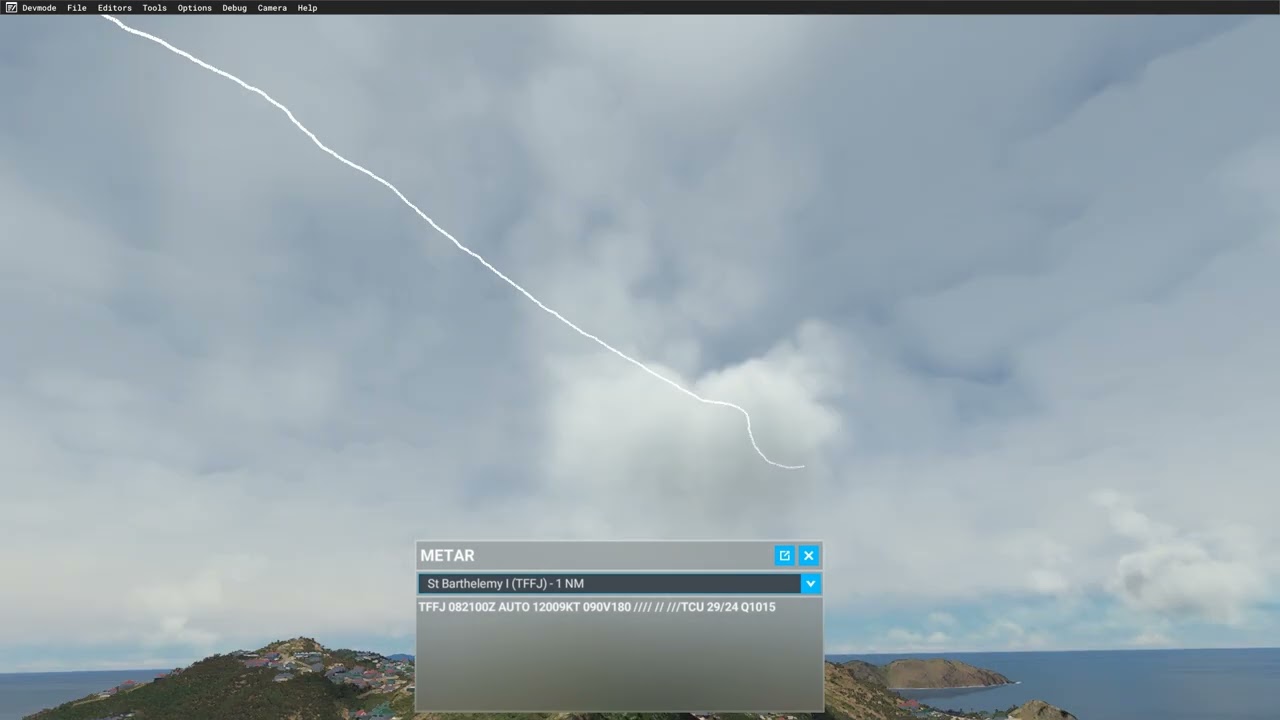
Vid not working for me but I see your lightning at a weird angle from the thumbnail. I noticed similar when I had it in sim too. Didn’t look terribly realistic. Cloud to cloud lightning is a thing but not this weird diagonal lightning so far as I’ve ever seen.
Not sure why they wouldn’t play as they are pretty standard YouTube videos. Perhaps a browser issue of some kind.
About the lightning, you see that a lot, and before they reduced the amount we used to see, you could see these flashes cross from horizon to horizon, and occasionally really bizarre stuff like inside the cockpit itself.
It would take multiple people from different angles to accomplish this, but my suspicion is these flashes are entirely client side, and projected somewhere into your viewport. If two people were viewing a storm at say 90 degree angles apart, would they both see the same flash projected into 3D space at the same time, kind of like trying to triangulate the position of the lightning flash. I know you couldn’t do that with two people by definition, but I suspect both users would see different things, and in different places in the sky.
For me live weather has become boring because of the kack of clouds type, and the absence of storms, that includes the kack of different CBs and now very rare lightening, I do see them sonetimes (very rarely l, even if they are indicated by meteoblue or even in the world map) but the come from really stupid looking clouds. 3 years ago the sky in mfs was a sight to behold …alwsys different..you never knew what you woukd fly into (if you didn’t plan)
You need CAPE, yes, but it’s only one of the three ingredients needed for a thunderstorm.
High-level look:
CAPE is a measure of the instability aloft. The saturated adiabatic lapse rate (SALR) is 1.5°C/1000’ at low altitude up to 3°C/1000’ higher. If the environmental (actual) lapse (ELR) rate is higher than that, meaning it cools more rapidly as you ascend, then that parcel of air will have more CAPE and is considered unstable. This means another parcel of warmer air lifted from below will continue to be buoyant and rise until it reaches equilibrium.
The opposite of CAPE is CInH, which is convective inhibition. This is when the ELR is lower, generally due to a temperature inversion aloft, meaning the temperature drop as you ascend is very low, possibly isothermic, or it may actually rise. This is known as “the cap.” A parcel lifted from below into a cap will usually not rise any further unless the cap erodes or there is extremely strong lifting (see below).
The second ingredient is lift - you need something to start pushing that parcel up from below, to overcome gravity. This can come in the way of thermal lift from the sun (like you’d see in airmass-type storms), or changes in air density like you’d find along fronts and dry lines, convergence of air masses, where the only way to go is up (we often see this in outflows from nearby storms), or mechanical lift, like rising terrain.
The last ingredient is moisture - obviously you can have instability aloft and even lift, but if there isn’t enough moisture, it won’t make the moist layer deep enough to create a thunderstorm.
Now, that’s just what you need for a thunderstorm. To sustain it, or make it intense, you need other factors.
Agreed, it was a cheap “solution” that caused as many problems as it tried to solve. However, it was moving in the right direction because spatiotemporal resolution and accuracy in weather is absolutely necessary for realistic simming. It just wasn’t thought through to the conclusion nor implemented very well for a long time.
One solution, as you said, is to simulate the meteorology, but I agree that’s way outside the scope and capabilities (and likely a dearth of global data with the necessary resolution to get below the mesoscale). The other is to use better rapid-refresh observation, like satellite and radar, where it’s available.
You sim is broken, throw out your PC and buy a new one.
It certainly still does exist in MSFS and was matching real world conditions I could see out my window.
That’s a great meteorological explanation thanks, but my observation on use of CAPE forecast was not about explaining real life storms and instead a response to this quote regarding where storms are placed in the sim:
So I’m sure the sim doesn’t get anywhere close to stimulating all of those metrological details and I really wouldn’t expect it to. If this claim is right then what parameter does the sim use to decide where to place a storm? I would imagine it’s the CAPE as I can’t really think of any other standard forecast parameter that would be more suitable. Any alternative suggestions?
I played with it a little and the lightning prevalence wasn’t 1:1 tied to the Meteoblue NEMS plots of CAPE. They might be doing some composite parameter that includes things like Relative Humidity, ThetaE, or Lifted Index. And then throwing a random number on top of that. Who knows? It’s a black box.
I think there are definitely ways to do it better using just the numerical forecast models. Most of the global models can parameterize convective activity between grid points, and you could pair that with a more robust thunder composite parameter maybe.
Other primary issues are that the lightning is not tied exclusively to deep convection (cumulonimbus thousands of feet tall), and the sim rarely draws deep convection in Live Weather thunderstorm environments. Lightning is either on or off based on your position (not the storm’s), and it draws the lightning from the nearest clouds, which might be small translucent puffs. I think they need to work on this before they start getting into parameterizing convection in the forecast models.
Great info here. If you are looking for thunderstorms as a test of MSFS live weather you can do no better than the East Coast of Australia near Sydney and far inland to Parkes in Summer time. We get a thunderstorm almost every afternoon during the heat of Summer. I think it has something to do with the hot land and cold Pacific Ocean but that is probably a gross simplification.
I will be checking it to see how accurate it is. I will also be interested in the Coastal weather around Sydney because FSX always had a problem with the Pacific Ocean off the coast of Sydney because of a lack of weather stations (no station east of sydney). To make an overcast East of Sydney over the ocean even manually I would have to set a global overcast first before changing local weather stations. If I did not do this the Pacific would be clear skies east of Sydney in live weather I seem to recall. I will be interested to see how MSFS 2020 handles Pacific Ocean weather.
It would be interesting to correlate the size and duration of the convective, lightning-producing cells to what appears in the sim. My guess is the smaller and/or more brief they are, the less chance they’ll show up in the sim. Unfortunately that’s the nature of a lot of airmass-type storms all over the world.
100% agree - live weather is not good in MSFS. Clouds look better than post SU5, but flying through or around thunderstorms is boring and usually just non-existent.
I saw that is MSFS 2024 they are going to solve some weather problems, I don’t know if they are referring to that with addition to some live weather mistakes