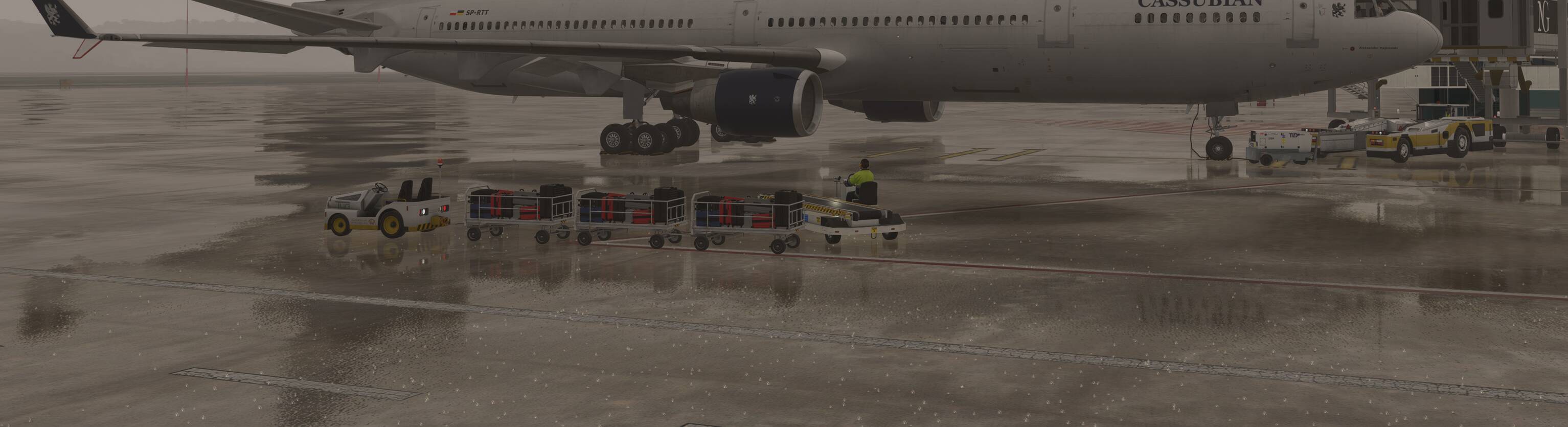
In external views, rain and snowfall are often barely visible, even under moderate to heavy precipitation. This makes weather conditions difficult to read visually and reduces the overall sense of atmosphere and scale.
In addition, wet runways and taxiways lack convincing surface response. The current damp ground rendering feels flat, with limited depth, reflection behaviour, and texture variation, especially under dynamic lighting.
A rework of precipitation visibility in external view, combined with an improved wet ground mesh and surface shading for runways and taxiways, would significantly enhance realism. More pronounced rainfall and snowfall, along with better-defined wet surface deformation and reflections, would greatly improve immersion during adverse weather operations.
Last night I was watching it snow at EHGG. I was disappointed that none of that snow left a white layer. I switched then to EHAM where it was snowing too and there things were even worse. The snow sounded like rain.
I wonder if third party addons do this better.
Another big issue is that it seems that wet surfaces seem to increase friction instead of decrease. This has been an issue in 2020 and continues in 2024
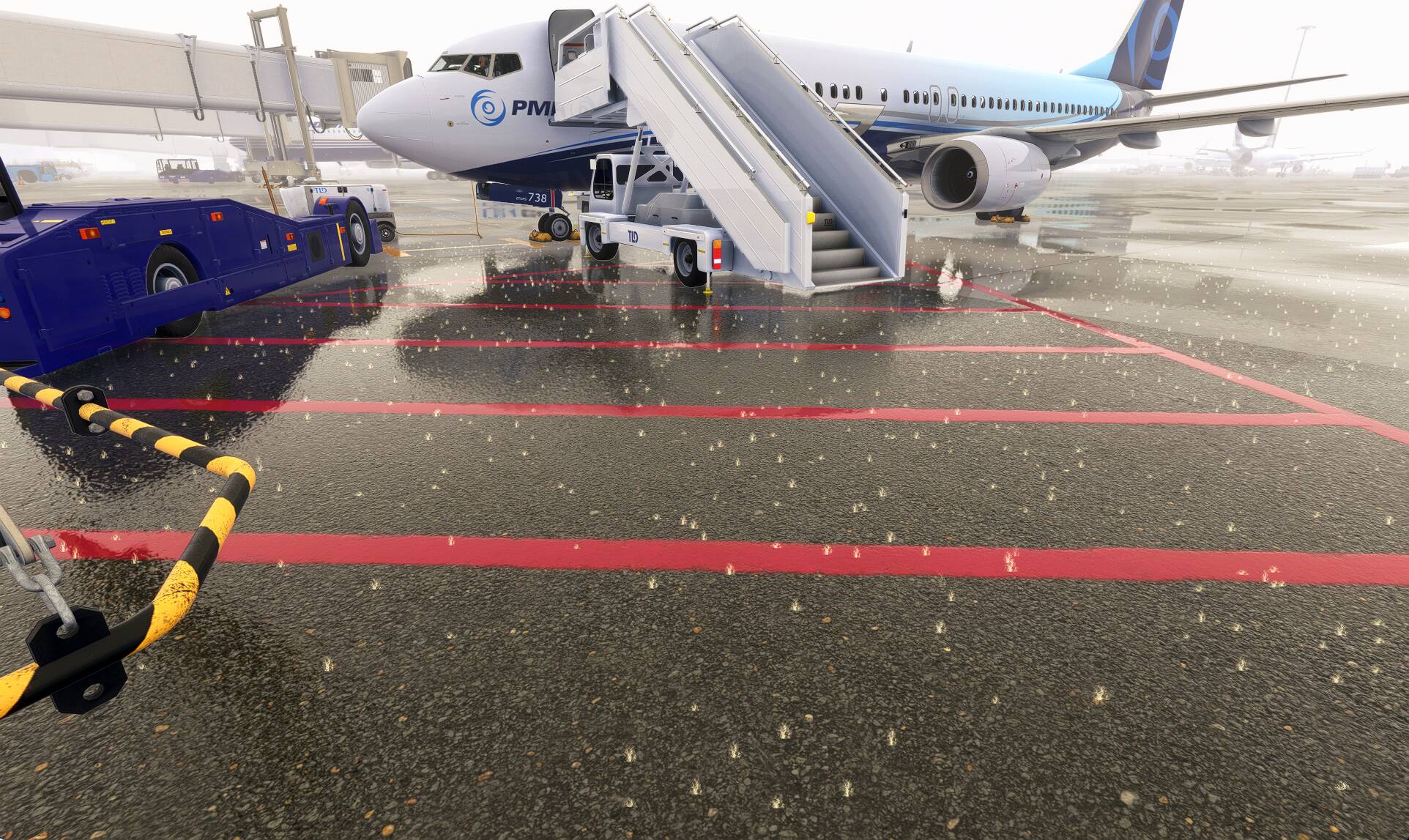
I am pretty happy with how this is done, and I get a good idea it is lousy weather when I walk to the aircraft and see this. Already coming up with ideas to let my colleague do the walk-around!
The issue is not whether the scene suggests bad weather, but whether it is physically and visually correct.
A few factual points, based on the SDK and long-standing community observations:
In MSFS, rain and snow particles are largely invisible in external view, except at extreme precipitation rates. This has been widely reported since MSFS 2020 and remains unchanged in 2024. The weather system does not render volumetric precipitation in a way that scales realistically with distance, speed, or lighting.
The wet ground rendering on runways and taxiways is static. It relies on material darkening and basic reflections, without puddle depth, flow, spray interaction, or proper specular response. This is especially noticeable at night, where the surface often looks flat and uniformly glossy.
This screenshot is taken with precipitation set near maximum, which masks the limitation. At realistic rain intensities (the majority of operations), the effect largely disappears in the external view.
Other simulators (notably X-Plane) already implement clearly visible precipitation, surface response, and water interaction, demonstrating that this is a rendering and surface-modelling choice, not a conceptual limitation.
So yes, the atmosphere is suggested — but the precipitation visibility and wet surface mechanics themselves remain underdeveloped, particularly for airport pavements.
Their implementation of rwy contamination is spectacular. I tried stopping a fully loaded 777 on a wet runway vs a dry one the other day. Boy oh boy. Wich in turn makes performance calculation ultimately necessary.
But the current overall weather and atmospheric simulation in MSFS has still a lot to catch up in that regard
I’ve noticed the lack of rain visibility in external view too and fully agree. Ideally it’d be visible running down the windshield externally too.
I also wish it would be possible to have moderate to fairly heavy rain without reducing visibility (into the distance) to almost nothing. In real life, just because it’s raining doesn’t mean you can’t see further than what feels like 50m or so!
That is an absolute must in any simulator. So far MSFS 2024 just feel like a game when it comes to the real dynamic and friction contamination on a runway. Bravo to Xplane
 I tried stopping a fully loaded 777 on a wet runway vs a dry one the other day. Boy oh boy. Wich in turn makes performance calculation ultimately necessary.