Pee-Wee and Nag at the Movies
Strategic Air Command, Part 1
Pee-Wee says: Well. That was a long break.
Too long. That was an awesome vacation, but now I’m itching to research and write. Where to?
Pee-Wee says: How about what we talked about on the couch last night after the movie? Hint: I already started researching. 
I was wondering why those books were on the desk. But where’d the map come from?
Pee-Wee says: It’s a long story. I’m ready when you are.
Say no more, my dear. So, to make it official…(ahem)…
Welcome back, geography and history friends! Today we’re taking a tour of filming locations from Paramount’s wonderful 1955 drama Strategic Air Command, starring Jimmy Stewart as Air Force Reserve Pilot “Dutch” Holland and June Allyson as his wife, Sally.
Pee-Wee says: It’s the best movie ever.
Not according to the general public. Most critics panned the poor acting from everyone except Jimmy Stewart, and it tied for ninth place when compared to other top grossing films of 1955.
Pee-Wee says: Thou speaketh blasphemy.
I’ll agree it was pretty good, but I wouldn’t say it was the best. The filmography was amazing, but the move was…
Pee-Wee says: …the best ever. Except maybe for Spirit of St. Louis.
You just like Jimmy Stewart.
Pee-Wee says: Who doesn’t?
True. By most accounts, he was a real gentleman, humble and forthright.
Pee-Wee says: Stewart wasn’t just an acclaimed actor, but also a veteran combat pilot and All-American hero. He actively campaigned to fly in combat and completed more than twenty daylight bombing missions over Germany, commanded his own squadron of B-24s, and served as a group operations officer and a combat wing chief of staff. He stayed in after the war, too, remain qualified on the B-36, B-47, and B-52, and rode along on a bombing raid over Vietnam shortly before he retired as a Brigadier General in 1967, the highest-ranking actor in American history. He’s kind of my hero…and it was the best movie ever.
Yes, dear.  Anyway, let’s break this tour into two parts, like the movie. Let’s look at locations around Fort Worth and Carswell first and then head to Tampa Bay and MacDill.
Pee-Wee says: Then can I talk about the movie’s real stars: the B-36 and the B-47, and maybe a few others?
Our readers would expect no less.
Pee-Wee says: Yay! Because, let’s be honest: the airplanes are the real stars of Strategic Air Command. And speaking of planes, we’ll need a good one to fly.
No short or soft-field operations and no long legs. The J3 Cub? Cessna 150?
Pee-Wee says: I think there’s really only one suitable choice for touring USAF facilities of the 1950s.
Hmm. I see where you’re going.

Pee-Wee says: Perfect! This is Lockheed T-33A 56-1777 assigned to the Air Force Communications Service at Scott AFB, Illinois. AFCS was formed in 1961 by elevating the Airways and Air Communications Service to the major command level on par with the Tactical, Strategic, and Military Airlift Commands. The new command was responsible for building, maintaining, and operating the Air Force’s communications systems: survivable networks connecting America’s nuclear forces to the National Command Authority, mobile radar and communications sets airlifted to natural disaster sites, and even the telephone lines connecting control towers to airbase fire stations. The AFCS also managed the Air Force’s thousands of air traffic controllers.
The AFCS’s T-33s worked alongside C-140 Jetstars and T-39 Sabreliners at one of four Facility Checking Flights—the 1866th at Scott AFB, 1867th at Clark AFB, 1868th at Wiesbaden AB, and 1869th at Tinker AFB—testing and calibrating radio and visual navigation aids around the world. Thanks to prolific painter Jocko417 for creating this magnificient skin for iniBuild’s T-Bird. (We’re still solidly in the 2020 camp, but Jocko recently updated this skin for use in 2024.)
Pee-Wee says: Ooooh, I love Dayglo and bare skin. I need a Dayglo bikini.
Yes you do. Let’s add that to your Christmas list.
Pee-Wee says: I think that goes on your Christmas list.
Anyway, that’s Naval Air Station Joint Reserve Base Fort Worth in the distance, formerly Carswell Air Force Base and home of the real 7th and 11th Bombardment Wings (Heavy) where Col. Holland and the audience are introduced to the awe-inspiring B-36 “Peacemaker.”
Pee-Wee says: One of the 7th BW’s assigned bombardment squadrons was the veteran 436th. Remember the Philippine-bound B-17s that stumbled into the Pearl Harbor raid? Those aircraft were assigned to the 88th Observation Squadron, which upon reaching India in March 1942 was renamed the 436th Bomb Squadron. Small world!
All 384 B-36s, the XC-99, and the XB-60 were produced at Convair’s factory at Carswell. The final aircraft was delivered on 14 August 1954, only a few months before Strategic Air Command’s premier.
In 1949, Convair held a competition to name its new strategic bomber. The winning submission, “Peacemaker,” was submitted to the Air Force’s Munitions Board Aircraft Committee, but was rejected because of its potential religious connotations. A final decision was deferred and, for reasons unknown, was never reviewed. The B-36 remained officially unnamed.
Another product of the Fort Worth plant, the F-111, also served without an official name. It’s long-time nickname “Aardvark” was only officially adopted when the type was retired in 1996.
Pee-Wee says: Go ahead and finish the intro. I’ll be back in twelve minutes.
I’ll hack the clock.
This tour has only four waypoints and three of them are active airports. We flew two separate flights, but if you desire, Carswell to MacDill is about 830 nautical miles as the crow flies, or an hour and forty-five minutes as the jet flies. 
| Waypoint | Identifier | Coordinates | Skyvector Lat/Long |
|---|---|---|---|
| NASJRB Fort Worth (Carswell AFB) | KNFW | 32.7691 -97.4416 | 324609N0972630W |
| Greater Southwest Regional Airport | 32.8313 -97.0491 | 324953N0970257W | |
| MacDill AFB | KMCF | 27.8494 -82.5211 | 275058N0823116W |
| Al Lang Field / Albert Whitted Airport | KSPG | 27.7650 -82.6269 | 274554N0823737W |
Never seen Strategic Air Command? It’s available on Amazon Prime and other movie sites, but (shhh!) it’s also available for free on YouTube. Pee-Wee likes Florida, so she’ll fly the MacDill part. I’ll take Carswell.
Pee-Wee says: I’m back.
Twelve-minute potty break?
Pee-Wee says: I made cookies.
Ooh.
Pee-Wee says: White chocolate macadamia.
You’re the best. Watch the canopy!
 No Orangutans Allowed: Carswell Air Force Base
Consolidated Aircraft proposed building its Model 32 heavy bomber at a new factory on the shores of Lake Worth west of Fort Worth, Texas. Company and local officials approached the U.S. Army about sharing the construction of the adjacent airfield, a scheme that was approved in June 1941. The first Fort Worth-built Model 32, a B-24D/Liberator III destined for the Royal Air Force, left the new factory in April 1942. By the war’s end, 2,745 B-24 Liberators and 118 B-32 Dominators were built here, and more than 4,000 of their pilots were trained at Fort Worth Army Air Field.
Pee-Wee says: On 1 January 1948, Fort Worth AAF was renamed Griffiss Air Force Base in honor of USAAF Lt. Col. Townsend Griffiss, but the name lasted less than a month. Colonel Griffiss was a native of Buffalo, New York and his name was applied instead to the former Rome Air Depot in upstate New York. Fort Worth was instead named for Medal of Honor recipient and local native Major Horace Carswell.
The 7th Bombardment Wing (Very Heavy) was organized at Fort Worth in November 1947, barely one month after the United States Air Force became its own service branch. The first B-36A was delivered to the 7th BW on 26 June 1948. The 7th operated every major Peacemaker bomber variant and tested the RB-36 reconnaissance bomber and XC-99 transport.
The 11th Bomb Group was reactivated at Carswell and attached to the 7th BW for training in December 1948, then became its own Bomb Wing (Very Heavy) in 1951. “7-Eleven” remained at Carswell until the 11th relocated to Altus AFB in 1957, and within a year, both wings swapped their Peacemakers for Stratofortresses. The final operational B-36H left Carswell in May 1958.
Carswell was transferred to the Air Force Reserve in 1993 and later to the United States Navy. Today, Naval Air Station Joint Reserve Base Fort Worth hosts Navy, Marine Corps, Air Force, Air Force Reserve, and Texas Air National Guard flying units, and the co-located Air Force Plant #4 produces new Lockheed-Martin F-35 Joint Strike Fighters.
The 7th Bomb Wing is currently assigned to Global Strike Command and operates B-1B bombers from Dyess AFB near Abiline, Texas.
The 11th Wing is the host unit of Joint Base Anacostia-Bolling in Washington, D.C., and currently has no flying units assigned.
Pee-Wee says: The 7th Bomb Wing was deployed to Andersen AFB in 1966, but Brigadier General Stewart flew his final combat mission instead with the 454th Bomb Wing’s 736th Bomb Squadron, shortly after filming Flight of the Phoenix. You can read more about his long Air Force career here.
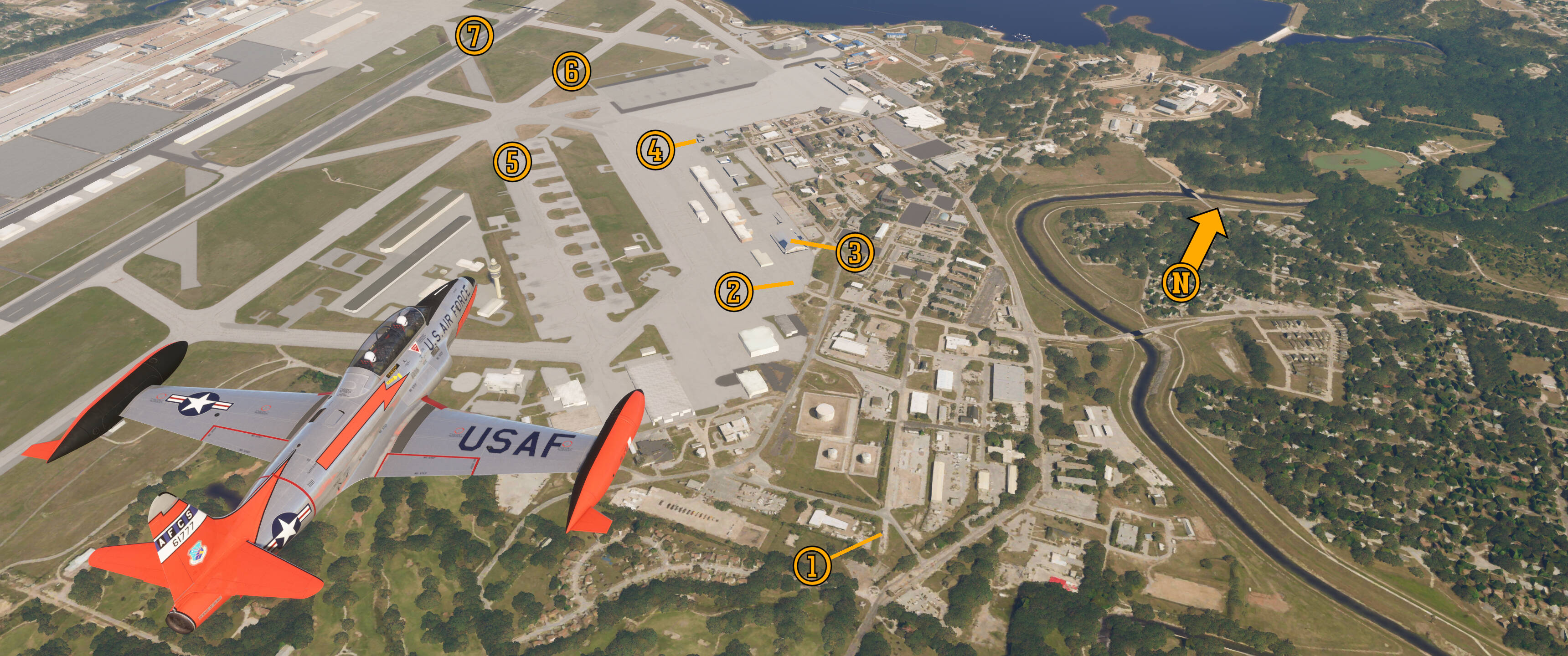
Here we are flying north over NASJRB Fort Worth. Most of the original Air Force infrastructure is gone, but the airfield layout is largely unchanged.
At the top of this photo is Lake Worth, created in 1914 by damming the West Fork of the Trinity River. Fort Worth’s Eastgate Neighbors neighborhood lies across the West Fork to the east. To the west, across the airfield, is Air Force Plant #4, Convair’s former “Bomber Plant.”
Pee-Wee says: Carswell’s main gate, where Col. Holland first encounters the unwavering rigidity of the new United States Air Force, was located (1) here on Knights Lake Road, near the base’s fuel depot and the Texas & Pacific Railroad’s “Bomber Spur” and yard. The gate was replaced shortly after filming wrapped with a much larger affair to the east which remains in use today. The railyard is gone but the fuel deport remains.
The audience is first introduced to the B-36 up-close when Col. Holland walks across the ramp toward (2) B-36H 51-5734. I love this scene: compare how Jimmy Stewart walks across the ramp to Barry Sullivan (Lt. Col. Rocky Samford). There’s something intangible in Stewart’s amble that says, “I’m a real pilot.” It’s subtle but noticeable!
Pee-Wee says: Oh, Jimmy.  Behind ‘5734’ you’ll see (3) the “engine shop” where R-4360s Wasp Majors and J47 turbojets were maintained and overhauled. This hangar survives today and houses several Marine Corps Offices, including the USMC Relief Society. Further up the flightline is the (4) fire station and former control tower, both visible during the Central Airlines DC-3’s “emergency landing” and the Air Police’s response. The control tower is long gone, but the fire station is still in use today.
In the movie, you’ll notice all sorts of aircraft parked (5) on the transient dispersals located on or adjacent to what was (6) Runway 17L/35R. Pee-Wee will talk about many of them later. Colonel Holland’s “one takeoff and one landing” were both on (7) 12,200x300-foot (3,718x91-meter) Runway 17R.

Pee-Wee says: We’ve turned around for another pass in this photo. Right about (1) here were the quarters where Col. Holland and Sally lived on what is today called Falcon Drive. Their home was one of twenty-four duplexes dedicated to NCO families, most of which were demolished sometime between 1995 and 2001. The location is hard to spot: look underneath the trees directly north of the (2) commisary. Two of the duplexes remain standing across the street and are occupied by the base housing service.
Later in the movie, Col. Holland tags Major “Ike” Knowland to be his navigator outside the (3) “807th Bomb Wing’s” operations building. While the unit was fictional, the building was one of several actual administration buildings and may have been the 7th or 11th Bomb Wing’s headquarters. The building was demolished sometime between 1963 and 1968.
Pee-Wee says: Many of the background performers in Strategic Air Command were actual servicemen and women assigned to Carswell. Check out the sharp and chic WAFs walking past in this scene. Why, yes, their uniforms do resemble those of contemporary flight attendants! That was a conscious design choice of Col. Geraldine May, the WAF’s first commander.
Total enlistment in the Women’s Air Force was originally restricted to 300 officers and 4,000 enlisted up to a maximum of 2% of the total Air Force population and peaked at 12,800 during the Korean War. Women were finally admitted into the Air Force in 1976, and the Women’s Air Force was disbanded.
Over here is (4) the exact spot where Sally waited for “Marco Polo” during his exceptionally long trip around the traffic pattern. It’s been paved over today.
Pee-Wee says: Here’s the (5) fire station again, which brings us to a very minor continuity error in the movie: look carefully as the fire trucks are leaving the station and you’ll see the Central Airlines DC-3 already parked in (6) this dispersal. The DC-3 stops right about (7) here before disgorging General Hawks’s band of dastardly marauders.
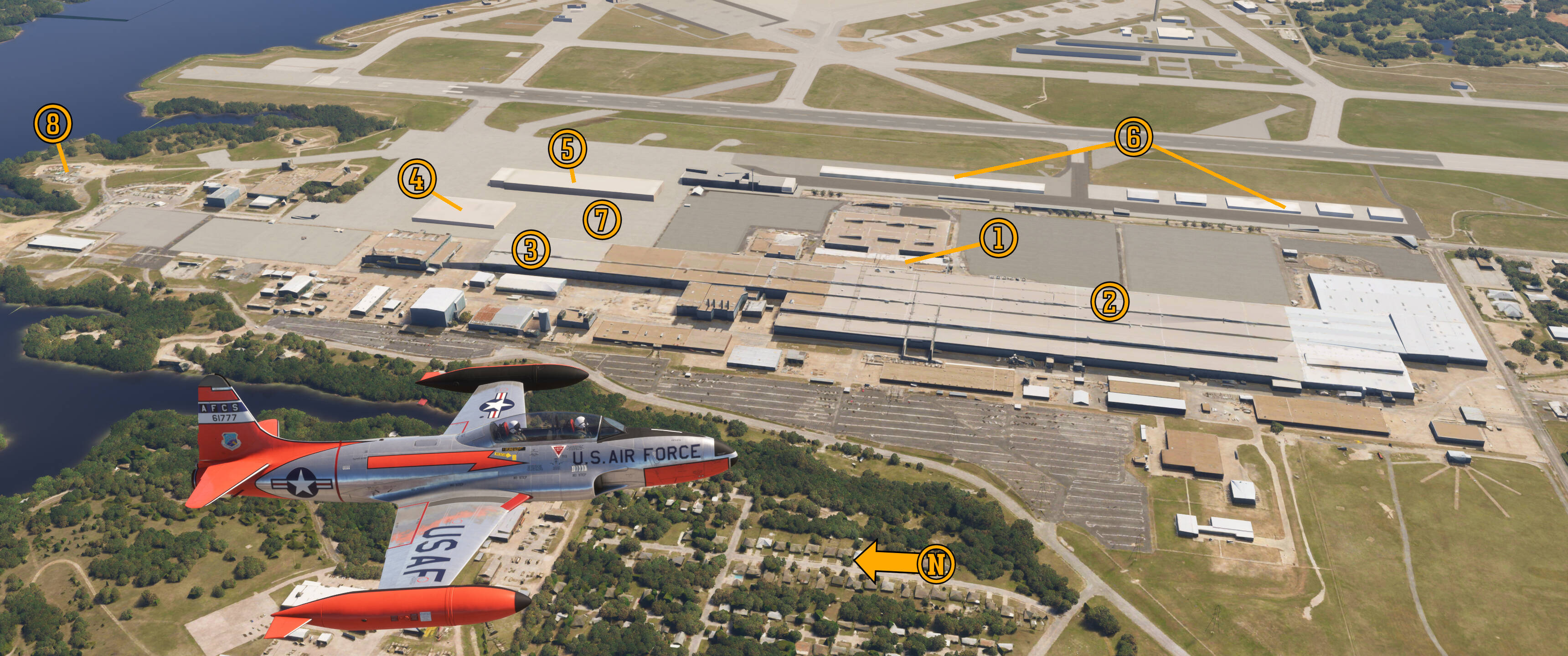
Here’s Air Force Plant #4. It’s changed only slightly since the days when B-36s were built here. The (1) administration building still stands, although it’s been extended eastward. Assembly of B-36s began with construction of major components in (2) this area. The final assembly line began approximately even with the administration building and could accommodate thirteen aircraft, the final four being turned 45-degrees to allow the bombers’ 230-foot (70.1-meter) wide wings to fit within the building.
Pee-Wee says: You’ve probably seen photos of B-36s and B-24s on the Fort Worth assembly line. They were taken (3) at the north end of the plant just inside the doors onto the finishing line. Over (4) here is the Experimental Building in which the B-36 mockup was reassembled after moving from San Diego. Convair realized that this building was too small for construction of the prototypes and built the neighboring (5) Hangar Building for that purpose. The NB-36H and XB-60 jet prototypes were also built inside the new hangar.
Pee-Wee says: The XC-99 transport prototype was built at San Diego. Major assemblies were produced at Fort Worth and shipped via rail to California.
Finished aircraft were prepped for their delivery flights on the (6) flightline adjacent to Carswell’s Runway 17R. When the B-36As were returned to the factory for conversion to RB-36Es, their components were stored on (7) this ramp until being reintroduced into the final assembly line. For reasons lost to time, one RB-36E was fully assembled and completed outdoors here.
Pee-Wee says: Up (8) here is the secure area where the NB-36H Nuclear Test Aircraft lived and where Convair operated the little-known Ground Test Reactor, the first operational nuclear reactor in Texas. Built from the tornado-damaged remains of B-36H 51-5712, the NTA first flew in July 1955, four months after Strategic Air Command premiered. The reactor riding in the NTA’s aft bomb bay was only operated on 21 of the aircraft’s 47 flights and never provided propulsive power. The program was eventually cancelled, and the NB-36H was scrapped at Fort Worth in September 1958.
Look in the distance behind ‘5734’ as she begins her takeoff roll about thirty minutes into the movie and you’ll see what appears to be the crane used to lift the NB-36s cockpit capsule into the airframe. Today this area is used for storage and appears to be collecting some pretty high-tech junk!
Project Specialized Aircraft Maintenance–Strategic Air Command (SAM-SAC) was in full swing when Paramount’s film crews arrived at Fort Worth, which explains the large number of B-36s surrounding the Convair factory. The program, one of the first “contract maintenance” programs under which aircraft were returned to the manufacturer for maintenance and reconstruction, was designed to bring standardization of parts and equipment to the B-36 fleet. As many as thirty-eight Peacemakers were undergoing modification at Fort Worth at any given time, each requiring an average of fifty-nine days for completion. The first of 494 SAM-SAC aircraft arrived in June 1953 and the last was returned to the Air Force in April 1957, less than two years before the type was retired from service.
Pee-Wee says: “How could 494 aircraft go through SAM-SAC when Convair only built 384 B-36s,” you ask? SAM-SAC was completed in three stages, and some aircraft returned to Fort Worth multiple times, increasing the total count.
Well, that’s all there is at Fort Worth. Ready for MacDill and Part Two?
Pee-Wee says: Hold up, buckaroo. We have one more stop here.
Oh, yeah. I almost forgot.
 One More Stop: Greater Fort Worth Regional Airport
Pee-Wee says: The Greater Fort Worth Regional Airport at Amon Carter Field (later Greater Southwest International Airport) opened for commercial service on 25 April 1953, about one year before filming of Strategic Air Command began. Located 23 miles (37 kilometers) east of Carswell, construction of this new commercial airport began in the 1940s as a joint effort between Dallas and Fort Worth. Unfortunately, Dallas balked when it learned that the terminal building would be on the west side (i.e. the Fort Worth side) of the airport, and the project ground to a halt.
The Air Transport Command and Naval Air Transport Service used the “Arlington Municipal Airport (Midway Airport)” for training during World War 2 when the airfield consisted of three runways, a large ramp, and little else. Construction of the originally proposed passenger terminal and American Airlines hangar finally began in 1951.
Pee-Wee says: Several notable aircraft were on static display for the airport’s “grand opening” in 1953, including the XC-99 and B-36H 51-5736, close sister ship of 51-5734, the star of Strategic Air Command. American was the predominant carrier at Greater Southwest, and while Braniff and Delta both leased land here, neither ever built their planned hangars.
The FAA finally intervened in the decades-long struggle between Fort Worth’s Greater Southwest Regional and Dallas’s Love Field, “strongly encouraging” the metropolitan neighbors to pick a location for a single airport serving both. A site immediately north of Greater Southwest was selected and when the new Dallas-Fort Worth International Airport opened in 1974, the end finally came for Greater Southwest. Today the site is covered by an industrial park and American Airlines’ headquarters campus.
Pee-Wee says: In Strategic Air Command, Col. Holland’s physical examination is interrupted by a telephone call from Sally when she arrives unexpectedly at Greater Southwest. She is seen sitting in a telephone overlooking the ramp where an American DC-6 and Convair 240 are parked.

Here we are flying east above the site of the Greater Fort Worth Regional Airport with DFW in the distance. Pee-Wee added outlines of Runways (1) 17/35 and (2) 13/31. The (3) passenger terminal was located to the west of the airfield. The American Airlines hangar was located (4) here.
Pee-Wee says: Built in the 1980s, American’s corporate headquarters campus is located (5) alongside the former Runway 17/35. The only aviation infrastructure remaining here today is the (6) northern 2,300 feet (700 meters) of Runway 17/35 and (7) General Electric’s jet engine test facility off FAA Road.
Okay, everyone, it’s time for an airplane crash. Click to read on or skip ahead to  .
.
Pee-Wee says: On 30 May 1972, a Delta Airlines DC-9-14 crashed at Greater Southwest during a routine training flight when the trainee captain lost control of the aircraft at low altitude after encountering the wake from a preceding American Airlines DC-10. The twin-jet crashed onto Runway 13 and burned, and the four people aboard–a company check airman, two captain trainees, and a FAA inspector–were killed.
The DC-9 came to rest (8) just southeast of the intersection of Runways 13 and 17.
The dangers of wake turbulence were already known in 1972 and IFR flights were provided what was thought to be adequate separation. Unfortunately, while pilots operating under VFR were expected to “see and avoid” wake turbulence, they were provided limited information on how exactly to avoid the invisible vortices. The common belief was that only small aircraft pilots need worry about wake turbulence anyway, but the arrival of heavier wide-body jetliners like the DC-10, L1011, and 747 rendered even medium-sized aircraft like the DC-9 and 727 susceptible to the dangers of wake turbulence.
The NTSB and FAA went round and round until the FAA finally increased the required spacing behind “heavy” aircraft and provided pilots with new information regarding the behavior and avoidance of wake vortices.
Well, I think that covers Carswell and the Fort Worth area. You can talk airplanes now. Pass me the cookies.
Pee-Wee says: Woohoo! Move over.
Pee-Wee says…
Strategic Air Command features quite a variety of military and civilian airplanes. Let’s take a look! (By the way, all the images below are copyrighted by Paramount 20th Century Fox. Stay back, foul lawyers! )
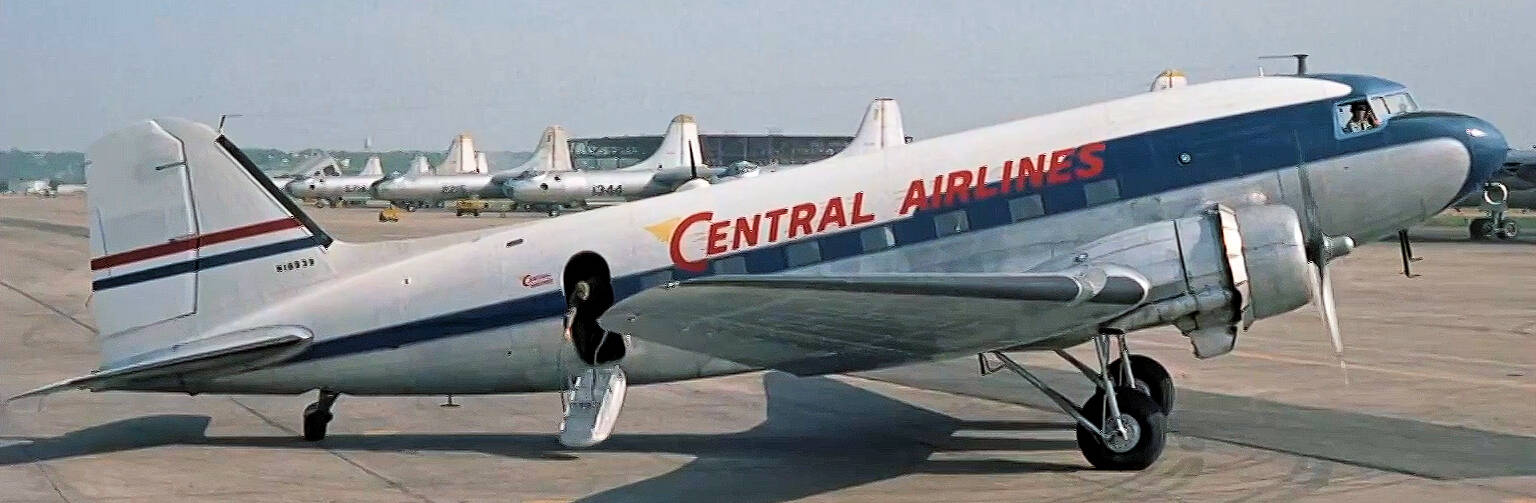
First up is this beauty, DC-3A-197B N18939 of Fort Worth-based Central Airlines. Her paintjob certainly reveals her original owner! She was delivered to United Air Lines on 16 March 1938 as Mainliner Denver. At the time of filming she was owned by the F. Kirk Johnson Company and leased to Central. Johnson was founder and CEO of the Ambassador Oil Company and an early financial backer and board member of Central Airlines. N18939 was sold to Central in 1961 and was sold immediately after the merger with Frontier in 1967. She was scrapped in 1973.
Did you notice the large hangar under construction behind N18939? It still stands today and is home to Marine Aerial Refueler Transport Squadron (VMGR) 234’s KC-130Js and Marine Transport Squadron (VMR) 1’s two C-40As.
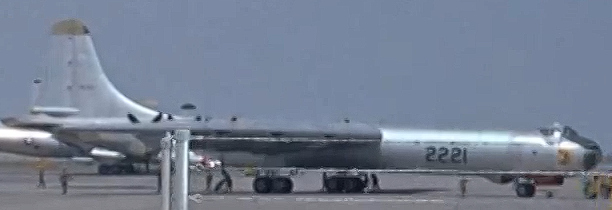
You’ll have to look quickly at about 25:41 to catch this beast! She’s 52-2221, one of nineteen Featherweight III B-36Js flying by March 1954. Operated by the 7th Bomb Wing, ‘2221’ was only three months old when she made her (very brief) Hollywood debut. Sadly, she only lasted about five years and was scrapped with her sisters before the end of the decade. The first B-36s went to the scrapyard in February 1956, eighteen months after the final J-model was delivered and less than a year after the premier of Strategic Air Command.
B-36Js carried an additional 2,770 gallons (10,485 litres) of fuel in new outboard wing tanks and were fitted with stronger landing gear allowing a gross weight of 410,000 pounds (185,972 kilograms). SAC’s final Peacemaker, B-36J 52-2827, retired on 12 February 1959. Barely four and a half years old, she was displayed for many years outside the passenger terminal at Greater Southwest International Airport. After several close shaves with the scrapman, ‘2827’ now rests safely at the Pima Air & Space Museum in Tucson, Arizona.
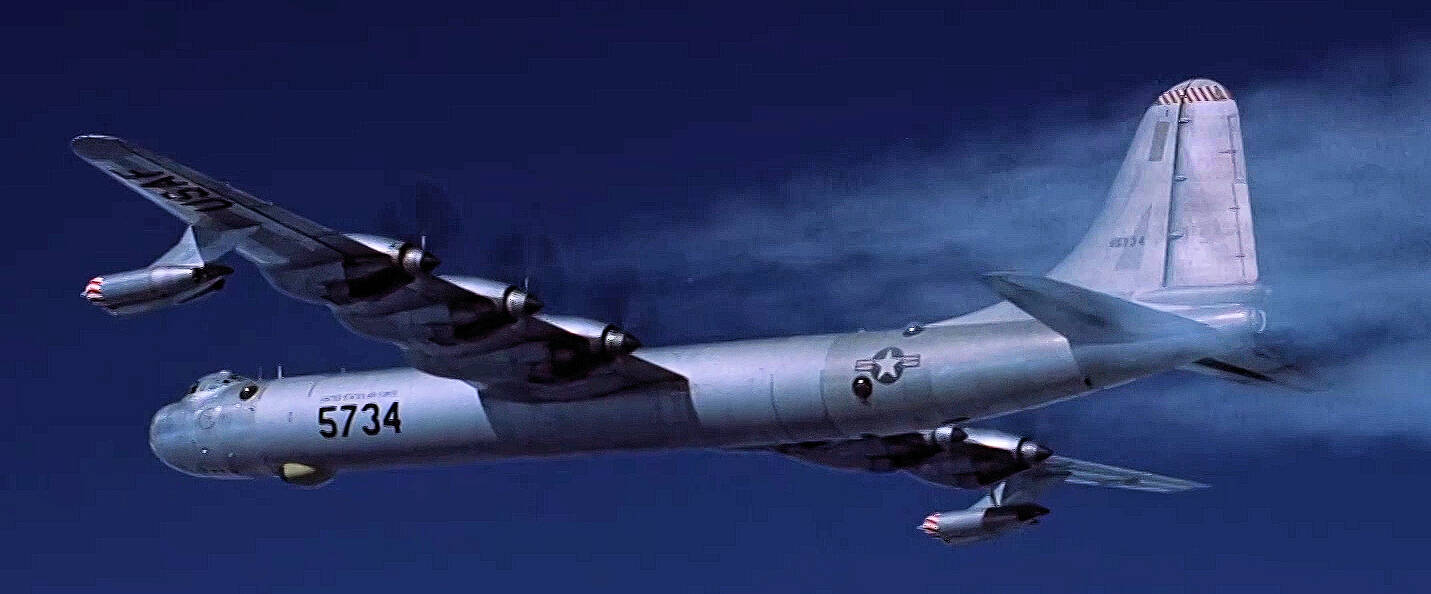
And here’s the star of the show! B-36H 51-5734 was about sixteen months old when Paramount’s cameras caught her in spectacular high-altitude splendor. At the time of filming, she was operated by the Grey Geese of the 11th Bomb Wing. ‘5734’ also lived a short life, retiring to Davis-Monthan Air Force Base on 17 August 1957 after only four years and nine months in service.
This beautiful shot emphasizes the B-36’s different fuselage skins: dull magnesium around the bomb bays and shiny aluminum around the pressurized crew areas. Also, notice the remnants of the large unit marking on her tail. For the sake of secrecy, SAC removed tail codes from its aircraft in April 1953. 11th BW aircraft carried the Triangle U code while the 7th carried the Triangle J.
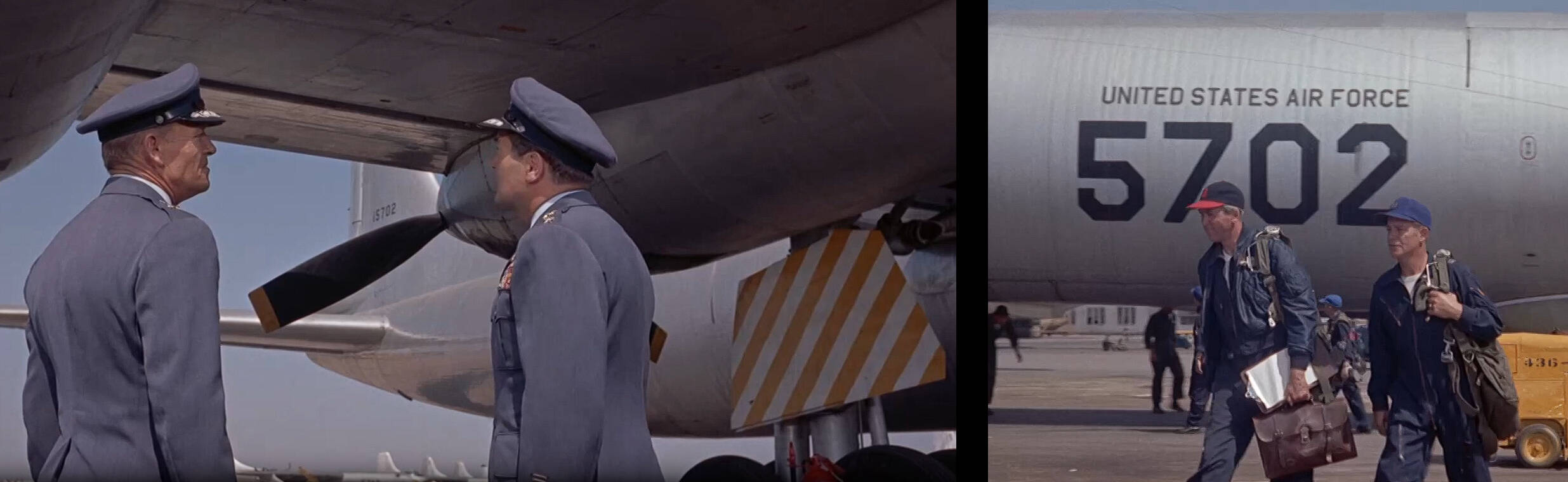
Colonel Holland’s assigned aircraft is 51-5702, a Block 10 B-36H delivered to the 11th Bomb Wing in July 1952. In the movie, this aircraft was apparently testing a modification designed to reduce fuel tank leaks. The modification proved spectacularly ineffective and with fire spreading across the aircraft’s left wing, Colonel Holland must ditch ‘5702’ on the ice near Thule Air Base in Greenland. Look carefully during the crash scene and you’ll see that the model makers actually painted the model as ‘5702!’
The B-36 did actually suffer from fuel tanks leaks, an unfortunate characteristic that was eventually corrected with a new tank sealant during Project SAM-SAC.
The real ‘5702’ survived until October 1957 when she departed Carswell for Davis-Monthan AFB. She lives on today in miniature, thanks to EAA member Craig Marckwardt. You can read his fascinating story here.
Nag says: I’m going to jump back in for a second. The writers of Strategic Air Command went to great lengths to make their film realistic, and they succeeded better than most modern aviation films. Notice that when Holland consults a navigation chart immediately before everything goes south, it’s an actual chart of the west coast of Greenland. As the crew of ‘5702’ is preparing to bail from the stricken aircraft, Major Knowland gives their position as 76 degrees 10 minutes north latitude and 68 degrees 45 minutes west longitude. That’s right here, approximately 22 nautical miles south of Thule AFB.
When the fire starts, Colonel Holland commands the flight engineer to feather and isolate the three engines on the left wing, then instructs his copilot to start the jet engines on the right wing, a sound decision considering the loss of thrust from the left piston engines. But watch Jimmy Stewart carefully: he appears to retard the throttles for the failed engines and advance the other three while watching the engine instruments, then trims for the changing airspeed, and even appears to add right rudder! Now that’s realism.
In your face, Tom Cruise.
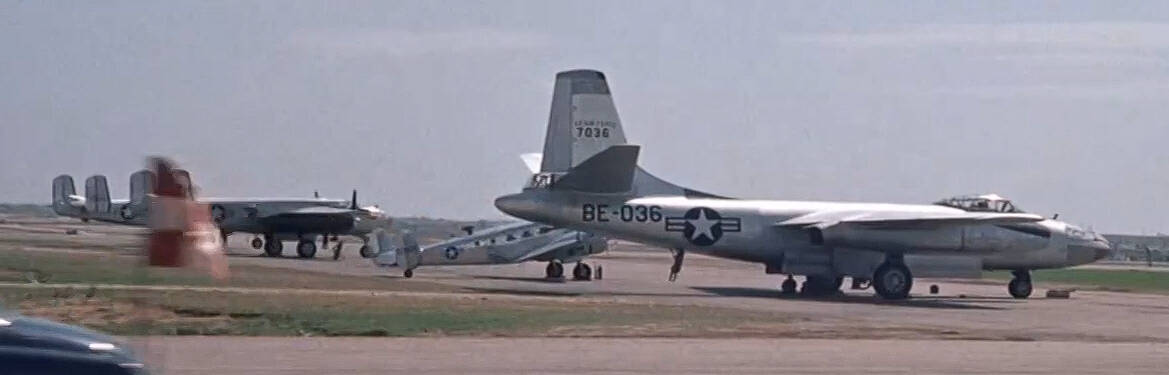
Plenty of interesting transient aircraft are visible throughout the first half of the movie, including a B-29, a C-97, two T-33s, an F-84, and these four aircraft. In front is North American EB-45A 47-036 of the Air Force Flight Test Center. The thirty-sixth B-45A built, ‘7036’ became a JB-45A in December 1955 two years after she appeared on the big screen here but was retired barely one month later. She was scrapped at Norton AFB in 1958. Sadly, I wasn’t able to find any information as to what experimental programs this aircraft was assigned. Do you have more information? Respond here or DM me!

Some sources incorrectly claim that one of the B-25s in the background is the photo ship used for filming, but it was actually Paul Mantz’s B-25H N1203 that captured the amazing footage, including the dramatic takeoff sequence for which the famed pilot flew nearly inside the bomber’s wingspan through the entire sequence (which is why ‘5734’ appears so far to the right of the runway centerline).
Unfortunately, I can’t make out any identifying marks on either Mitchell or the C-45 in front of them. Sorry.
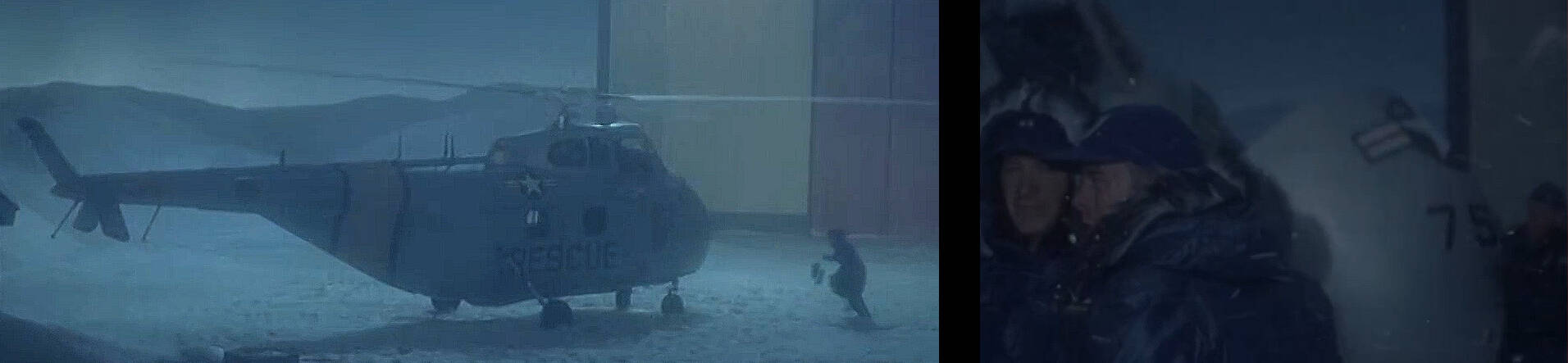


Here’s one last aircraft, and she’s a mystery. Air Rescue H-19B is seen at “Thule AFB” after recovering Colonel Holland’s crew. Her only identifying mark is the ‘75’ on her engine compartment door. The only possible serial number fit would be an aircraft between 52-7500 and 7599, all of which were delivered in late 1953 or early 1954. Whatever this Chickasaw’s identity is, she was virtually brand new when she appeared on film! I suppose we’ll never know the identity of this guardian angel…unless one of you has more information!
Pee-Wee says: Okay, I’m done.
That was very informative. Thanks for researching all of that! There are so many things in the movie that I never noticed until we started digging.
Pee-Wee says: You’re very welcome. I’ll have much more in Part 2, but for now, I’m going to take a break, because I have a headache.
Have a cookie.
Pee-Wee says: I need a glass of milk, too.
And a “blankie?”
Pee-Wee says: Sure. I’m not proud.
That’s all for now, folks. Tune in for more interesting film trivia in Part 2. I’m sure you’ve all noticed that our tours are getting fewer and further between. Not to worry: we’ve simply been busy with work or occupied with family matters. We’ll be back again soon!
Pee-Wee says: Have fun, sleep well, and remember to tell your parents you love them. Bye for now!