Pee-Wee and Nag at the Movies
Strategic Air Command, Part 2
Pee-Wee says: Welcome back, everyone! Let’s continue our tour of Strategic Air Command filming locations. Today we’ll visit not only the first home of the Air Force’s wonderfully sexy B-47 Stratojet, but also the winter home of the St. Louis Cardinals.
We added three interesting sites not related to the movie, so here’s the updated list of waypoints.
| Waypoint | Coordinates | Lat/Long (Skyvector) |
|---|---|---|
| Al Lang Field / Albert Whitted Airport (KSPG) | 27.7689 -82.6331 | 274608N0823759W |
| Sunshine Skyway Bridge | 27.6205 -82.6552 | 273714N0823919W |
| Peter O. Knight Airport (KTPF) | 27.9150 -82.4505 | 275454N0822702W |
| American Victory Ship & Museum | 27.9437 -82.4441 | 275637N0822639W |
| MacDill Air Force Base (MCF) | 27.8458 -82.5072 | 275045N0823026W |
Pee-Wee says: We’ll start at Albert Whitted Airport in St. Petersburg and work our way across Tampa Bay to MacDill Air Force Base. Feel free to fly whatever airplane you want for this tour. Once again, there are no short or soft field landings, no water landings, and no long legs, although the longest is over water. And, yes, the runway at Peter O. Knight is short, but you’d be amazed by the size of airplane that can land there. (Ooh…foreshadowing!  )
)
One important note: it seems that as of November 2nd, YouTube has unfortunately removed Strategic Air Command, probably because too many people were watching it! It’s still available from other sites and for rent from YouTube.
Pee-Wee says: That means all of the video links I created over several days are dead. Sorry, everyone.
And you put so much work into those links.
Pee-Wee says: Sadness. 
Such is the nature of YouTube and the ens##tification of the Internet. You should take a deep breath, watch thiery minutes of advertisements for laundry detergent and divorce attorneys, and enjoy some crummy AI-generated videos of dogs saving babies from orangutans with chain saws.
Pee-Wee says: I’ll pass. 3DBotmaker has a new DRC-X video, so I’m still happy as a Mustang at a parade! Anyway, let’s get started. I know you’ve been waiting to say it, so go ahead… 
Thanks. Let’s play ball!
 Not the Call Up He Expected: Al Lang Field
Strategic Air Command’s main character is “Dutch” Holland, a veteran combat pilot and the St. Louis Cardinals’ newest third baseman. The film opens with Sally Holland and her reverend father arriving at St. Petersburg’s Al Lang Field on the west shore of Tampa Bay. Inside, Dutch and the Cardinals are warming up for an intersquad game.
Al Lang was a busniessman and mayor of St. Petersburg who worked tirelessly to not only beautify and grow his city, but to attract major league baseball teams to Central Florida. Because of his efforts, fifteen teams–the Grapefruit League–still train in Florida today.
Pee-Wee says: The Cardinals seen in the movie are the actual 1954 St. Louis Cardinals! Look carefully and you’ll see pitchers Hal White (#26*) and Tom Poholsky (#23) warming up, shortstop Dick Schofield (#19) playing the part of the rookie “Brewster,” veteran catcher Del Rice (#18), and shortstop and future manager Solly Hemus (#7).*
Like Dutch, several of the real '54 Cardinals were veterans of World War 2. Solly Hemus served four years as an aviation ordnanceman aboard aircraft carriers. Hal White was the Navy’s Recreation Director on Guam and played exhibition ball while Cot Deal (#22*) was a physical education instructor and ball player at Enid Army Flying School.*
That’s Stu Miller (#36*) taking the mound as the B-36 roars overhead. He served postwar aboard CVL-48* Saipan as an Navy aerologist. Here he is standing with his shipmates, third row, fifth from the right. Gosh, I love the Internet! 
Wow, that was a deep rabbit hole.
Pee-Wee says: Throw me a rope! Here’s a fun fact: in 1954, the oldest major league baseball player was the Cardinals’ Al Brazle (#27*), but if we assume the character Dutch Holland was the same age as Jimmy Stewart, he would have been three years older than Brazle. Dutch’s number was* #43*, which was Brazle’s age at the time of filming.*
Huh. I didn’t know that, and I had no idea you liked baseball so much.
Pee-Wee says: Oh, I don’t.
Really? But you spent hours researching all of that.
Pee-Wee says: I just really like looking into things that I know nothing about, and let me tell you, no organization keeps statistics and historical records like professional baseball! Sorry baseball fans, but while I love a good ballpark hotdog, I’d rather watch paint dry. 
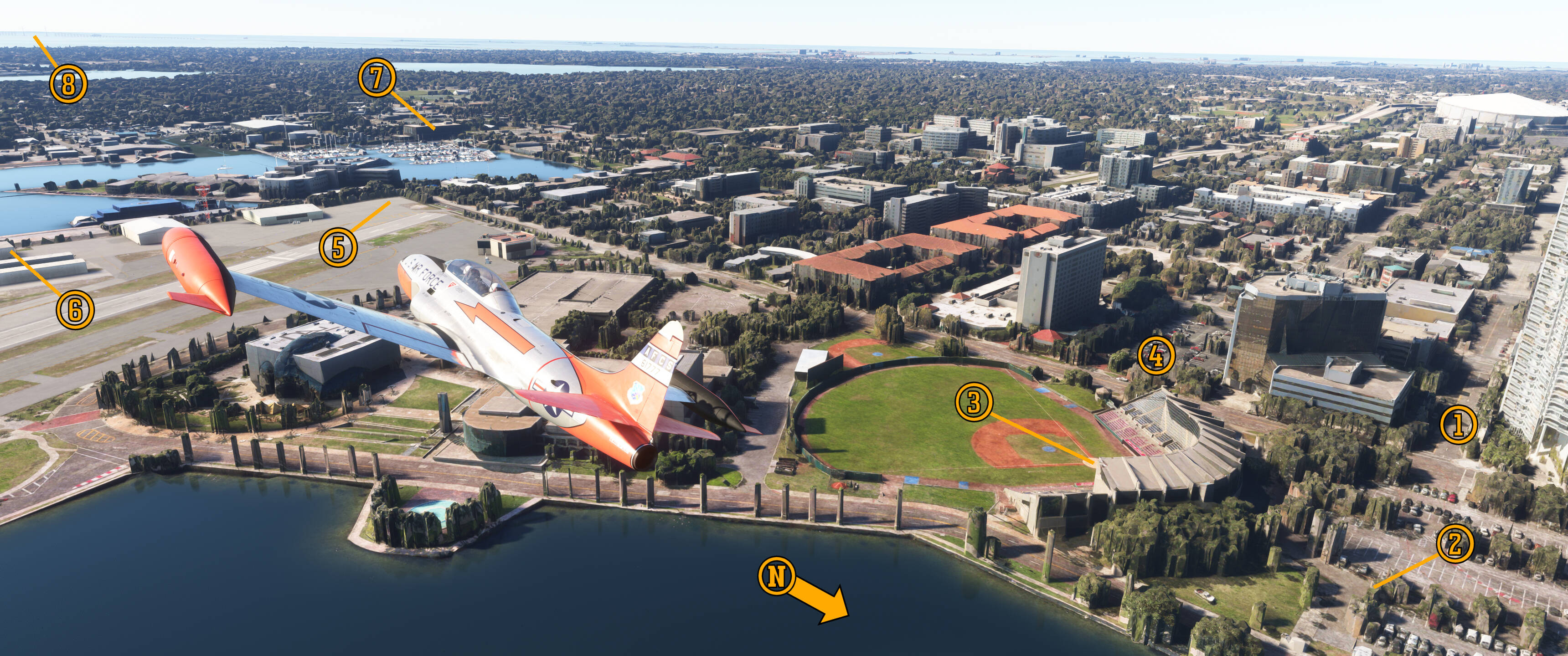
Pee-Wee says: The movie opens looking west along (1) 2nd Avenue as Sally and her father park (2) Sally’s new Cadillac curbside at Al Lang Stadium. Built in 1947, the stadium was replaced in 1976 by the more modern facility visible in MSFS. Built slightly further south, the new (3) home plate is located just inside the 1947 stadium’s second base, which means most of the spots where the action happens in Strategic Air Command lie beneath the new stands.
The historic West Coast Inn stood (4) here, overlooking the stadium from the corner of 3rd Avenue and 1st Street. On 25 March 1935, Babe Ruth hit possibly the longest home run in baseball history at Waterfront Park, St. Pete’s original original baseball field located in what is today the stadium’s parking lot. The Sultan of Swat hammered the ball an astronomical 610 feet (186 meters) onto the West Coast Inn’s second floor balcony. The historic hotel was demolished in 1967 and replaced by another parking lot.
Pee-Wee says: That last sentence sums of Florida in a nutshell. 
To the southeast and visible in the movie when Sally and her father take their seats is Albert Whitted Field, one of the oldest airports in the United States. Albert Whitted was one of the Navy’s first aviators and a storied promoter of aviation in his native St. Petersburg until his death in an airplane crash near Fort Walton Beach in 1923. Five years later, St. Petersburg named its new airport in his honor.
On New Year’s Day 2014, famed aviator Tony Jannus flew a paying passenger from St. Petersburg to Tampa aboard St. Petersburg–Tampa Airboat Lines’ “Lark of Duluth,” the world’s first scheduled commercial airline flight. Thirteen days later, Jannus flew the world’s first commercial cargo flight, carrying a load of hams and bacon to Tampa. During its short existence, SPT’s two Benoist XIV’s flying boats carried 1,204 passengers and sightseers around Tampa Bay without accident or injury.
Pee-Wee says: It’s pronounced “ben-WAH.” Tom Benoist built 106 airplanes before his untimely death in a freak trolley accident in June 1917.
Although that historic first flight launched from the Central Yacht Basin to the north, many consider Alfred Whitted the birthplace of commercial aviation. Today, a memorial and replica Benoist XIV stand on the site of SPT’s hangar, and a magnificent replica Lark of Duluth hangs in the EAA Museum at Oshkosh.
Pee-Wee says: Albert Whitted is where one of my favorite airlines, Ted Baker’s National Airlines, was born. The field also boasted its own Goodyear blimp!
And I’m sure you’ll tell us about it in excruciating detail.
Pee-Wee says: Dang. Shots fired!  Anyway, Goodyear’s NC-11A Vigilant arrived at its (5) new hangar at the corner of 8th Avenue and 1st Street in December 1929 but was wrecked in northeast Alabama the following November. Vigilant’s loss and the deepening Depression ended St. Pete’s airship dreams, and the truncated hangar was relocated (6) further east in the late 1940s and removed altogether in 1999.
See? I can be brief. You may carry on now.
Wow. I’m impressed! As Sally and her father head to their seats, the three smokestacks of Florida Power Corporation’s (7) Bayboro Plant rise above the trees beyond right field. Bayboro was one of two plants powering Pinellas County when Strategic Air Command was filmed in 1954, nine years before an oil fume explosion destroyed the center smokestack. Shuttered during the 1973 oil crisis, the repurposed building’s current tenants include an environmental reconstruction organization, an architectural firm, and the NOAA’s Southeast Regional Office.
Pee-Wee says: Waaaaay off in the distance is (8) our next stop.
 Mind the Gap: The Sunshine Skyway Bridge
Pee-Wee says: While Dutch and the Cardinals were practicing, the first road bridge connecting Pinellas and Manatee Counties was nearing completion about 10 miles (16 kilometers) to the south. The bridge was the brainchild of…well, probably everyone in Pinellas County! Until the bridge’s opening, driving from Sarasota to St. Petersburg required a ninety-mile (145-kilometer) circumnavigation of Tampa Bay on a series of roads that were generously described as “patchwork.” The Bee Line Ferry was another option, but its capacity and number of daily journeys was limited.
The bridge project was right on schedule, too, having been proposed in…hold on…1924?!
Pee-Wee says: Yeah, getting the project off the drawing board proved challenging. The Great Depression didn’t help, and the fact that the bridge’s proposed route crossed three county lines made approval difficult.
Ah. Politics.
Pee-Wee says: The Sunshine Skyway Bridge finally opened in September 1954 with a single, two-lane span. It was the tallest bridge in Florida, and at 4.2 miles (6.8 kilometers) was the longest continuous bridge in the United States. Driving the Skyway cost $1.75 for cars ($5.00 for semi-trucks, $0.50 for bicycles) and took about six minutes at the posted 45 mph (72 kph) speed limit. Interestingly, and to the joy of those like Nag who despise “Zombie drivers,” the bridge also boasted a minimum speed limit of 35 mph (56 kph). A second span was added fifteen years later, allowing two lanes in each direction, and it’s that span that’s the subject of this next part.
Yep, it’s time again for “Chronicles of Catastrophe.” Skip ahead or click the blurred text to keep reading.
Pee-Wee says: Shortly after sunrise on 9 May 1980, the freighter MV Summit Venture struck the Sunshine Skyway’s support piers and caused a quarter mile (0.4 kilometers) of the southbound span to collapse. Two cars and a pickup truck fell 150 feet (45.7 meters) into Tampa Bay and were crushed by the force of hitting the water at nearly 70 mph (118 kph). Four others and a Greyhound bus, their drivers unaware of the bridge’s collapse, drove into the abyss. Thirty-five people were killed: husbands and wives, laborers, truck drivers, graduate students, an infant, and even a couple running from the law and travelling under assumed names.
The only survivor from the bridge was Wes MacIntire of Gulfport, Mississippi. His truck ricochetted off Summit Venture’s hull before crashing into the water, a chance occurrence that greatly reduced the impact forces and saved his life. The disaster wasn’t MacIntire’s first brush with death: he was also the only survivor from a Higgins Boat that sank approaching the Normandy beachhead on D-Day.
Investigators determined that heavy rain from a passing thunderstorm obscured harbor pilot Captain John Lerro’s vision and rendered the ship’s radar ineffective as Summit Venture approached the narrow channel beneath the bridge. Unable to navigate effectively or turn away from the bridge, Lerro ordered the ship’s engines reversed and the anchor dropped in a desperate attempt to stop the 33-000-ton ship, to no avail. While he was immediately blamed for the accident and vilified by the Press, a Florida Grand Jury and the Coast Guard cleared Lerro of negligence, and NTSB Chairman James King stated that:
“…[Lerro’s] least risk maneuver was to attempt to navigate through the channel and under the Sunshine Skyway Bridge. There was no bright line for decision-making. He acted reasonably in the situation in which he found himself.”
Along with improved collision protection for bridges, the NTSB recommended developing a system that would warn motorists of bridge failures in real time. The Board determined that, had such a system been installed and drivers notified of the collapsed bridge ahead, only three cars–those actually on the felled span–would have fallen into the water, and thirty-two lives may have been saved. Forty-five years after the disaster, only a handful of bridges worldwide are equipped with such a system.
Lerro returned to piloting for a while but was forced ashore when he was diagnosed with Multiple Sclerosis. He taught briefly at the Merchant Marine Academy and volunteered with Hillsborough County’s telephone crisis hotline until his death in 2002. Forever haunted by the accident for which he was blamed, Lerro is often remembered as the disaster’s “36th victim.”
A historical marker is located at the rest area north of the bridge.
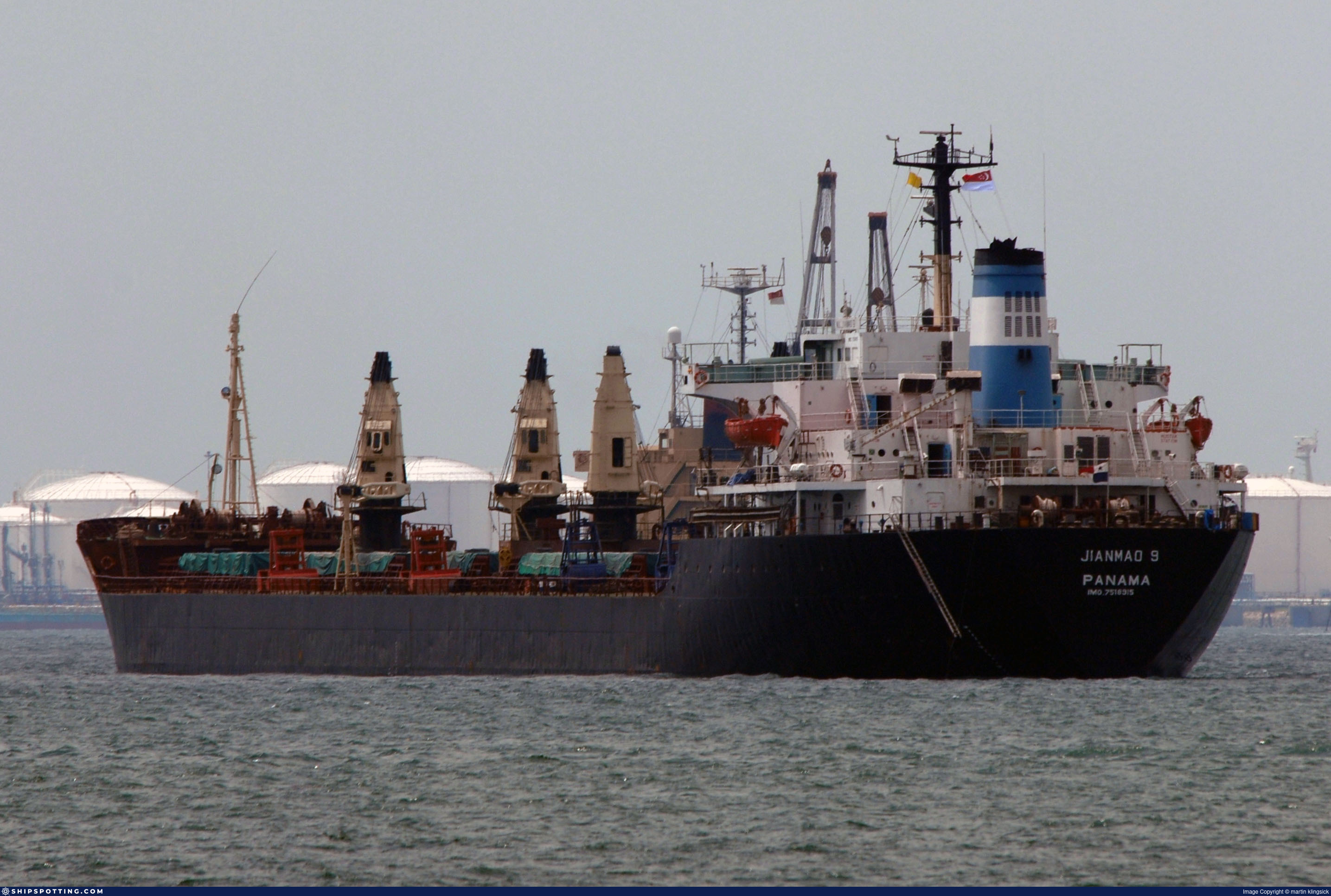
Pee-Wee says: Summit Venture was repaired and returned to service. She was sold several times over the years and sailed as Sailor, Sailor I, and finally Jianmao 9. On 9 November 2010 she sank in heavy seas off Vietnam. All 27 of her crew were rescued.
May 1980 was a rough month. The Sunshine Skyway story was big news…until nine days later when Mount St. Helens erupted.
Pee-Wee says: A beautiful, modern cable-stayed bridge was opened east of the original spans in April 1987. The new bridge’s design included large rock-filled concrete fenders and barrier islands–“dolphins”–protecting the support piers. In 2005 it was renamed the Bob Graham Sunshine Skyway Bridge in honor of the former governor and senator who first suggested the bridge’s design.

Here we are turning north around the new (1) Sunshine Skyway Bridge. The cable-stayed design was suggested after Governor Graham visited the Pont de Brotonne over the Seine in Normandy. The new bridge’s piers are protected by these (2) circular concrete buffers. The original spans were located almost directly behind our T-Bird.
Pee-Wee says: Portions of the (3) approaches to the original bridges remain intact and are used as fishing piers today. I’ve walked to the end of those piers in real life, and I have to say it was a little eerie knowing what happened here back in 1980. That’s (4) St. Petersburg in the distance.
By the way, this excellent Sunshine Skyway Bridge scenery was included in World Update #2*.*
 Chaos Isn’t Going to Like This: Peter O. Knight Airport (KTPF)
Approximately two miles south of downtown Tampa is the city’s first commercial airport, Peter O. Knight. The field was built in 1935 by the Works Progress Administration with three runways and a modern passenger terminal overlooking a seaplane basin. National Airlines was the sole commercial passenger airline here until Eddie Rickenbacker’s Eastern Air Lines arrived in 1937, the former operating Lockheed 10 twins along its “Buccaneer Route” from Miami to Jacksonville, and the latter operating Douglas DC-2s to Atlanta via Tallahassee.
By the end of World War 2, TPF was growing increasingly unsuitable for operations by larger aircraft, as highlighted by the non-fatal crash of a National Lockheed 18 in September 1945. A few months later, Eastern and National relocated to the former Drew Army Airfield across town.
Pee-Wee says: National’s NC33349 was built as a C-60A for the USAAF and converted to a Model 18-50 in 1945. While landing here on 13 September 1945, the aircraft overran the rain-soaked runway and stopped in the water beyond. All 14 passengers and crew survived, but 349 was written off.
Today, TPF is a vibrant general aviation airport with upwards of 60,000 aircraft operations annually. In 2012, it briefly gained national attention because of one spectacular unplanned operation.
Pee-Wee says: On 20 July 2012, an Air Force C-17A arriving from Rome, Italy landed on Peter O. Knight’s Runway 22. It was a textbook landing, albeit at the wrong airport! The aircraft’s intended destination was MacDill Air Force Base, approximately six miles to the southwest.
The crew realized their error after touchdown and maximized the Globemaster’s stopping capabilities to keep her on the paved runway. A video of the landing is available on YouTube, and if you watch the aircraft’s deceleration carefully, you’ll see the exact moment when the pilots said “oh, s##t!”
A replacement crew used the aircraft’s reverse thrust to back down the runway again, and several hours after the incident, the empty aircraft was flown to MacDill without incident.
The Air Force investigation blamed crew fatigue. After days of flying across multiple time zones with minimal rest, constant changes of destination and departure times, and 10.5 hours of flying which included a difficult air-to-air refueling, the crew was reportedly operating with a capacity only slightly better than being drunk.
Additionally, while the crew was aware of the proximity of TPF to MacDill and the similar runway alignments, they didn’t know that Tampa Executive Airport, located about six miles northeast of TPF, also had a similar runway arrangement. Having erroneously identified Executive as TPF, they assumed the next airport to come into view would be MacDill. If you’ve ever flown while fatigued, you’ll understand the danger of “expectation bias!”
Thankfully, the only damage sustained in the incident was to the pilot’s egos. Their passenger, General James “CHAOS” Mattis, was quite forgiving of his pilots, acknowledging the many hundreds of errors he made in his career. (I’ve flown with guys who know the pilots, and they have confirmed that the crew was lightly disciplined and continued to fly.)
Pee-Wee says: At the time of the incident, C-17A 08-8199 was assigned to the 305th Air Mobility Wing at McGuire AFB, New Jersey. Two years later, she’d migrated to the 62nd/446th Air Wing at McChord AFB, Washington. On 18 October 2020 she was damaged while landing with her nose landing gear retracted at Kandahar AB, Afghanistan.
Want a model of this notorious aircraft? GeminiJets’ 1:400 scale model isn’t available for direct purchase anymore, but you can find it occasionally at other online stores like this one or Ebay.

Pee-Wee says: Here we are diving toward Tampa proper, looking west. Here’s (1) Peter O. Knight’s Runway 4/22, the longest on the field at 3,583 feet (1,092 meters). Notice how (2) MacDill’s Runway 4/22 is almost in line with TPF’s runway and also located on a peninsula with houses to the north. Whoopsie!
TPF’s original passenger terminal stood on the airport’s south side (3) here. It was razed in the 1960s and replaced by the current building which today houses fixed-base operator Atlas Aviation. This (4) boat ramp off Severn Avenue is the old seaplane ramp into the anchorage. Across Tampa Bay you can barely make out the (5) Sunshine Skyway and (6) Albert Whitted and Al Lang Field.
Next, we’ll follow the (7) Seddon Channel north toward our next stop. We’ve gotta’ get down, though.
Pee-Wee says: I’m workin’ on it. Sheesh. Back seat driver.
 The Victory of Cigar City: The American Victory Ship & Museum
Two miles north of Peter O. Knight is Tampa’s Channelside District, a one-time industrial area that is one of the hottest addresses in town today. Here you’ll find high class condominiums and townhomes, shops and restaurants, the Florida Aquarium, and the Tampa Bay Lightning’s Benchmark Arena. Looking to buy? The median home here costs approximately $660,000 (€572,000). Bring your piggy bank!
Pee-Wee says: That’s all well and good, but if you ask me, the real draw here is the American Victory Ship and Museum. The United States’ Emergency Shipbuilding Program built nearly 6,000 merchant ships of various kinds during World War 2, most notably 2,755 Liberty ships. Equally important if less numerous were the later Victory ships. The Victories were faster and more modern than their mass-produced cousins, and many of those that survived the war served for decades in merchant fleets worldwide.
American Victory was one of 69 VC2-S-AP2s built at California Shipbuilding south of Los Angeles, the same yard that produced the ill-fated Benjamin R. Curtis Liberty ship. (If you’ve read our Houston tour, that name should be familiar. Kaboom!  ) Delivered in June 1945, American Victory toiled throughout the Pacific Theater during the war’s final months and brought American men and equipment home afterwards. She was reactivated for the Korean and Vietnam Wars but finally mothballed for good with the James River Reserve Fleet in 1969.
“What on Earth is a VC2-S-AP2” you ask? Well…
V means “Victory type”
C means “cargo”
2 refers to the ship’s waterline length, in this case 400 and 450 feet (122 to 137 meters)
S means “steam-powered”
AP2 refers to the design variant, in this case a 6,000 hp general cargo ship. Other types included the AP3 with 8,500 horsepower, a single M-AP4 with diesel machinery, the AP5 assault transport, and the postwar AP7. The basic AP1 was unbuilt.Now you know.
Tampa Bay harbor pilot Captain John Timmel and Victory Ship, Inc. saved American Victory from scrapping and brought her to Port Tampa Bay in the late 1990s. She’s fully restored and operational, and even sails around Tampa Bay occasionally, making her one of very few museums capable of moving under its own power! American Victory is open Tuesday through Sunday from 10 a.m. to 5 p.m., but opens two hours later on Mondays. Fifteen dollars grants you access to all of the ship’s restored public areas.
Pee-Wee says: We’ve visited American Victory, and you should, too! 

Pee-Wee says: There’s a lot to see in this west-facing photo! Here’s American Victory nestled between Cruise Terminal 2 and Carnival Legend and Terminal 3 and Norwegian Dawn. Terminal 6 is vacant in MSFS, but you can see several floating drydocks and barges at International Ship Repair to the north.
Right next door is the (5) Florida Aquarium, an amazing aquarium and one of the world’s leading coral research and rehabilitation laboratories. Try to avoid school days, though: nearly 100,000 school children visit the aquarium every year.
Pee-Wee says: Between the Selmon Expressway and Interstate 275 is Amtrak’s beautifully restored (6) Tampa Union Station. Built in 1912, the station’s eight tracks once hosted passenger trains like Seaboard’s New York–Miami Silver Meteor, Atlantic Coast’s competing Champion, and other less glamorous offerings like SAL’s Palmland and ACL’s Southwind. Today, the station sees only Amtrak’s Floridian, a recent mashup of the Capitol Limited and the Silver Star.
Hey, you’re a fan of Florida’s classic railroads. Seaboard or ACL?
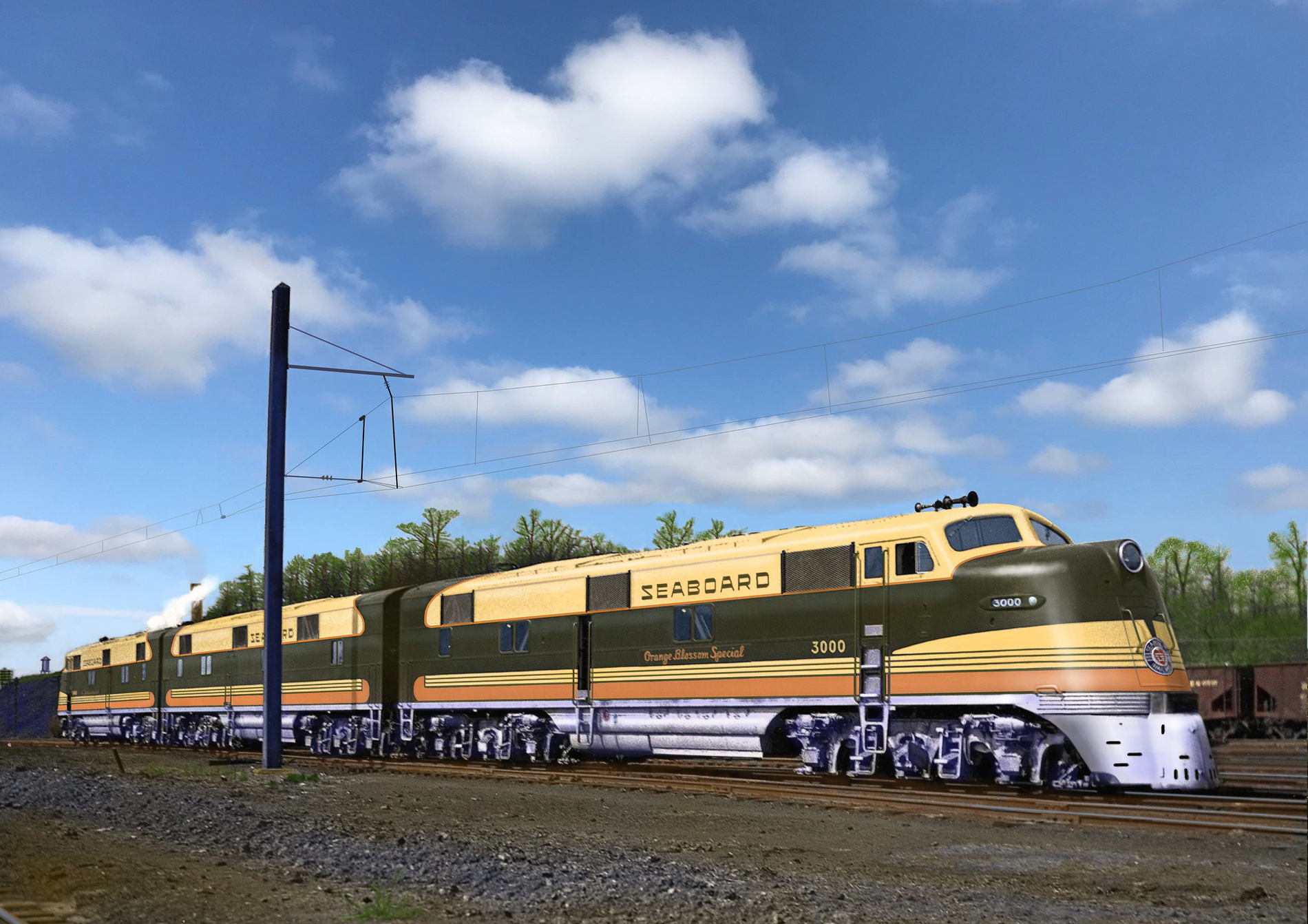
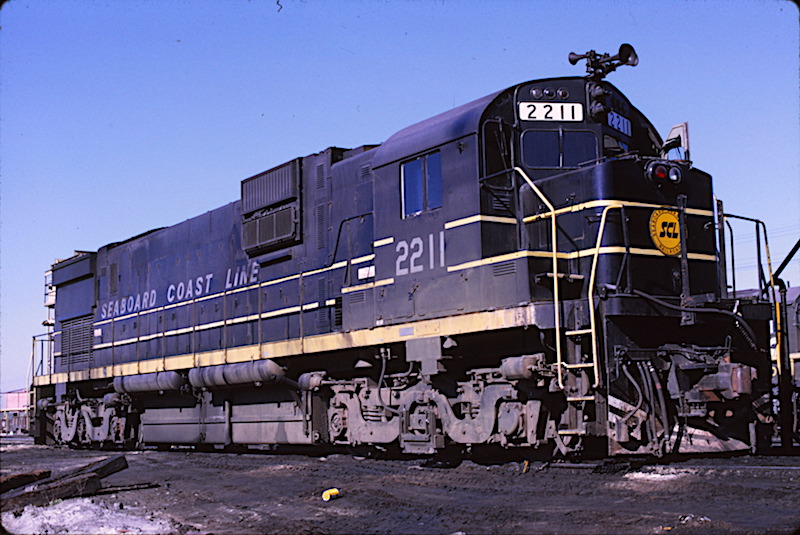
Pee-Wee says: Seaboard, all day. The Orange Blossom Special’s E4As were things of beauty, and any railroad that operated such an assortment of diesels–EMDs, GE, Baldwins, and even F-Ms–is okay in my book. I’m particularly fond of its C-420s, and the Seaboard Coast’s C630s. And I’ve always felt like the SAL was “friendlier” than the larger ACL. Just my opinion.
So, you like Alco Centuries.
Pee-Wee says: 251s, baby. 
Anyway, over here is the (7) Hillsborough River flowing 60 miles (97 kilometers) from its headwaters in the Green Swamp south to Tampa Bay. The river was apparently named in the late 18th Century for the 1st Earl of Hillsborough, Secretary of State for the Colonies.
Beyond the river is (8) Tampa International Airport, formerly Drew Army Airfield where bomber crews trained throughout the war. Drew became Tampa’s primary airport when Eastern and National moved here from Peter O. Knight after the war. With Trans Canada’s arrival in 1950, the airport was officially renamed Tampa International.
Even further in the distance are (9) the Howard Frankland Bridge and the (A) Courtney-Campbell Causeway. The Frankland connects Tampa with St. Petersburg and was subject to significant reconstruction over the last thirty years, much of the work designed to fix the bridge’s significant faults that earned it several unflattering nicknames. The Courtney Campbell connects Tampa with Clearwater and was the longest overwater fill project in the United States when it opened in 1934.
Pee-Wee says: Many people muck up both bridges’ names. The Frankland is often incorrectly referred to as Franklin Bridge, and the Courtney Campbell, named for St. Petersburg Representative Courtney W. Campbell, is sometimes written as Courtney-Campbell.
I think it’s fitting that we visited American Victory on this tour, considering the movie’s subject matter.
Why’s that?
Pee-Wee says: Strategic Air Command was at its heart an American propaganda film.
You think so?
Pee-Wee says: Uh…yeah! Heck, the main character is a baseball player and war hero who’s married to the daughter of a minister, and who flies with guys named “Ike,” “Rocky,” and “Sgt. Bible.” No wonder it makes me crave apple pie. 'Merica! 
I can’t disagree! Let’s get back to those filming locations. Our next stop is a few miles south of Downtown.
 Ready to Defend…And Pass Gas: MacDill Air Force Base (KMCF)
Pee-Wee says: We’re rounding Third?
Yes, we’re into the home stretch. In the second half of Strategic Air Command our protagonist is promoted to full “bird” Colonel and transferred to MacDill Air Force Base in Tampa as the Deputy Wing Commander of the 305th Bombardment Wing. He and Sally return to their original home, and life is good.
Pee-Wee says: Until Dutch bins his flying career and almost ends his marriage in one fell swoop.
Well, kind of…yeah.
Pee-Wee says: Construction of Southeast Air Base on Catfish Point began on 28 November 1939, two days before the War Department announced the base’s renaming in honor of Army Colonel Leslie MacDill, a vocal proponent of Army aviation during the formative interwar years. The 29th Bomb Group’s B-17s and B-18s arrived here on 17 January 1941 and began patrolling the country’s eastern seaboard twenty-one days later, two months before the base’s official dedication.
MacDill hosted a B-17 replacement unit until June 1942 when training shifted to the new B-26 medium bomber.
Pee-Wee says: Martin’s first Marauders were tricky beasts. Their finicky electric propellers were susceptible to runaways, their nose landing gear were prone to failing, and their wings were too small. Inexperienced pilots found the aircraft unlike anything they’d flown before: a medium bomber that felt like a fighter, that was seriously unforgiving near the edges of its flight envelope, and which howled down final approach at a blistering 140 mph (121 knots, 225 kph).
A heavy B-26 landing with one engine inoperative approached at 155 mph (134 knots, 250 kph). For reference, that’s similar to a 737-700’s approach speed near maximum landing weight. For pilots whose “heavy” experience was limited to Curtiss AT-9s or Beech AT-10s, that was “hauling a#s!”
Pee-Wee says: Accidents were plentiful, and the exaggerated phrase “one a day in Tampa Bay” was mumbled often by pilots flying the “Widowmaker.” Some records indicate that in one month alone, twenty-one aircraft were lost. A review of accident reports is telling: in most cases, the pilots of crashed aircraft were two low time 2nd Lieutenants.
MacDill remained a “bomber base” for another seventeen years after the war until the Tactical Air Command took control, although SAC maintained an alert area complete with “mole hole” and dispersed B-52s and KC-135s here into the 1980s. During the Cuban Missile Crisis, the famed 363rd Tactical Reconnaissance Wing’s RF-101Cs and RB-66Cs flew low-level and electronic reconnaissance missions over and around Cuba from MacDill.
Pee-Wee says: But throughout the latter half of the 20th Century, the airbase remained a training field at heart, hosting F-4 and F-16 advanced training schools and the Air Force’s aircrew water survival school. Today, the 6th Aerial Refueling Wing’s KC-135Rs and the Central and Special Operations Commands call MacDill home.
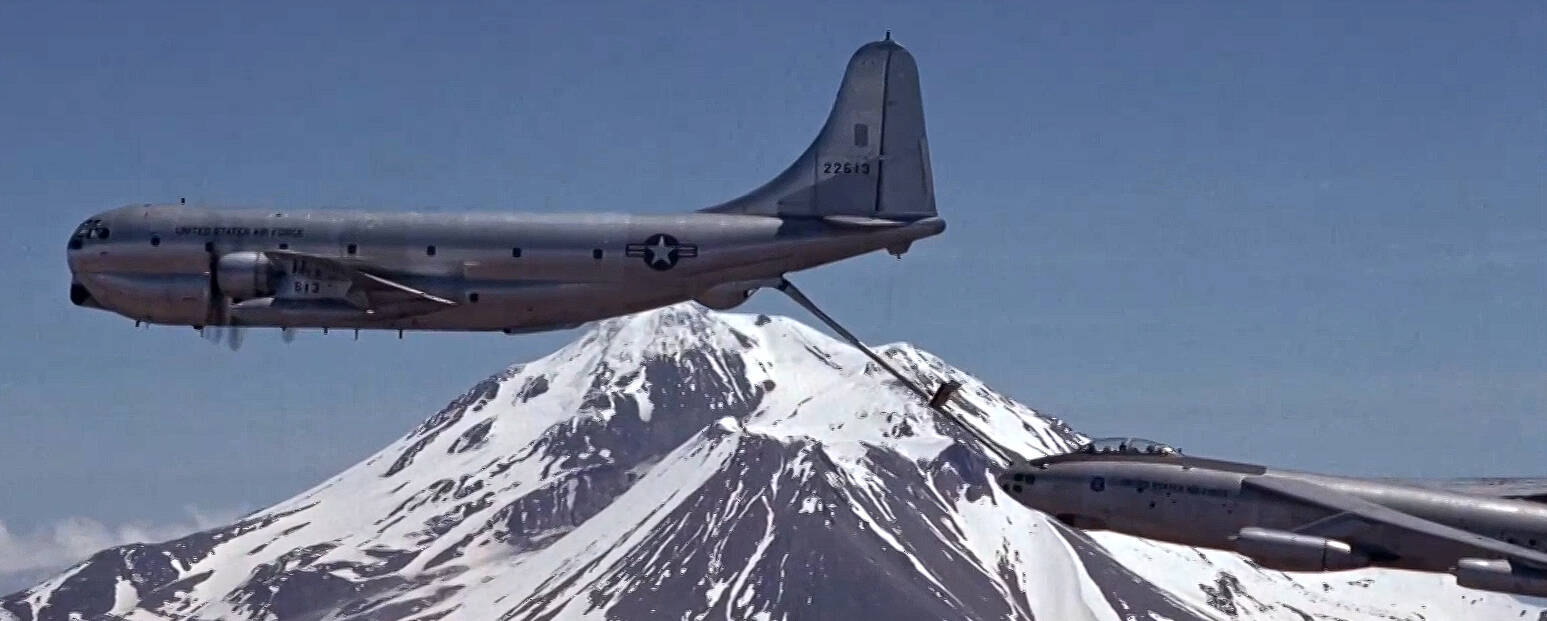
In the Spring of 1954, MacDill was home to the B-47s and KC-97Gs of the 305th and 306th Bombardment Wings (Medium), and aircraft from both appear in Strategic Air Command. Let’s take a look at those filming locations!

Pee-Wee says: Here we are looking down on MacDill from the east, just like the shot from the movie. Much of the filming was accomplished on the (1) east ramp in front of Hangars 3 and 5 where KC-135s park today. The first panning shot of MacDill in the film was taken from (2) the airfield control tower atop Hangar 1.
Also visible in this photo are the current (3) Florida National Guard and Navy Reserve facilities and the (4) munitions storage area. In the distance is the former (5) SAC mole hole and alert ramp. Compare the housing and recreation area in the bottom left of the photo to the smaller and more spartan accommodations seen in the film!
Pee-Wee says: Way over (6) here is Port Tampa, once the terminus of Henry Plant’s South Florida Railroad, the narrow-gauge line which finally connected Tampa Bay to the Atlantic Coast Line and the national rail network in 1893. It was from here that Col. Leonard Wood, Lt. Col. Theodore Roosevelt, and 590 of the “Rough Riders” sailed for Cuba and glory aboard SS Yucatan during the Spanish-American War.
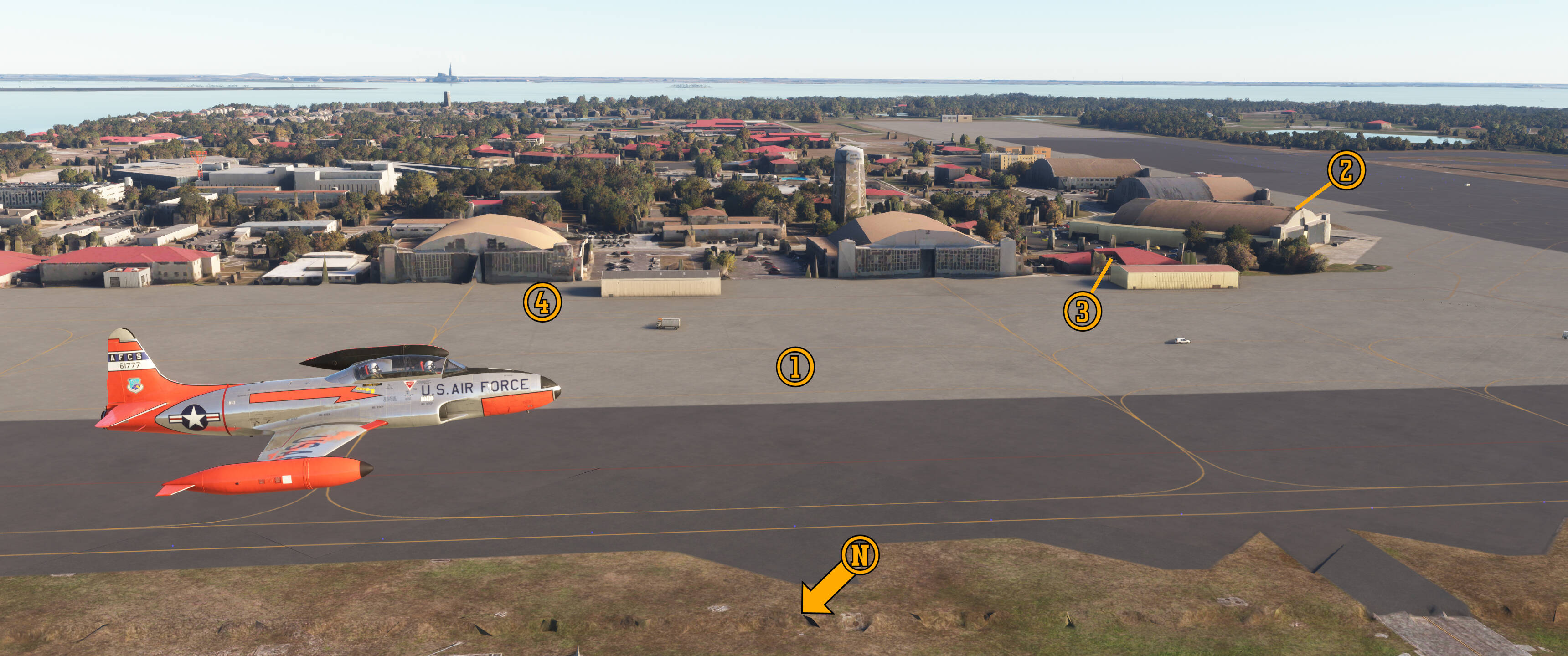
Pee-Wee says: Several scenes were filmed here on the (1) east ramp. The audience is introduced to MacDill with a long panning shot taken from the (2) former control tower atop Hangar 1. Look carefully between (3) Hangar 3 and the control tower and you’ll see the yellow (4) building which houses the 366th Bombardment Squadron’s offices. Later in the movie, after the Hollands quarrel, Dutch walks from this building before hopping aboard a pickup truck with his Japan-bound crew.
That’s the actual 366th Bomb Squadron’s sign on the building, complete with “winged skull” emblem! By the way, who do you suppose was the poor airman who was responsible for watering the sand? 
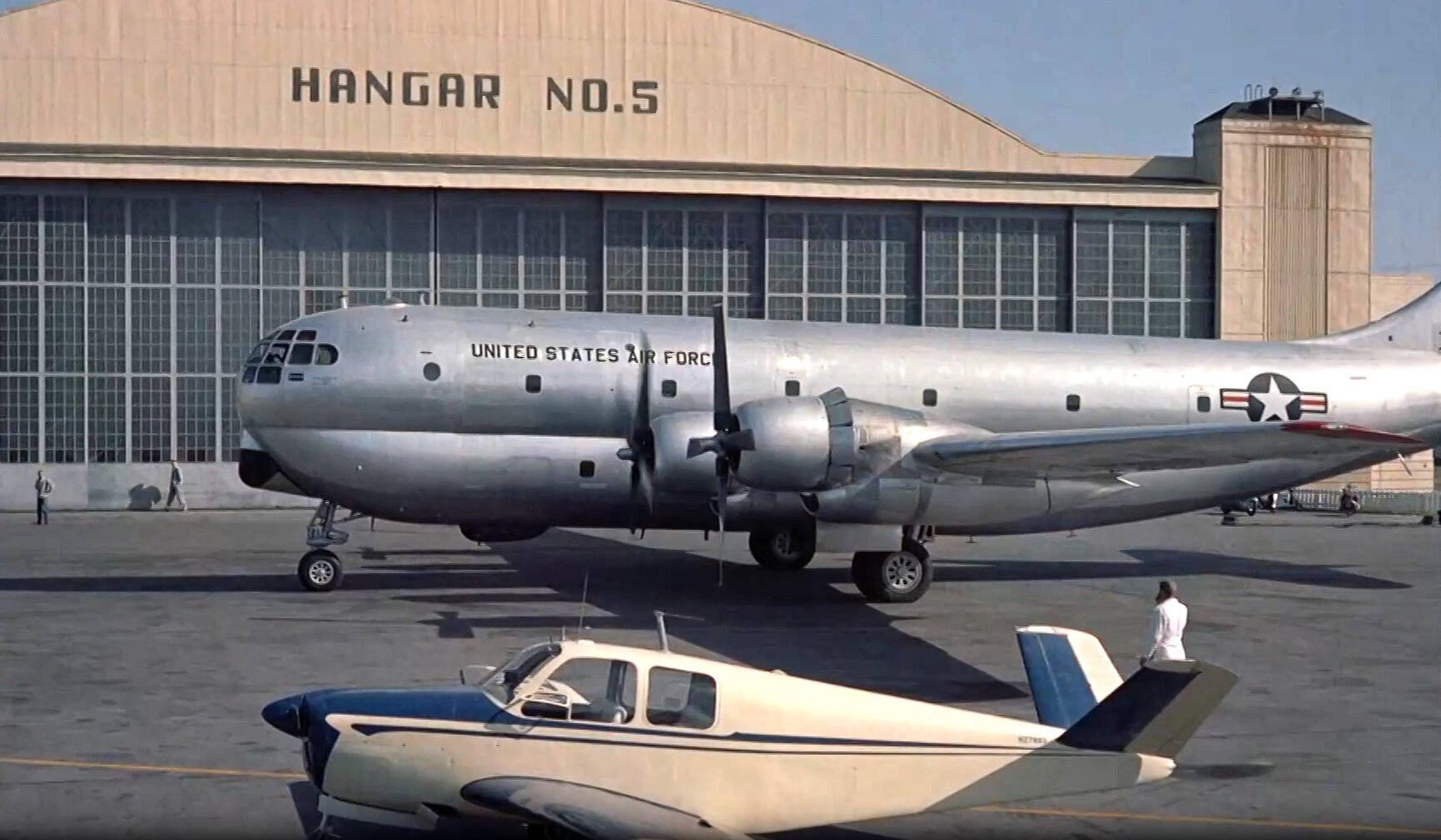
The producers of Strategic Air Command strove for realism and took few liberties, but when General Hawks’s C-97 stops at Wichita, that’s actually MacDill’s (4) Hangar 5 in the background. Note that sometime after 1954, MacDill’s hangars were renumbered. Hangar 5 is now Hangar 1, and 3 is now 2.
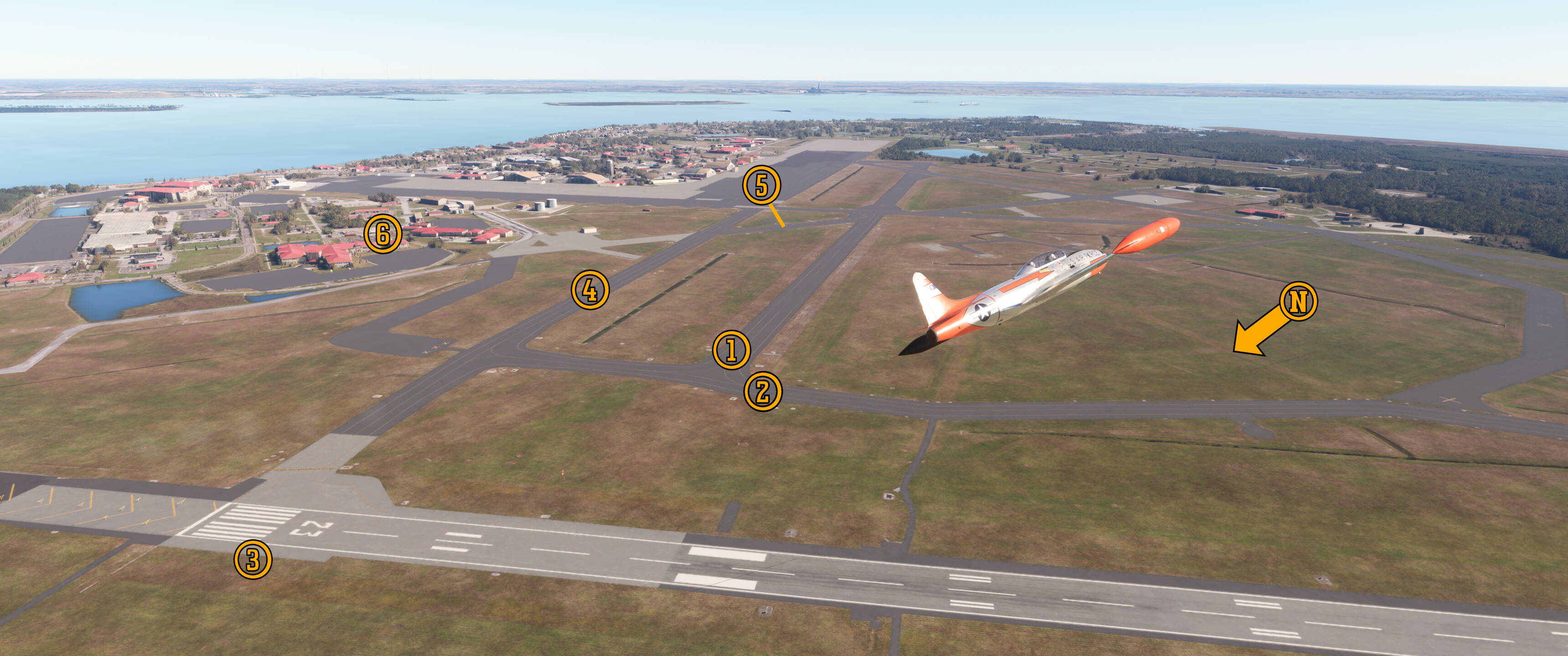
We’re looking southeast across the airfield in this photo. Dutch taxis his B-47 down the former (1) Runway 19 to this exact spot, where the (2) film crew was waiting. A few seconds later, Dutch taxis into position on (3) Runway 22. The runway certainly appears wide, and it was: in 1954, Runway 22 was an astonishing 500 feet (152 meters) wide! It’s since been reduced to a more normal 150 feet (46 meters), although you can still see the original width in the discolored grass.
Pee-Wee says: Watch carefully as the B-47 turns onto the runway and you’ll see the aircraft’s left outrigger gimble, something that only happened during tight turns. I’d never seen that happen before! We’ll talk about the takeoff scene and SAC’s willingness to disregard safety for the sake of filming later. 
KC-97s were parked (4) here along the former Runway 19’s parallel taxiway where today the (5) “bird bath” aircraft wash is located. This fresh-water spray rack removes corrosive saltwater spray from arriving aircraft. To the east is the contemporary (6) base clinic and recreation area, modern facilities that airmen stationed here in 1954 could only dream of!
That’s it for this tour, gang. I’ll bow out of the next part and let Pee-Wee gawk at the airplanes, but I’ll see you again in our next installment.
Pee-Wee says: Hey! You like the airplanes, too.
Yeah, but you really love digging up historical tidbits. I’m not saying it’s bad. It’s just what you do, and you’re really good at it.
Pee-Wee says: Nice save. Thanks for tuning in, everyone! Stay tuned for the final part in which I’ll check out the 305th and 306th Bomb Wing’s B-47s, some KC-97s, and even a super-rare C-97 and early production Bonanza. Bye for now!






 I love surfing, but when it’s that cold, you’ll find me back at the lodge, sitting in front of the inglenook, wrapped up to my eyeballs in my favorite quilt and nursing a hot cocoa!

 )
)




 On a Rock and a Prayer:
 Island of Misfits: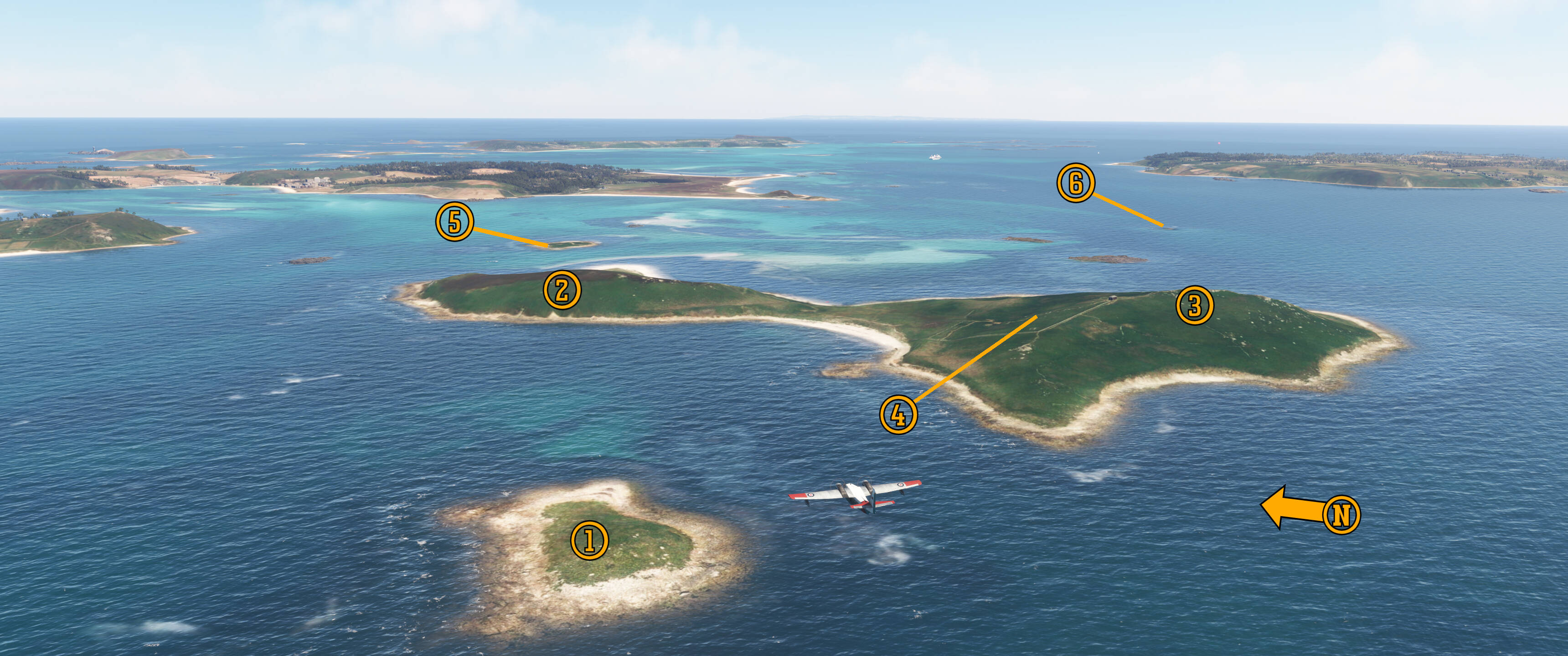
 The Island With The Town: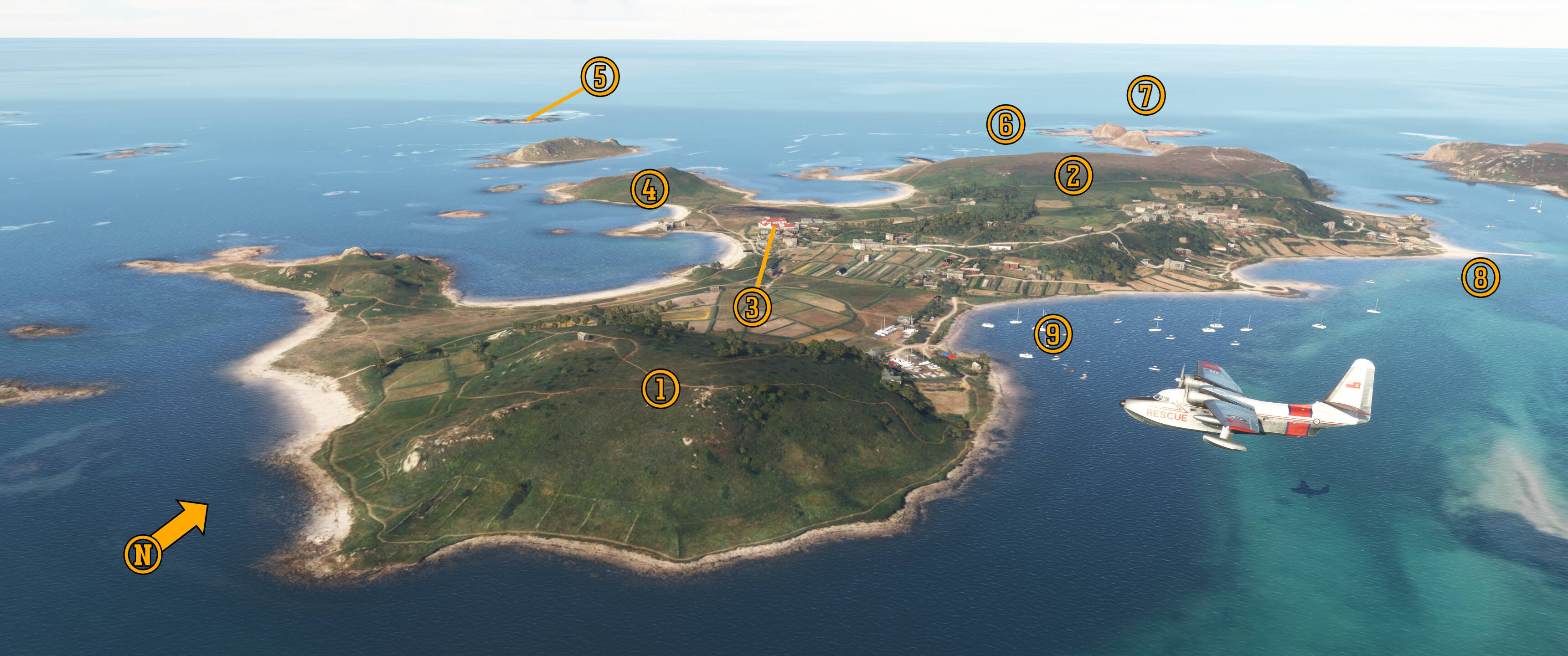

 But I did stop within the airport boundries…mostly. Next time I’ll bring the Zenith.