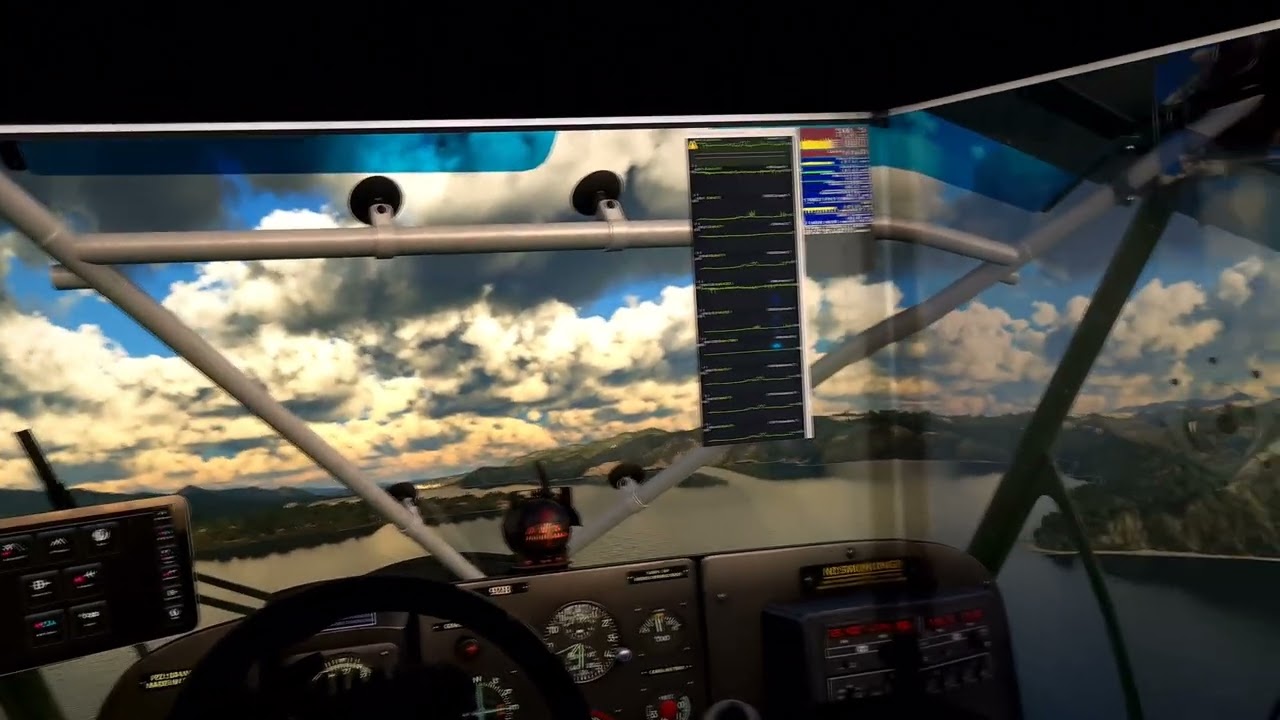
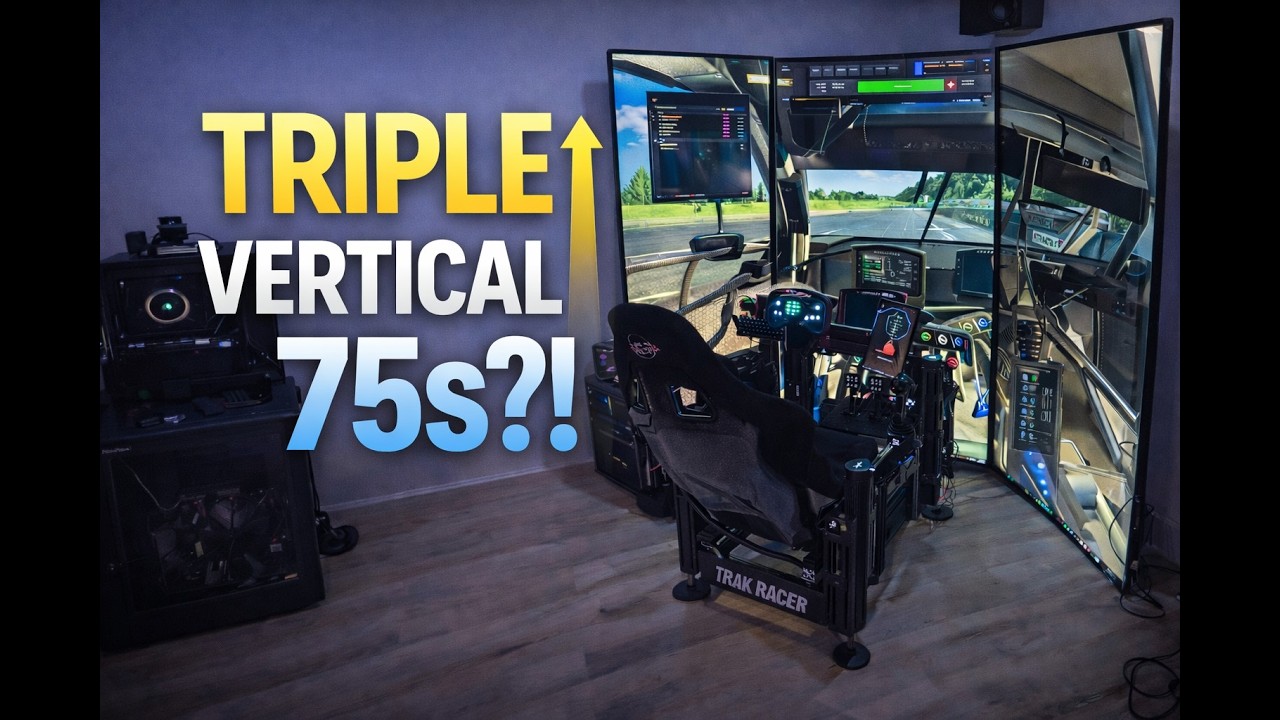
After seeing several amazing triple screen setups at FSExpo last weekend, I decided to replace my 65" OLED with a triple 43" 4K screen setup. I used to run triple screen about 10 years ago, mostly in DCS, and eventually got rid of it as I was tired of constantly fiddling with settings to get alignment and perspective right. I realize we’re very limited in MSFS’s current implementation of multiple screens - in particular, the difficulty of aligning the perspectives given we don’t have any control over individual screen FOV, as well as the fact that alignment seems best when zoomed way in, which isn’t ideal for most of us. Nonetheless, I’m trying to make the best of it and would love to hear others’ experiences.
I’ve realized that even with a 4090, getting 3 4K screens working at a reasonable framerate with my current system seems near impossible; dropping side monitor resolutions to 1440 makes little difference, and same with all the different DLSS options. My only conceivable hardware upgrades are either a 13900k or a 7950XD, neither of which are very appealing at the moment.
For any of you that have gotten triple screen working, could you fill out the following info so we can start to compile all our experiences?
Template: CPU: GPU: Center screen resolution: Left screen resolution: Right screen resolution: DLSS/DLAA/TAA etc.: Test case aircraft: Test case airport: Average FPS:
Here’s mine: CPU: i9-12900k GPU: 4090 Center screen resolution: 4k Left screen resolution: 4k Right screen resolution: 4k DLSS/DLAA/TAA etc.: DLSS Balanced Test case aircraft: PMDG 737 Test case airport: KDCA Average FPS: 23-25
CPU: i9-14900k GPU: 4090 Center screen resolution: 4k Left screen resolution: 4k Right screen resolution: 4k DLSS/DLAA/TAA etc.: DLSS quality Test case aircraft: Diamond D40 Test case airport: KSGU Average FPS: 35-40
This has been a real struggle to get working. I am actually running 5 screens. Two screens are for popped out Garmin G1000 PFD and MFD. I have found that I cannot use Gsync (variable refresh rate) with the two side screens attached to the graphics card with a Display Port to Hdmi cable. Even the center screen that uses HDMI to HDMI cable cannot use Variable Refresh Rate because as soon as I pop out a window for the G1000, Variable Refresh Rate goes away.
The 15" touch screens are very finicky. Sometimes they work great, sometimes I have to reboot the computer or unplug the usb cables and plug them back in. I have not been able to find out what causes this.
I would recommend anyone trying three screens should use a computer monitor instead of a tv screen. My TV screens are 55" and do not have a display port connection. You can get computer monitors that are 48" that do have a display port connection. This would work far better. Display port to HDMI has many problems.
I have spent more time trying to get his to work than I have flying. Part of my problem is that I am not very computer literate and there are not many people that have tried this to go to for help.
I guess this is why multimonitor is under the heading Experimental.
Right now my setup is working. I do not believe I will ever be able to use variable refresh rate with display port to hdmi cables and popout windows.
CPU: 7800x3d GPU: 4090 Center screen resolution: 4k Left screen resolution: 4k Right screen resolution: 4k DLSS/DLAA/TAA etc.: DLSS quality, FG:OFF Test case aircraft: Wilga Test case airport: – Average FPS: 50
TLOD: 200
i will check your airport but i don’t have your plane and report back my fps for more comparable fps
Thanks! I’ve kind of given up on true triple screen at this point and instead I just run a window that is 7680 x 2160, so it starts halfway across the left monitor and extends to halfway across the right monitor. With this I can get reasonable performance, minimize stretching at the edges, and it also still gives me some leftover screen space to open other apps like Navigraph and LittleNavMap.
Having just moved to triple screens (PC, MS Store, MSFS 2024 SU4) I’d really love to know what settings / compromises others with triple screens are using to get acceptable performance.
It took me a long time to get here - new PC, 9800X3D, RTX5090, and 3x 4K Samsung TVs. I was using just 1 TV for a few months during SU4 testing, and just connected the 2 side screens over the holidays, and want to find the sweet spot.
On a single screen, I found this worked really well:
Win 11 25H2, ReBar and HAGS on by default
TV 120 Hz, VRR compatible
TAA at render scale 80 (to reduce GPU load)
Max Frame Rate 31
DLSS Frame Gen x2 (target 60, or 62 or so)
VSync Half monitor refresh rate
Ultra, with TLOD 400, and Motion Blur, Light Shafts, Traffic, Parked, all off.
DLSS Frame Gen only works on the main screens, so with 3 screens, I’m experimenting with:
DLSS 4.5 Quality (render scale 66.7%)
FSR3 Frame Gen x2
I’d prefer TAA or DLAA (I want max pixels to see distant details and traffic) and also want to keep TLOD and LOD as high as possible… but I think I was asking too much and things were flickering and not quite stable. So I’m not sure if both full pixels AND full LODs are possible?
Wish I could be of more help but I actually get rid of my triple screen setup this past summer and replaced it with a single 57 inch ultra widescreen (the Acer Predator Z57) that runs a resolution of 7680x2160 (ie 2x4k). I found this to be a much more reasonable setup, performance wise, and it was also nice to get rid of the bezels.
And then just last week I found the new LG 45" ‘5k2k’ monitor had gone on sale and I thought it was worth a try, and so far I like it a lot. I get 25 to 40% higher FPS compared to the Z57, and although you obviously lose screen space at the edges, those parts were very stretched to begin with and at times kind of distracting, so I think I will probably stick with the 45".
There are two main types of triple-monitor setups - one is three separate views using settings→advanced options also with three individual monitors and the other is Nvidia Surround or equivalent with either a single ultrawide or also three separate monitors. I prefer the first approach so that the distortion of the side views is minimal and with Vsync and Framegen x2, most of us get a very smooth result at 60 FPS. Also, three 4K 50” inch monitors will cost as low as $650 total. BTW, I do reduce my side views to 2K resolution in the MSFS settings so as to reduce VRAM and maintain good performance.
Please indicate if it isn’t obvious which approach you are using.
I spent the day testing. I have 3 separate 48" TVs, set up as Main + 2 additional full screen windows. I was hoping to find settings which would allow:
Using 4K on all 3 screens
High TLOD, because I never want to see scenery popping in ever again
Good details of things like light pole, etc
All at a respectable 60 FPS (target) without stutters when panning views.
Thanks to the updated NVIDIA driver (591.74) I think I was able to figure out what works best at least on my system:
DLSS Quality, which renders at 66.7% then upscales, is surprisingly good in this version, and in fact shows more fine details than TAA. I compared Preset K and Preset M.
Apparently Preset K is still DLSS 4, and Preset M is DLSS 4.5, intended for Performance and Ultra Performance settings (50 and 33% render scale, respectively). M does show some more detail even using “Quality” on 4K, it’s a bit sharper, but with 3 screens it pushes my GPU over the limit. So by sticking with K, I can keep TLOD settings higher:
Parked and Aircraft Traffic Quantities both OFF (using BATC)
Cars, boats, Medium
DLAA is visually crisper, since it renders full scale with no upscaling, however, with 3x 4K screens and higher TLOD, it also is too resource heavy. I could reduce settings and use DLAA, but I found DLSS Quality with higher settings a better compromise.
So far, even with TLOD set high, the MSFS Dynamic Settings automatically reduces TLOD and LOD for you when the GPU is over burdened (like at a busy airport), but once leaving the airport, the high TLOD ramps back up and works well.
Edited above: Preset K is still DLSS 4, while Preset M is DLSS 4.5
Testing and flying are 2 different things - and after a few full flights, I’ve ended up doing what many have suggested, which is:
4K on main screen
2K on side screens, which gives GPU and CPU some breathing room
This let me return to TAA at render scale 100, giving better detail on the main screen, and acceptable on the side screens.
I can stay almost in the green with TLOD 400 at busy airports (with Dynamic enabled, TLOD reduces temporarily when necessary).
The new DLAA 4.5 with Preset M does show slightly more detail than TAA, however, once again, it is very resource intensive with triple screens, so I’ll stick with TAA for now.
DLSS Quality (66.7% render scale) with Preset M was good visually, but too intensive on the system.
DLSS Quality with Preset K worked fine, but I didn’t like the blur when adjusting cockpit insturments.
CPU: AMD Ryzen 7 7800 X3D GPU: Geforce RTX 4070 Super Center screen resolution: 1920 x 1080 Left screen resolution: 1920 x 1080 Right screen resolution: 1920 x 1080 DLSS/DLAA/TAA etc.: DLSS 4.5 “M” (was DLSS 4.0 “K” before) “Quality” Test case aircraft: prop, single engine Test case airport: any Average FPS: 35 - 50, limited to 30, i.e. half the refresh rate of the monitors.
I don’t know if this will help anyone, but I’m finding some interesting results on 3 screens with the new DLSS 4.5 and Performance Mode (1080 render, upscale to 4K) with Preset M (for anti-aliasing).
I had made a compromise based on the following:
DLAA at 4K (currently Recommended Preset K) had the best visual clarity on my main screen, especially for finer scenery details, better than TAA, so I started with this.
But DLAA is a bit too demanding for triple 4K screens, at high TLOD
I compromised by setting the 2 side screens to 2K
Image is rendered at 2650 x 1440 and upscaled by the TV to 4K.
This is acceptable, but I do notice the blurrier details on the side screen.
So I decided to try a few things:
I reverted NVIDIA App to default - so no override in the App
I used DLSS Swapper instead, to update both the DLSS and FSR3 versions used by MSFS
I tried DLSS “Performance” Preset M at 4K for all 3 screen
This renders at 1080 and GPU upscales to 4K
The result for cockpit instruments is, not quite as clear as DLAA, but less blurry in motion
The result in scenery is similar, a very slight difference in detail, but hard to tell difference
The gain is 4K on the side screens.
But there is a cost - driving triple screens at high TLOD is still not easy even rendering at 1080 and upscaling - the number of pixels means a lot of processing, and RAM and VRAM are slightly higher than DLAA with 2K + 4K + 2K.
Since FSR3 is the only frame generation that works with multiple screens, I found an improvement by using DLSS Swapper to update FSR 3. I don’t have any numbers, but in current SU5 beta testing, the slight version update made an improvement.
Your settings are interesting to me because I’m also running three monitors (48” OLED TVs) and apply the same methodoligy as you do - Maintaining 30 raw FPS accross the three displays to then use FSR to double it up to 60.
I have a 9950X3D, 64GB of 6200MHz RAM at CL30 and a 5090. I run all three screens at 4k.
I always used to use TAA until DLSS 4.5 gave us present L and M after which time I switched over to DLSS and found that the ghosting on the glass displays was “satisfactory”.
To me, a far more useful measurement of data is either GPU or CPU timing, as opposed to FPS. This was we can see what is being stressed on the system. I run BATC or SayIntentions at 5 to give a pretty decent amount of AI traffic in the sim as well, so my mainthread is usally pushed. I use the program we’re not allowed to talk about to manage my TLOD and OLOD with a base of 80 for TLOD and 140 for OLOD.
As a general rule, I can easily maintain 30 raw FPS at most airports in the Fenix, iniBuilds or PMDG aircraft with full overcast clouds or at night using DLSS Quality and preset M. This gives 60 FPS outright. Sitting at inibuilds EGLL with all screens at 4K in DLSS Quality, with clear skies, my GPU is runing at around 19ms and the CPU around 20ms with 50 or so AI aircraft around me. Given to maintain 30 raw FPS I can have either get up into the mid 20’s…thats plenty of wiggle room.
I just switched to DLSS Performance as you mentioned using Present M. At EGLL in the above, my GPU timing dropped down to around 15ms. Whilst thats nice, it doesn’t change anything other than slightly lower the visual quality as the system is still easily maintaining 30 raw FPS.
For what its worth, I’ve always found DLAA a killer - its harder than TAA on my system. I’ve tried 2k on the side monitors and it just looked….bad to me.
CPU:i7 11700k
GPU:RTX 3080
Center screen resolution:3840x2160
Left screen resolution:3840x2160
Right screen resolution:3840x2160
DLSS/DLAA/TAA etc.:
Test case aircraft: C310R
Test case airport: SKBO
Average FPS:14-20