Sorry but I am talking from experience as pilot on the 737 on which I have more than 6000hrs (3/4/5/7/800/Max). On a hot summer day even 2-3 minutes with no airflow in the cabin with a full load of passengers the temperature raises noticeably. Being a very easy and quick procedure is used very often between engine starts. Also with idle thrust during taxi on a very hot summer day the bleed supply is just enough to keep the temperature in the cabin acceptable, if the cabin temp is warm following the engine start sequence it won’t really cool down until you took off, so that’s why even those 2 minutes can make a significant difference in passenger comfort.
5 Likes
Wow a basic feature  …
…
Having a RNAV/VNAV that atcually works and then having fine-tuned for close to real life… That’s a basic feature…
Having them design a working and may I add.. complex EFB… thats a basic feature that is needed in a future upgrade…
Hey…
Even fine tuning some of the decals dotted around the aircraftbthat are currently low quality is a featue needed touching up (not critical though…)
Hey… even working on the current 737-800 that everyone is hanging out for…
Having the team at PDMG put all of the above aside…
To work on coding something probaly complex that predicts what the OAT is and real world weather just for your mist visualizations… So you can see the condensation pouring out of the vents that were only turned on not long after the pilots got on the plane well before YOU… as in a passenger first boarded the aircraft… Something most pilots and almost 99% of us wouldn’t see, or bother trying to see as ‘we’ are ‘by aviation law’ locked away in the cockpit busy sorting out procedures and flight planning…
You are definitely not not asking for much are you
2 Likes
…whoosh.
I think he was being a little tongue in cheek there.
4 Likes
Aaah😏 My reply just toung in cheek too…
Or was it… …
…
But I did get the feeling that a few comments before, he was questioning the experts with his handful of flights on a plane vs $$$ and hours apon hours of actual flying… when talking about the isolation packs…
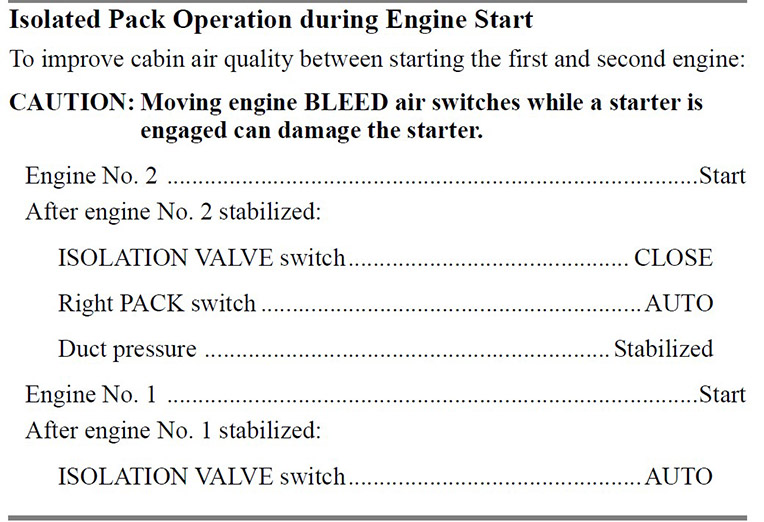
Almost. The correct order is, once ENG2 is stabilised, first close isolation valve and then turn on the right pack.
For normal engine starts we open the isolation valve to let APU bleed (left duck) to blow into the right engine starter (right duct). During engine starts packs are normally off. So when we do the isolated pack operation we want to close the isolation valve and switch on the right pack (which blows mostly into the cabin and just barely in the cockpit (all right duct). If we didn’t close the isolation valve the right pack would be stealing bleed air from the APU and this can result in not enough L duct pressure to start ENG1.
And here’s a diagram I just frankensteined.
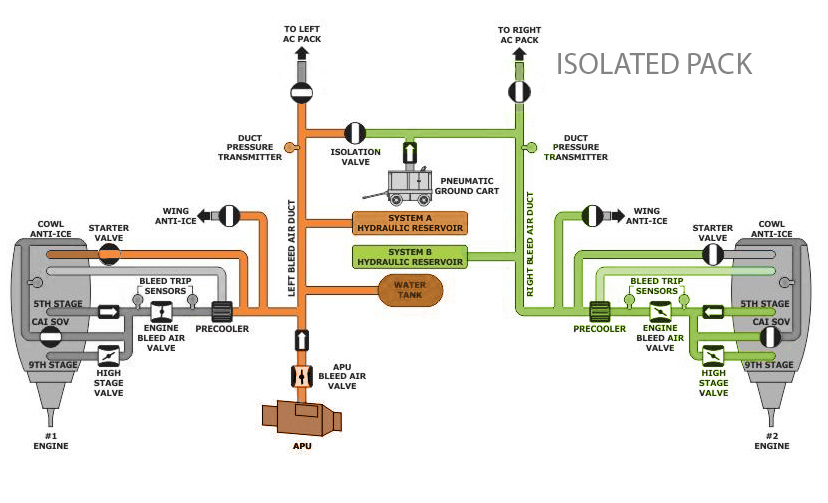
7 Likes
I don’t think so. Granted, you wrote this (I think) before PMDG released the -600 at $35, which is both an amazing price for people who might be on a really strict budget but want a high-fidelity study-level aircraft, and will result in them selling a boatload more of the varient than they otherwise would have, likely making more money in the process.
Remember, software is like drugs… The second pill costs $0.05, but the first one costs billions. Not that much for a 737 for MSFS, but the point remains.
You also accused them of “wanting more” as if that is a bad thing, but I disagree. We ALL “want more”, including yourself unless you’d turn down a raise should one be proffered.
1 Like
Well … the XXX is a version PMDG does not sell … so even $35 is expensive in that case. That is what i meant with backfiring. The marketing “drove” people to the dark side
And because they wanted more … they lost sales on XXX downloads.
Anyway … i will wait for the -800 … because that is the only version i really want .. and have been waiting for it for many months now. Despite the fact they could have released it as the first available version
@you_smart _people_in_here
regarding isolated pack operation:
… and ENG 2 bleed air goes on before engine startup or after engine stabilized and isolation valve closed?
also a different question regarding normal engine startup using the apu. what is the correct gauge psi with apu bleed on, packs off and isolation valve open? (it seems to be showing low psi until the eng starter switch is engaged)
i thought you needed 30psi - like you do when performing a crossbleed start.
Hands down my favorite topic on this forum.
An expert can chime in here, but usually the ENG bleed air is always left on except for a few circumstances (like bleedless takeoff as one), even if engines are off. That’s why you don’t see a reference to switching on engine bleed switches in the procedure posted above.
Yes, I noticed this as well. I think pressure will build during start as the APU can adjust pressure for required demand. This is also why you see an increase in duct pressure once a pack is turned on. You’ll see a similair effect if you increase engine throttle, it’ll also increase duct pressure.
1 Like
Correct. I’ve never switched off the bleeds except for the one time I did a no-bleeds take off during initial line training for my type rating (and in the sim of course during engine failures for additional go around thrust).
You’ll verify that the bleed air switches are on when you arrive to the airplane and they’ll stay on during the whole operation.
If it’s indicating less than that or zero until the starters come on it could be a bug. Normally, the pressure decreases when you use the starter. With the started cutout the APU will give you about 40PSI with packs off unless it’s crazy hot outside. I’m flying on Sunday. I’ll check the numbers if I remember to. I know technically you can start the engine on just 20PSI (which is the requirement for ground air starts on the first engine). Then after the first engine is started with the ground air cart you do need to advance thrust on the operating engine to reach 30psi of duct pressure as you say.
2 Likes
If you’re like me, and don’t care about the real life config with corresponding liveries (for instance, I fly only modern aircraft with modern equipment, LED lights, and the HUD is a must), then:
- Pick a livery, modify it to your liking, remember its registration number. Whenever you load that livery it’s already equipped.
- When you load another livery, instead of tweaking all over again, just go to the “AIRCRAFT” option, and on the right, select “LOAD FROM ANOTHER”, and load the reg number that you tweaked previously. Your new livery is now equipped just like the one you tweaked yourself, and is now default for the new livery also.
- You’ll notice that above that option there is also “RESTORE ORIGINAL”. Use that to restore any livery to its original setting before you tweaked it.
I usually have 3 aircraft tweaked: 1 tweaked in KG for non-US flights, etc.; 1 tweaked and with LBS for US and other countries that use LBS; one for BBJs. So when I get a European livery, I load from my KG-tweaked livery, say KLM; when I load a US livery I load from my LBS-tweaked livery (Southwest, for instance).
3 Likes
Great workflow yes, which i’m aware of. What was stopping me from solving the puzzle was that i wasn’t sure that any tweaks will save over to the new livery, all because of ONE INCIDENT where my tweaks did not save over for the next flight in one livery, but then maybe it was because i did not end the flight with a cold n dark.
All sorted out now, thanks!
It was probably just a glitch. I rarely if ever end my flights with a full cold & dark shutdown. Usually I call the jetway or stairs, and start de-planing the passengers; then call the baggage loaders and carts and start unloading the cargo. Once those are all done, I usually end the flight. I’ve never had an incident where my config changes to a specific livery/airframe have failed to save.
Now, a couple of time PMDG or a third-party has put out an updated version. After installing those, the options are set back to what they were of course.
1 Like
I might have updated the livery too on that incident (i think) with a new version from FSTO, that could be it.
Either way, past is past 
1 Like
Question for you, when given ‘climb unrestricted to FL###’ from a low altitude like 5000ft do you use FLC mode and keep 250kts to cruise to achieve a faster rate of climb or do you dial the speed up to say 300kts above 10,000 and climb at a higher IAS but slightly slower VS? In VNAV I know it uses the programmed FMS speeds associated to the phase of flight you’re currently in. I also know the pilot can obviously just do whatever they feel is best for that flight. Just wondering what you manually use for climb above / below 10,000 in FLC mode. Is it more efficient to climb to your cruising flight level at 250kts and then speed up to your final mach speed?
Not 737 related, but my GPU has decided to go mental and it put all sorts of weird dead pixel looking things on my screen in the middle of a flight, left these weird things on my screen after CTD, then I couldn’t update or roll back the drivers, and on top of that it seems to have corrupted my windows installation, and I’ve had to reboot, losing everything in the process. Gutted. Now windows doesn’t even recognise the GPU is plugged in, and the dots still appear though. Removing the GPU solves this, so I know it’s that. It’s under warranty but that’s not the point. Looks like my simming is over for a while. 
The red dots are usually a classic sign your GPU is failing. Just make sure your GPU memory isn’t overclocked, as that can give the same type of artifacts.
Relax Francis. Looks like someone takes himself and this game a bit too seriously. My post about the condensation was totally tongue in cheek, I’m beyond shocked that someone actually took it seriously. My post about the packs being shut off during engine start was simply based on a small sample set of flights during hot conditions. At no point did I claim to be doubting the guys that fly the real thing.
Have a good night bub.
Fantastic schematic. What’s the purpose of the bleed air feed for the water tank? To keep it from freezing at altitude or to pressurize it? Is there any situation where a jet might be required to do a no-packs takeoff (not including an engine failure)? I always found it amazing that the jet could take scorching hot air direct from the engines and within a very short time period, have it chilled and coming out of the overhead vents.