Hi racers! 
Today I’d like to share a technical analysis of one specific turn on the Budapest track. 
This is the well-known turn after Gate 5 and 13 (formally Gate 4 on the second lap) that we recently discussed with @becaspr and @ITALynx11 - so which trajectory is actually more optimal here: a flat one or a more vertical one?
I actually did a similar analysis of this track back in December, where I compared two YouTube videos:
- my own run with a time of 50.173 s (YouTube)
- and @ITALynx11’s run with a time of 50.038 s (YouTube)
As you can clearly see in those videos, we flew the turns at Gates 5/13 differently: I used a vertical turn, while @ITALynx11 flew it flat, eventually beating my time by 0.135 s.
That made me curious - where else could there still be some margin to gain back a few tenths of a second? So I created a table for myself with the gate crossing times and speeds from both videos.
Since I fly in VR, unfortunately this information is not always clearly visible in my own footage - often the time board or airspeed indicator is simply out of view. Because of that, I had to estimate the gate crossing times visually: I took the frame where the pylon disappeared from view as the gate crossing moment and calculated the time based on the frame number in the video editor.  The airsspeed often had to be “interpolated” from nearby moments where the airspeed indicator briefly appeared on screen. Clearly not an ideal method, but at the time I didn’t have a better one, and so, the comparison wasn’t very precise.
Still, what I saw and understood back then allowed me to regain the lead the very next day, after a few attempts, with a time of 49.750 s - that’s 0.288 s faster right away! Based on the numbers I had at the time, the data suggested that a few more tenths of a second might still be achievable.
Last weekend, @ITALynx11 took the lead again with a new record of 49.703 s - and, many thanks for that  - uploaded a new YouTube video showing that the turns after Gate 5 and 13 are now flown almost vertically as well. Thanks to this video, we now have much better source material for analysis than my VR footage, since the time board and speed indicator are always visible.
So for today’s analysis, to improve accuracy and consistency, I will compare these two videos:
- 1st Run: @ITALynx11’s 50.038 s run, with flat turns at Gate 5 / Gate 13 (YouTube)
- 2nd Run: @ITALynx11’s 49.703 s run, with almost vertical turns at Gate 5 / Gate 13 (YouTube)
Here is how the gate crossing speeds and times look for all gates (with an accuracy of within one frame, i.e. 0.017 s for 60 fps video):

If we plot the time delta and speed delta across the track, I think the picture becomes quite clear:

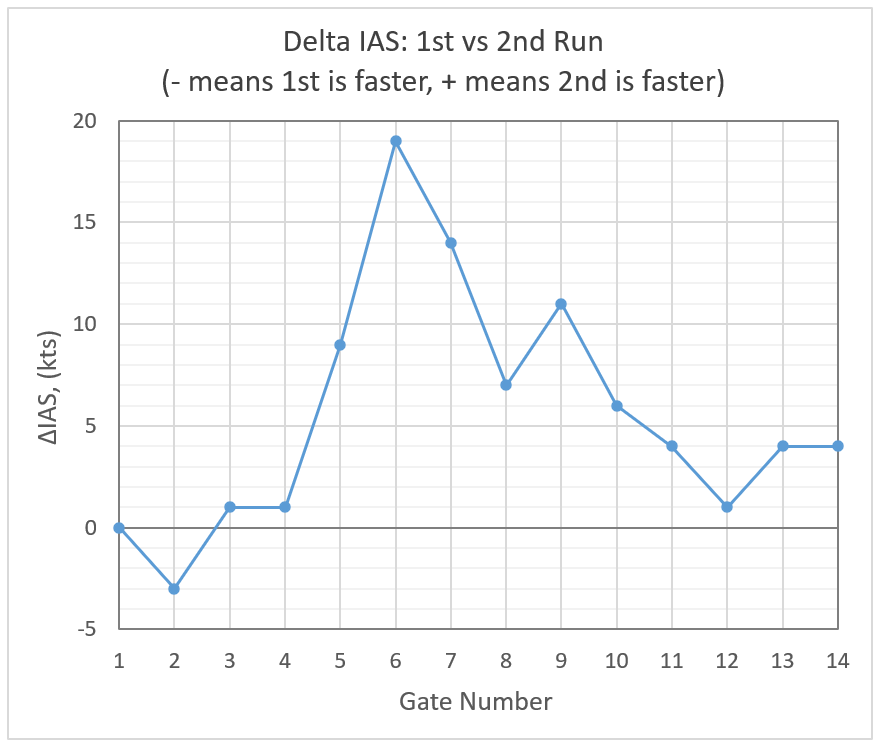
As I mentioned before, in racing - just like in optimal control problems - sections of track are almost never considered in isolation. Sometimes losing time in one section allows you to gain an advantage in another, and ultimately that’s what brings the win.
When the turn after Gate 5 is flown vertically, the turn itself becomes about 0.6 s slower (which is a lot!), but it provides an exit speed advantage of roughly +20 kts. As a result, this approach starts paying off already by Gate 9, and the overall speed across the track becomes noticeably higher. In addition, avoiding the counter-turn before Gate 5 helps preserve roughly 8 kts of speed instead of wasting it.
On the other hand, flying the final turn at the same gates (Gate 13) vertically is no longer optimal: we see a loss of about 0.4 s, even though the entry speed was 4 kts higher! This suggests that for the final turn, a flat trajectory works better - here, turn time becomes more important than exit speed.
That is exactly how I built my own strategy: the first turn (Gate 5) was flown vertically, while the final turn at the same gates (Gate 13) was flown flat.
Today, I’ve also uploaded both of my runs using this approach:
- my ex-record of 49.750 s from December 22 (YouTube)
- and my new run from today, 49.651 s:

How much faster can this track still be flown?
Based on my estimates from the December analysis, I arrived at a figure of around 49.4 s. The new analysis strongly supports this hypothesis:
49.703 − 0.361 (loss at the final turn) = 49.342 s.
It’s quite possible that there are additional sections that could still be optimized. I’m sure @ITALynx11 won’t keep us waiting long with a new record. 

I hope you guys found this small research interesting.
For me, this case turned out to be very illustrative - both as an example of how a fairly effective technical analysis can be done using only “simple tools” (video analysis), and as a good demonstration of the trade-off between choosing a slower (vertical) turn to gain an advantage later through higher exit speed.
What’s next?
A technical analysis could be even more detailed and accurate if, instead of video analysis, we used in-game telemetry - for example via SimConnect. Maybe someone would like to explore that? 
As for the Budapest track, a similar analysis of the turn at Gate 9 seems like a natural next step. What if the same strategy works there as well? And this case also opens up interesting discussion opportunities for other tracks.
I’d be glad to hear your thoughts. 
Smoke on! 