(2262) Effects of Aircraft Flight Controls | profpilot.co.uk video #7 - YouTube
And roll rate influences AoA
We’re going to end up getting into a chicken-and-egg argument if we don’t appreciate that almost everything that has been said is technically true depending on the level of analysis you’re using. What the instructor said to his student was probably adequate for the purpose of his lesson at that time and place. It may not have been practical for him to describe it at a deeper level of understanding. Also notice the term “is a function of;” it is not “cause.” He could have said adverse yaw is a function of pushing the stick right without any rudder input. He may not have been a very good instructor, and it may not have been informative, but he wouldn’t be wrong.
For the purpose of this discussion, I would like to know whether what I assuming is true. Are the aileron up and down drag coefficients in the config parasite drag coefficients as opposed to something like the flap_induced_drag_scalar (I realize one is a coef. and the other is a scalar) that alters how how induced drag is calculated by the sim? If so, why would they be set to 1.0 and .5 by default when flaps are typically down at .05 to .1, and the gear at .0x? What is so special about an aileron that would give it a drag coefficient that high?
3 Likes
Not really? Not in exclusive causality. Roll rate can have many causes. Propellor wake, weight shifts, cross wind, turbulent air…
Isn’t it a problem (and logical fallacy) to base modelling not on the most direct causal precondition (roll rate), rather than one - but not the only one, not the only one in quality, and also not in quantity - that is correlated, but not an exclusive cause? (like aileron differential drag)
It’s a cognitive bias (by pilots) toward differential aileron drag, because it’s the only willful factor contributed by the pilot, while the other factors that cause roll rate, that are not caused by pilot input, are overlooked.
In flight school all focus is on the ailerons - apparently - causing adverse yaw, for obvious reasons. But it shouldn’t be in modeling the aerodynamic forces causing it.
The more one digs into the available research on this, it seems aileron differential drag is really only a minor factor to the direct(!) causes of adverse yaw.
The whole wing vectored forces in a roll are what needs to be modeled for realistic behavior.
Now which options does the SDK have regarding roll rate?
1 Like
because aileron differential drag is only a minor factor directly(!) contributing to adverse yaw, but the crude SDK leaves developers with no choice but to use this factor to model SOME adverse yaw, so the values have to be extremely exaggerated to yield some real world results, even though it’s only a minor contributing parameter that is tweaked?
1 Like
This is really interesting, and kind of relevant 
No One Can Explain Why Planes Stay in the Air
Do recent explanations solve the mysteries of aerodynamic lift?
I think most of us understand that both principles apply to wing lift and are accumulative, that flying level upside down requires a higher angle of attack/speed ratio basically proves this.
Yes you are right of course, there are many forces that may cause an aircraft to roll. But not all of those change the shape of the wing. And more so from a practical perspective it’s the pilots number 1 job to counter all those other forces - if they don’t it soon won’t be long until the aircraft is spiralling towards the ground… So it’s the effects of the intentional roll that matter when the wing has changed shape that concerns us most here.
The SDK (nominally) has many variables that allow for those other rolling forces to be modelled. How effective those are, I’m not qualified to say. But they are there.
But I think we need to be realistic: Asobo has adopted a particular method for modelling aerodynamics and this isn’t going to change. To do so in any fundemental way would require every existing aircraft model to be revised at significant cost - not going to happen when even smaller changes can have outsized consequences. Nor does the availability of a new variable = better (as I’m finding with lateral tire friction scalars on tail-draggers).
Where there are specific or narrow issues that can be addressed, then yes it’s worth the discussion and I think we can add value as a community (already seen with the Cx discussion) But beyond that, it’s not really worth the candle: the path has been chosen. At that point, if the direction of travel doesn’t suit, then it’s best to scope the available alternatives that have adopted a different method.
FWIW, for me, right now, I place higher value on the dynamic world offered by MSFS than the absolute fidelity of the flight model: you can still plan and execute cross-country VFR flight in a way that still kinda blows my mind. Would I prefer FM fidelity to be better in places? Yes. (And in some it really has to improve - like ground physics). Will I only fly aircraft that are as well modelled as possible? Absolutely. But after that I accept the limitations and if I’m missing some of the finer-grained behaviour, I can live with that. (And if I get frustrated enough I’ll go blow some pixels up in DCS…)
3 Likes
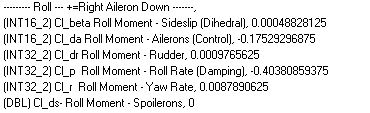
Well, of course, there were these in FSX for roll:
and to stick with the yaw / adverse yaw of the topic there were these:
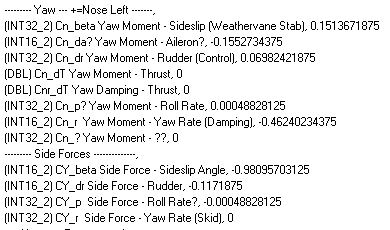
And most (if not all) of those had tables to scale the effect against both speed and AoA.
Ultimate flexibility for the developer. Yet because the forces in that sim were focused on one point, it wasn’t considered realistic enough and the aircraft were described as ‘running on rails’.
Now we have almost the exact opposite - the forces are spread across the aircraft so the aircraft interacts with the weather, while we get “up / down drag” and a reliance on accurate geometry that cannot be defined anywhere near accurately enough to be useful.
2 Likes
What geometry values are missing or why isn’t it possible to assign useful geometry? I could start a wishlist.
If it was that easy the experts wouldn’t be saying it’s not that simple.
In any event, the sim is just an approximate model of reality, and will likely remain so for some time even as it increases in fidelity and accuracy. It’s always going to be a balancing act to get some semblance of “realistic” behaviour with an approximation.
This!
I think to most users it’s not clear that this “accurate geometry” is not much more than a basic set of bounding boxes defined via some very rudimentary position and length data with the odd angle thrown into the mix.
Just off the top of my head, some real fundamentals:
Fuselage - shape is a cylinder, no variation. Width, height (which may be different) cannot be defined, nor any tapered shape longitudinally, nor any significant ‘lumps and bumps’.
Wing - no airfoil section, no ability to define anything other than a basic monoplane.
Horizontal tail - no dihedral or anhedral available.
Spoilers / airbrakes - angle of deflection is the only geometric variable.
I’m not saying that any other sim could do any / all of those, but when there are hardly any other controlling variables available to us and the SDK claims the following:

then we really need either the ability to define MUCH more accurately, or the reintroduction of the mass of aerodynamic coefficients and tables that were still present in MSFS at launch to run alongside the geometry as they did before.
3 Likes
Shouldn’t the ‘modern’ flight model be abandoned then, and finally a ‘realistic’ flight model be created by Asobo/MS from scratch?
I see lots of job openings on Asobo’s website for the flight sim department. but ZERO searches for aeronautical design positions.
I suppose Asobo doesn’t really care much about the flight model, as long as the eye candy toy planes “fly” through eye candy virtual reality believably enough.
IMO Asobo should currently focus 80% of their resources on developing a comprehensive and efficient flight model the airplane developers can use. But it seems more like they spend little more than 0% on it these days.
1 Like
That’s not true at all.
1 Like
that’s a straw man argument. if you have not a single person in your ranks who majored in aeronautical engineering and math, then it’s not about “approximation”. Then you simply can’t get close to anything in that realm. It’s a systemic malfunction.
Have at it. Show us how it’s done then: https://dev.epicgames.com/community/learning/tutorials/mmL/unreal-engine-a-diy-flight-simulator-tutorial
Didn’t know.
If he can turn things around we will all be happy.
I guess he will need to do exactly that: scratch the old ‘modern’ flight model and create a new one from scratch.
Why create something new, when you originally had the aerodynamic theory in the early days of MSFS and it’s just been removed in favour of this inadequate geometry base? Why not keep the geometry base for the interaction with the weather and for basic flight definition and put back ALL of the aerodynamic theory that was there in the first place. That wouldn’t need the work already done by third party devs to be ripped up and started from scratch. It would also be a ‘best of both worlds’ - the beneficial parts of FSX and X-Plane combined and improved upon!
Sonicviz is correct, btw. There’s just not much movement - hopefully because real consideration about what needs to be done is happening.
That’s not true at all either. You have no insight into the codebase, as to what can be adapted or changed. That old “we need to rewrite the codebase” is rarely true, and if it’s been designed well in the first place it’s entirely possible to do surgery on parts of it without a “total rewrite”.
The only people who know what can be done with it are Asobo.
They’ve obviously aquired new dev resources with the required skillsets, they’ve noted bugs (see the dev forum as well), and it’s plain they’re working on things. It’s not going to happen instantly either.
I really don’t understand the angst over it.
The sim works within certain boundaries and expectations that expand over time.
Manage your expectations and experience to stay within those ever growing boundaries and you’ll be much happier.
2 Likes