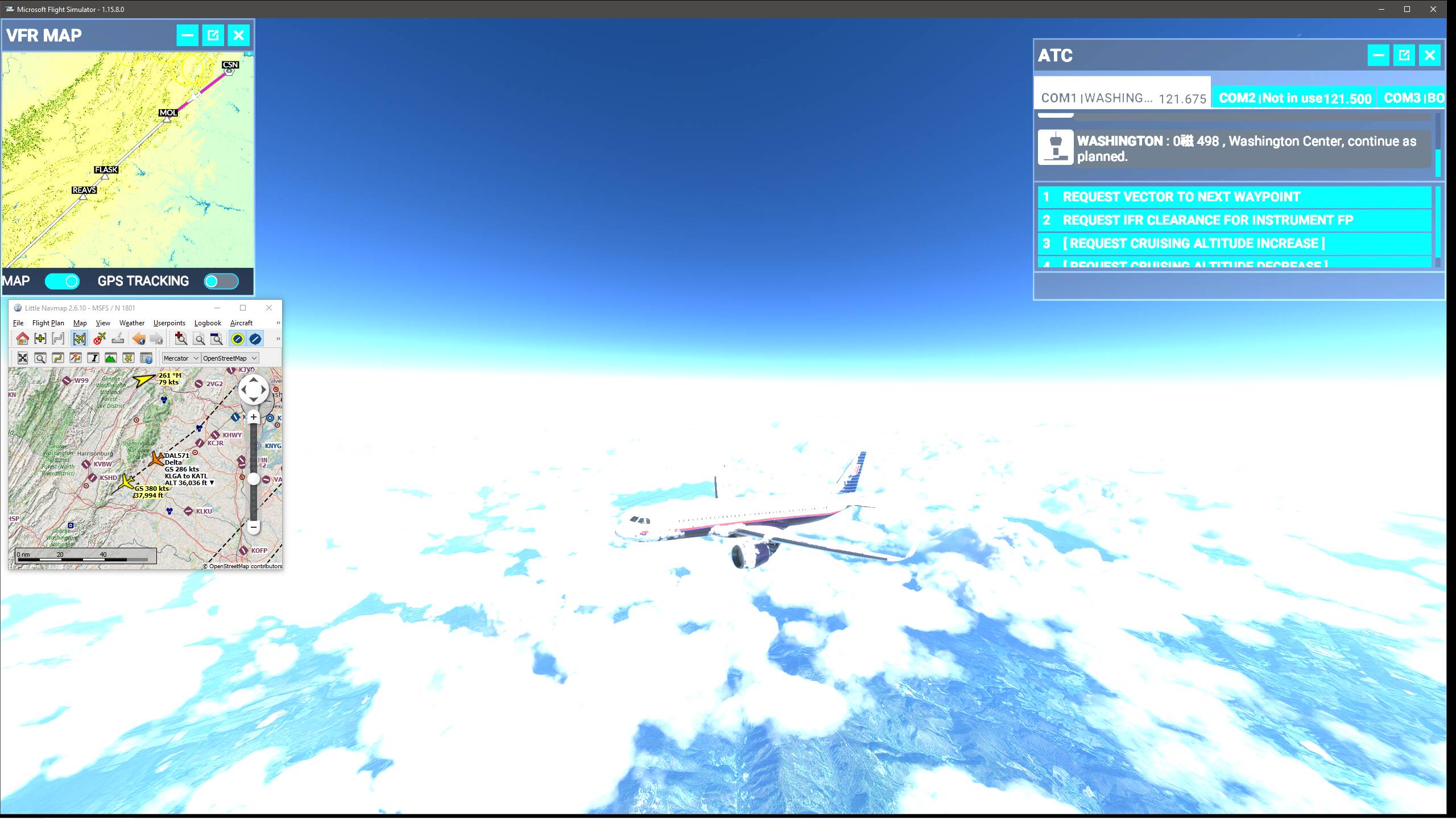
Excessive Icing effect

I don’t know how quickly it happens in real life, but a few days ago I had forgotten to turn on my Pitot heater, and I was flying just below a layer of cloud. I climbed just a little too close, and my airspeed indicator instantly dropped to zero, and ice appeared on the windshield within seconds. A few seconds of the pitot heater flipped on, and my airspeed indicator came back. The remaining ice took 5 minutes of lower, warmer air to clear.

I too want them to make it more realistic, rather than just give us an option to turn it off.

No, please, not just an “off option, period”! Please made the icing simulation more realistic in the future when you have time, Asobo…

If its too complicated to change all the icing logic, just a slider that we can tweak the speed of ice builup would be somewhat ok.

Like what we have now would be something like 20x(fictional number), give us 10x/5x/2x/1x

Would already help a lot

This is all so weird to me… Surely this has to be a very simple equation somewhere. Base icing rate times surface times some temperature based factor. I can’t imagine needing more than an if statement to disable it. I refuse to believe that it’s taking them so long to simply fix the off option. I am pretty convinced that what they’re doing is overhauling the whole icing system, alongside the weather system, to be delivered into SU4-6. If that is the case, then they making us wait for months and months instead of simply fixing the off option is simply ridiculous.

I agree with you, but the developers seem to be convinced that icing on a flying aircraft works exactly the same as icing on a rock in your back yard, and they are only giving us the on/off button because we whine so much. I hope that’s not the case, and that they realize what icing is supposed to do, but I don’t have high expectations at this point.

Not a programmer but I would guess an on/off switch is probably far easier than introducing a sequence that more exactly follows what actually happens.

In light icing it can take a while for the effect to be seen and felt as it builds up gradually from the leading edges - in heavy icing of course it occurs much faster. Deciding on how fast to implement realistic icing is going to be affected by many other things including outside temperature, humidity, aircraft speed and perhaps even the lift values of the wings. We all know what happens when the devs start mucking about with basics!

IMO this is not going to be a priority until they’ve got everything else running to users satisfaction, which will be a long long time I have no doubt. I guess this is not going to please the purists of course.

So for now I’d be happy just to be able to turn off the effects on the aircraft performance, as it’s supposed to do in the setup menu, should I be foolish enough to continue into icing conditions in a non-rated aircraft.

Is this really the way an aircraft looks with icing? I have never seen a picture like this before except in MSFS.

This has been remarked upon a dozen times. The “ice” in MSFS is based on an ice or frost layer on the physical model. (Open a model in Blender and it is clear what is going on.) When the conditions are present in the game then ice will start to develop. The more severe the conditions the greater the area of ice defined by the layer is filled. Thus it is a video game effect when the icing rate increases more of the layer is filled. As ice is removed off the airplane less area is filled.

In the real world, ice builds on layers. Thus in most icing situations, the more severe the encounter the thicker the ice is on the wing. This is not to say this is the ONLY way ice builds. Icing is an organic phenomenon and thus behaves differently based on the unique conditions in which it formed. In the right conditions you can get into run back icing where indeed ice will accrue aft of the protected surfaces. You can also encounter SLD (Supercooled Large Droplets) where water droplets are ‘looking for a place to freeze." You can find this around temperature inversions in which a fast-moving cold front is lifting warmer air. On the surface, we would classify it as freezing rain or freezing drizzle. However, since freezing rain and drizzle is a surface phenomenon in the air it is classified as SLD. NASA’s Glenn research center has encountered SLD up to altitudes of 15,000’ in their Twin Otter.

Icing is one of those things where you haven’t been in severe icing until you have been in severe icing. Old Turboprop pilots are going to have the largest chance of encounter based on the altitudes and routes we fly. Most of your jet pilots get hit with Type I/IV mixture, fire up the anti-ice, and blast through the worse of the conditions in less than a minute. So no most of them have never really had a severe encounter. Meanwhile, as a King Air pilot, I got into an inversion layer where I had to blow the boots 4 times in 5 minutes each for over a 1/2" of ice! The ice that day was forecasted as trace to light rime, we found a pocket of severe mixed to possibly SLD.

Finally, do you know what ice “looks like” in a real-world Full Flight Simulator (FFS) used to train pilots? The instructor punches in the icing they want on the Instructor Operator Station (IOS) and unless the airplane has ice detection, then the Instructor has to tell the crew “you have ice adhering to the airplane.” There are NO visual indications. The performance decreases are usually so subtle and happen over a long enough time that even experienced crews will tend to miss them.

At least Asobo thought about icing.

The problem is that, at least for me, ice seems to develop all the time, a few weeks ago I was flying a C172 in Arizona, clear blue skies and was forced to an emergency landing due to icing. Was so frustrated, I did not even tried the game again until yesterday, and guess what happened?

At KPIT at 1700, 15 C real temperature, FEW050 FEW250, relative humidity 58%, visibility over 10, when I’m at 2000 feet, icing starts, OAT shows -3C. Why?

I hear what you are saying and I have never experienced clear air icing in the game. All icing that I have seen in the game were associated with visible moisture. So sort of maintenance response is, “Checked and can not duplicate.” I recommend to post a video here of it happening and Zendesk the video.

As well as just fixing the rate and conditions of accumulation, it would be amazing to see icing build up more realistically in regards to the surfaces of the airplane. On the C172 for example, the first place you see ice won’t be covering the entire leading edge of the wing. It’ll be on small protuberances, such as the front of the tire/wheel pant, the pitot tube, the front of the strut.

The problem is the complexity of aircraft icing. To qualify my opinion, I have several thousand hours in real world GA single and multi-engine aircraft as a flight instructor and charter pilot. Various aircraft including C172’s, Navajos, Mu-2’s, Turbo Commanders, etc. Based in Michigan icing conditions exist 7 months of the year and even longer if you fly up in the teens or low 20’s (turboprop altitudes). In the winter every aviation forecast includes at least “chance of” light icing. But “chance of” is not “known” icing so it is legal to fly and take a look. Light to moderate icing is common and severe rare. There are 2 types of icing, clear and rime or a mixture of both. Rime is by far the most common. In say light Icing the accumulation will start on the corners of the windshield and on the leading edges of the wings not cover the whole windshield and airframe instantly like MSFS. Then ice starts to build on the propeller nose cone tip and the the propeller itself starts to accumulate ice resulting in a shaking vibration. In non-icing protected aircraft the prop icing can sometimes be successfully shed by cycling the prop rpm or engine rpm if fixed prop airplane. By this time you better be executing your escape plane, ie heading towards an airport or descending below the freezing level or get out of clouds all together. I always know where the freezing level is, pilot reported tops of the cloud layer and the ceilings, especially important if the freezing level is near the surface. Sometimes there are inversion layers where you can actually climb up into a warmer temp. The longer you stay in the ice the worse the situation will become. The Air filter on the front of the engine will start to ice over and restrict the airflow causing reducing engine power (just what you need!). A sometimes successful fix is to turn the mags on and off to make the engine backfire to clear the ice (yes this works). If the windshield is covered turn the defrost on full heat and place your approach charts in a “V” over the vent to direct the heat on a small area of windshield. At minimums, knock the chartbook out of the way and land looking through the small area you hopefully melted. (done this a couple of times). I’ve taken off and started to pick up ice in the climb right away and immediately returned to the airport. On other occasions just picked up a little enroute but kept a cautious eye on it. I like to use realtime weather in my flight sim and fly to destinations, not just go sightseeing VFR which BTW we can all agree MSFS is great at. Every time the temp is near freezing and there are clouds in the sky the aircraft immediately and completely freezes over whether your in a cloud or not. Its instant severe icing right now! We haven’t even talked about known icing certified aircraft operations and you can see how dynamic and complex icing conditions are. Until a more accurate modeling of icing conditions or a complete icing disable option is implemented in MSFS I’ll do all my IFR flying in Prepar3d. The inaccurate realtime weather, icing and heading bug 10 degree issue are show stoppers for me.

sorry but that is not correct

Its not the weight of the ice that is the problem, its the drag.

Its not even close to a good “turn around”? stop posting please

You may have noticed on one of the flight setup screens there is a slider where you can alter how “old” the aircraft is by increasing parasitic drag. I’m not sure if the sim actually utilises this metric in flight as ice builds up, though.

I don’t remember the label name in the sim, unfortunately.

perfect, I hope the Devs see this!

My only guess to that would be the aerodynamics for the “ice” scenario would overule the “parasitic drag” scenario, and if this is the case I could see this being correct as the ice would form over and rough bits of dirt and grime and such. Purely spitballing on my part though. I have used the setting in regular flight regimen and it does appear to give aircraft more personality…I rather like it tbh.

Say…incidentally. Have there been any signs of movement on this? I just took off on a day with scattered cloud that was well above the freezing level. I passed through the cloud, yes I did get a little ice…maybe 200 or 300 lbs worth. But with my de-ice set to auto, every time it went up 100 or so pounds it would go down again. I have never noticed that before…and trust me I keep an eye on it.

Edit: nope its still broke lol…must be jedi mind tricks again.

I saw a couple of people saying they are only flying in warm weather due to this issue?

Well, I did a flight a couple of days ago in the A320NX from New Delhi, India to Colombo, Sri Lanka - Temps in Delhi 39 degrees, going to 32 in Colombo.

No precipitation around, but a few forming storms and thunder and lightning.

Flew through one thin layer of clouds on the climb out, and guess what - Severe Icing Detected, and the whole air-frame is covered in ice.

I don’t know about you guys, but i’ve flown in and out of Sri Lanka on multiple occasions through storms much heavier than this, and I have never in my life seen ice on the air-frame.

While MSFS has absolutely wowed me on several occasions, there are some things that really make me wonder how they think it was okay to release like this.

The ATIS reporting 3 layers of clouds every single time is another one that pops to mind…

I really hope these kind of basic issues aren’t being swept aside as low priority feature requests.

Having been a developer for a company using the Microsoft TFS system I know all too well how backlogs can become a graveyard for some tasks, and I remember in a recent Q&A a mention of how on release they had something like 400,000+ emails in Zendesk.

In addition to that, currently reported bugs on the forum that have been acknowledged and are being worked on, continue to sit on the list redundantly, while others with only slightly less votes never see the light of day.

Someone in MS/Asobo needs to step up and work out a better process for this so they are hearing and seeing fundamental issues like this.