Do gliders have different ceilings or are all gliders restricted to a height ceiling only by available thermals? I’m aware of the Perlan missions as well.
Thanks for any discussion on this topic: I just can’t find a good answer about it. It doesn’t seem that glide ratio is particularly important for a maximum altitude?
Hi, glad that you are interested in gliders.
In RL glider flying most common ceiling is typically cloud base as clouds in RL mark where thermals are and without special training confirmed by entry in glider pilot license + special equipement not typically installed in gliders you are not allowed to enter clouds, so you cannot continue to rise at least over flatlands.
In blue thermal conditions another limit is thermal height limit caused by temperature inversion layer that typically occurs at some height - surrounding air temperature at some height rises with height thus preventing thermals to rise any further (as rising air cools with height).
Another common artificial ceiling are controlled airspaces like above 9500feet or even lower near airports.
Thanks EPPR - so it does seem that physically gliders are just limited in ceiling by the atmospherics and not by the powerplant and L/D characteristics like powered flight?
I’m very interested in the Perlan 2 project and want to pursue pushing the limits of the Sim with whatever I can that’s available in the Sim. Experiment with game mechanics mainly…
Planes etc in the game have pretty much hard-ceiling limits built in based on their power plants and the fact they fall like stones without them.
Also the real world stuff is very interesting to know. I am not sure I’ll ever be brave enough to pilot anything but we’ll see!
In real life I’m interested in this stuff but don’t know how deep I’ll follow the rabbit hole.
To reach very high altitudes gliders use yet another kind of weather mechanics - called wave soaring - typically over mountains fast blowing wind can create very long amplitude and length waves on the lee side of the mountains - those areas are typically marked by Altocumulus lenticularis clouds (google it for pictures). There are a lot materials about wave soaring on the net - gliders can reach altitudes like 5000 or 8000m above ground this way (oxygen required).
Perlan project also uses wave soaring but in very special place.
Sadly MSFS 2020 does not simulate wave soaring or Ac Lent clouds, on the other hand ridge soaring at least at some Sim Updates didn’t have limit so you could rise to quite high altitudes but don’t make mistake ridge soaring is not wave soaring.
Another, a bit graphically dated, but by many people regarded as still way more realistic than MSFS 2020 glider sim called Condor 2 simulates Ac Lent and wave soaring.
For any type of aircraft the ceiling will vary with weight. A Cessna with only a pilot onboard will considerably outperform one loaded with passengers and fuel.
If you could somehow design a glider that was half the weight of a typical one it would undoubtably climb higher in equal conditions.
Sadly that is not true - thermals, ridges, waves all have their limit and this is at the same time gliders rising limit, glider weight doesn’t matter - note that Perlan glider is way heavier than typical glider.
A few weeks ago there was a hurricane southwest of Japan. There was an airfield on an island in the eye of the hurricane. I took off there with an aerotow. The cloud picture in the FS was breathtaking. Stable updrafts between 8-10m and an achievable height of about 7km. Until nothing more came. I then flew north for 2-3 hours above the clouds to then land in very challenging conditions on the grassy area across the runway, almost vertical. So you can have quite a bit of adventure, which I wouldn’t risk in reality.
Regards
Ralf
How high you can climb mostly depends on whether you can find enough rising air (as already discussed in this thread). But this is not a limitation from the aircraft. A glider is physically limited by the “coffin corner”. As the aircraft rises, the air gets thinner which increases the stall speed. But the speed at which you get flutter does not increase. So at some hight, the stall speed is greater than the flutter speed. You would either stall or destroy the airplane. This is the reason why Perlan 2 has a very high maximum speed (377 kn TAS). A lighter glider has a lower stall speed which would also increase the max hight,
Hmm, if you can get as high as 10,000 feet, don’t go any higher you will pass out unless oxygen bottle equipped. Cloud base on a clear day is best, enjoy, looks fun in RL.
Given the right atmospheric conditions to carry them up, all gliders have a max ceiling determined by the altitude at which True Air Speed is so high compared to Indicated Air Speed that VNE and the plane’s stall speed converge, referred to as the ‘coffin corner’. Perlan II was mentioned, which is able to go so high because it’s design is optimized for up to >90k feet or so iirc.
Perlan I however was a modified DG-1000 and has a max altitude possible around 60k feet.. at that altitude if you flew any faster than stall speed the wings will rip off. Every glider will have it’s own specific altitude at which this happens.
I just need to rephrase what you said to see if I understand.
At some point your stall speed = your plane’s structural integrity at which point you either descend (because you’re stalled) or your plane falls apart.
At this ceiling the True Air Speed which also raises that stall speed has risen so high you reach that above condition.
In MSFS 2020 I was able to achieve this in my glider (fudging the atmospherics) and the result was to just basically stay in the air I had to constantly live in that “warning” sound that goes off when you’re too fast. But my IAS was only like 70knots, near stall.
Edit: That is why there is so many feeds on the forum to correct the current weather model and the default gliders . they are not accurate and will discourage new glider pilots from the joys of un-powered flight and soaring natures air
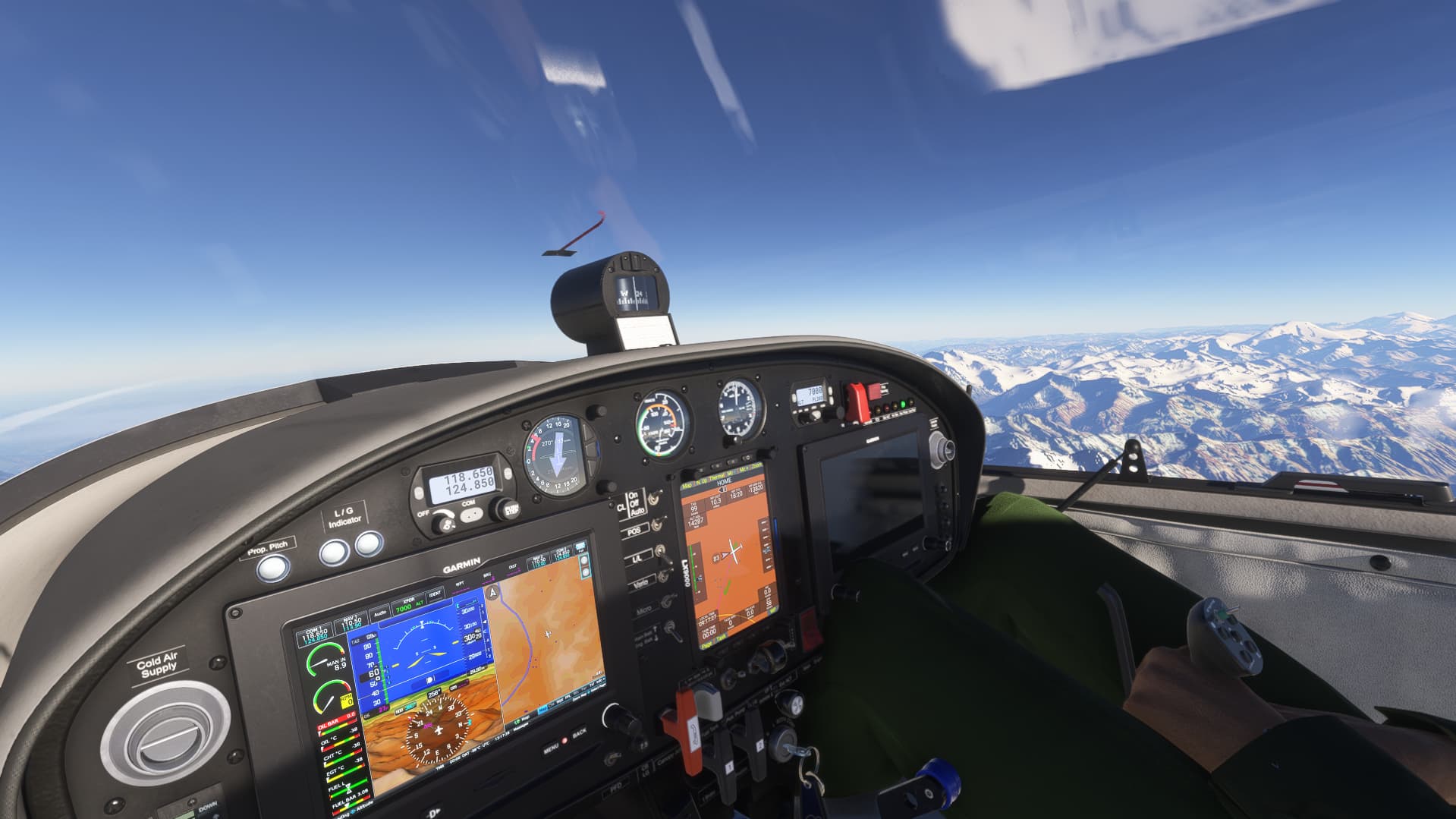
I just took the Stemme over the 30,000 ft-mark over the Argentine Andes. This does not seem to be the ceiling though, even 40,000 ft have been claimed to been reached in MSFS.
Hello, the Stemme is listed with a service ceiling of 9,000 meters (approximately 30,000 ft). You should keep an eye on the outside temperature during these flights, and there’s hardly any air to breathe. Therefore, such flights are usually very demanding. Even though, as far as I know, the FS’24 doesn’t simulate waves, such flights are possible in high mountains like the Andes or Himalayas.
Unfortunately, the FS Stemme doesn’t have functioning oxygen cylinders. I would have liked to have one, especially since Gotfriends had already implemented something like this in the Discus. Unfortunately, the cylinders were always empty after a short time. From a professional perspective, however, this was a step in the right direction.
One easy basic approch to calculate the maximum ceiling you can theoretically reach with your sailplane, given the proper engine, is to solve the basic lift equation for rho (density of air) and then look up in the table for the standard atmosphere for the corresponding height.
Use this equation:
In the equation m* g == 0.5 rho * v squared * lift coefficient* wing surface, v has to be within the structural limits. As the equation shows, the glide ratio is not a limiting factor in your sense.
But the power you would need for horizontal flight is proportional to Drag/Lift == beta (english definition of glide ratio) , as you see. You know Power == D * v ?
So, gliders have different ceilings due to their individual structural and aerodynamic constraints.
A hint:
Do not be afraid of learning basic fligh mechanics. You would only need (mostly) basic school algebra.
Good luck, bye walter.
Forgot to note, that you defintely would need a pressure suit for heights above 12.000 meters. It’s terribly cold there too. -50 degree centigrade.