Is Hypoxia modeled? If so, how high before it’s an issue? Are there any aftermarket supplemental oxygen mods for GA aircraft?
Yep, sure seemed like it. My screen went black after a short while above 14,000 (or maybe it was 15-16,000?) feet, flying from Denver to Aspen in the DA-62, on my first flight in MSFS2020. It was eerie, being “barely conscious”, but not able to figure out what the airplane was doing. Not having explored the sim, I didn’t know how to turn on supplemental oxygen. When I figured I was probably past the highest Rockies, I blindly attempted to drift down to a lower altitude, and sure enough, after awhile the screen came back dimly, and then fully.
Moved to Interests, General Discussion.
No it’s not. I’ve flown the Cessna JT-A (TD version of the C172 G1000) to the 17,500’ service ceiling, and there was no supplemental oxygen requirement (or equipment). For gameplay, you just have to assume you have the right O2 equipment on-board and if it’s time limited, play according to that gas availability.
The answer is clearly NO !
I just tried it. Started in La Paz, at 13000 ft, climbed up to 26000 ft with the DA-62 (oxygen supply off !) and with the VL-3 (mod rotax 915) up to 31000 ft. There were no effects in either case even after well over half an hour of flight.
No - but I believe it should be - if it is possible to do that. This has been raised before and I read some replies, with real astonishment, from real GA pilots who said that they often flew, without oxygen, at well over 10,000’ IRL and felt confident to do that because they were acclimatised. I guess that might be okay if you live at high altitudes. Try watching some of the videos of trainee pilots in a hypobaric chamber and see how their performance deteriorates.
It would be easy to build a hypoxia simulator! You need these items:
- an USB connected I/O device to read the ALT memory offset of MSFS
- a noose, connected to a DC motor with gearbox (for gradual tightening)
- some code to activate the motor once you surpass 10.000 ft
Happy flying!
Haha nice 
Haha!
Short flights 10-12k are fine, but over about an hour and you’ll start to get a headache. I’m a sea level dweller and will not go above 10k unless I’ve got a second pilot on board.
They could model it, but really you would want supplemental oxygen for any long high altitude flights. I was doing some planning for a flight over the rockies on pilot edge, thus my question. 17k in the BE36 for almost 2 hours and no problem.
Thanks guys
All,
pls you reported no functionality but no one reported settings in realism of sim. I’m curious what settings depended to this option you can find as relevant. Really, I have set all to max realism and I can tell you that I never fly with Seneca higher than 13000ft till this time. I’ll do some tests next time if I have reason to go higher 
i’ll just hold my breath when i’m in a cessna at 18,000 feet. That way when i pass out, there’s no real danger involved..
I wonder how they “Simulate” Hypoxia in the Multi Million Dollar Airline Full Motion simulators they use for ATP training ? Oh, I suspect they don’t even bother. It is done in the classroom. I guess we should not go there either in our $100 non-motion simulator.
No hypoxia, hyperventilation, is implemented in the sim. I would love to see stuff like vertigo effects(a pilot becomes disorientated. ) The latter is probably not easier to add to the sim.
There is probably other things I missed.
I like to fly in a hyperbaric chamber, and then when I start climbing above 18,000ft, I’m like “ok, start reducing the pressure”…. :). Just kidding, but if you want to know what Hypoxia feels like, stick your head in a bag and vacuum out all the air. :).
Don’t do that.
I’ve been in one of those pressure chambers where they simulate high altitudes. They take you up to altitude and you take off your mask. They gave us a sheet of paper with some questions and things to do while experiencing hypoxia to show how it effects your ability to think and focus, so you can recognize the symptoms. They also simulated a rapid decompression. Unlike what you see on the movies, the air turned to instant fog when we decompressed. The humorous aspect was that they recommended you don’t eat beans before hand. All that gas expanding in your gut you know… lol
Yes,
no need go to Everest, is enough simulate that bag over the face Yes typical pilot tests for that situations…
To me very good situation was some video from Xplane on Youtube about Japan Air flight, very horrible and they loose tail on 747, audio till impact and also hypoxia, very good example, recommend to all find this, very scared after that. Maybe to say to this with msfs, Hypoxia can have different ‘feelings’ …
There were add on aircraft in FSX and P3D that simulated this, the Lotus Simulations L39 springs to mind. It was similar in nature to some fighters having the G force black out affect. I haven’t noticed any in this version of the sim.
There is a request in the wishlist section for this kind of effect: Realistic Dangerous Weather - Physics Simulation
We have Black/Red outs in MSFS2020. Since their Reno Pack. Configurable via Assistance options/User experience - there are 2 options: G-effect and G-suit. Works pretty well at least with the L-39C
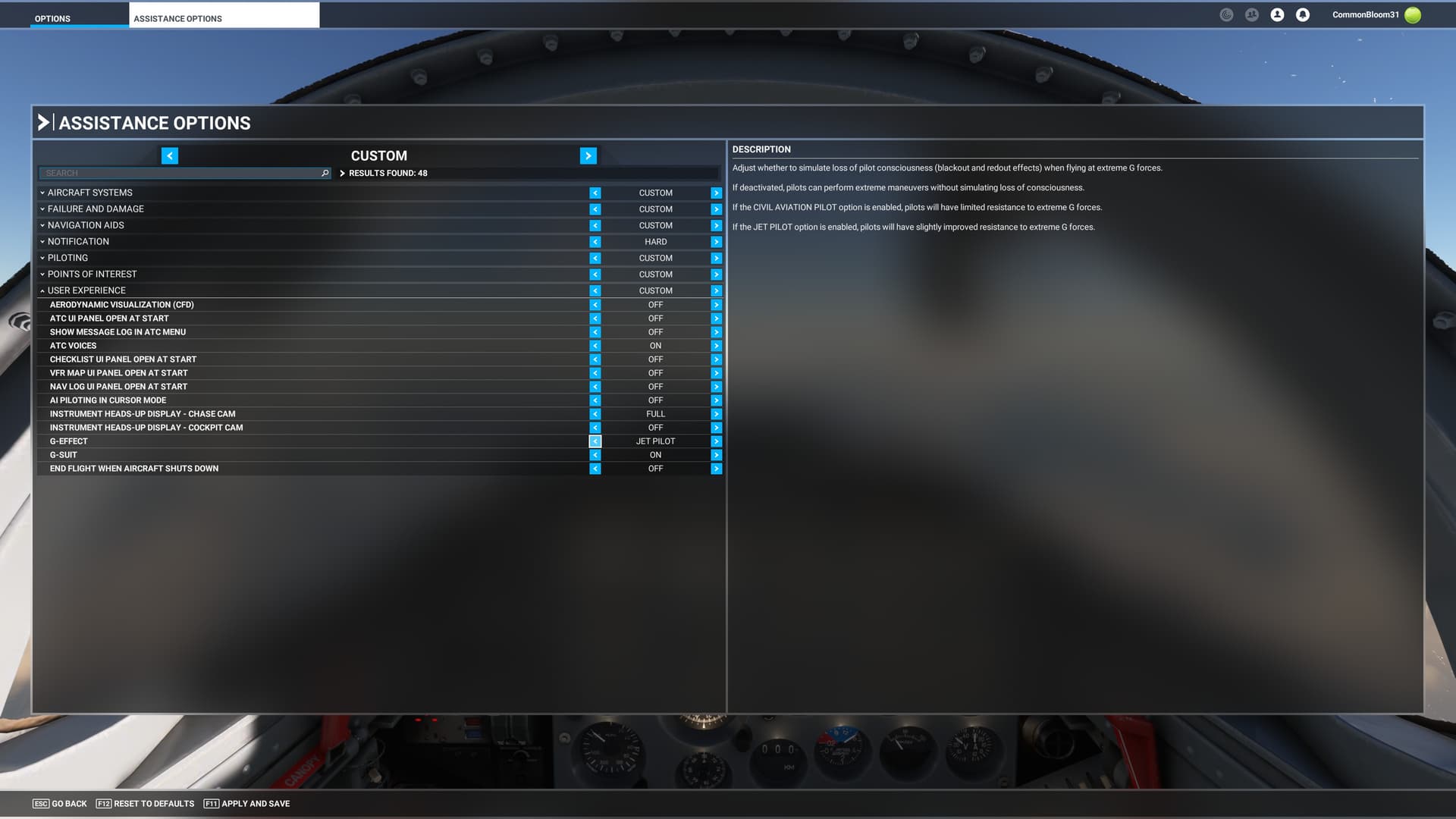
This is what you can see if you use Civil pilot without G-suit
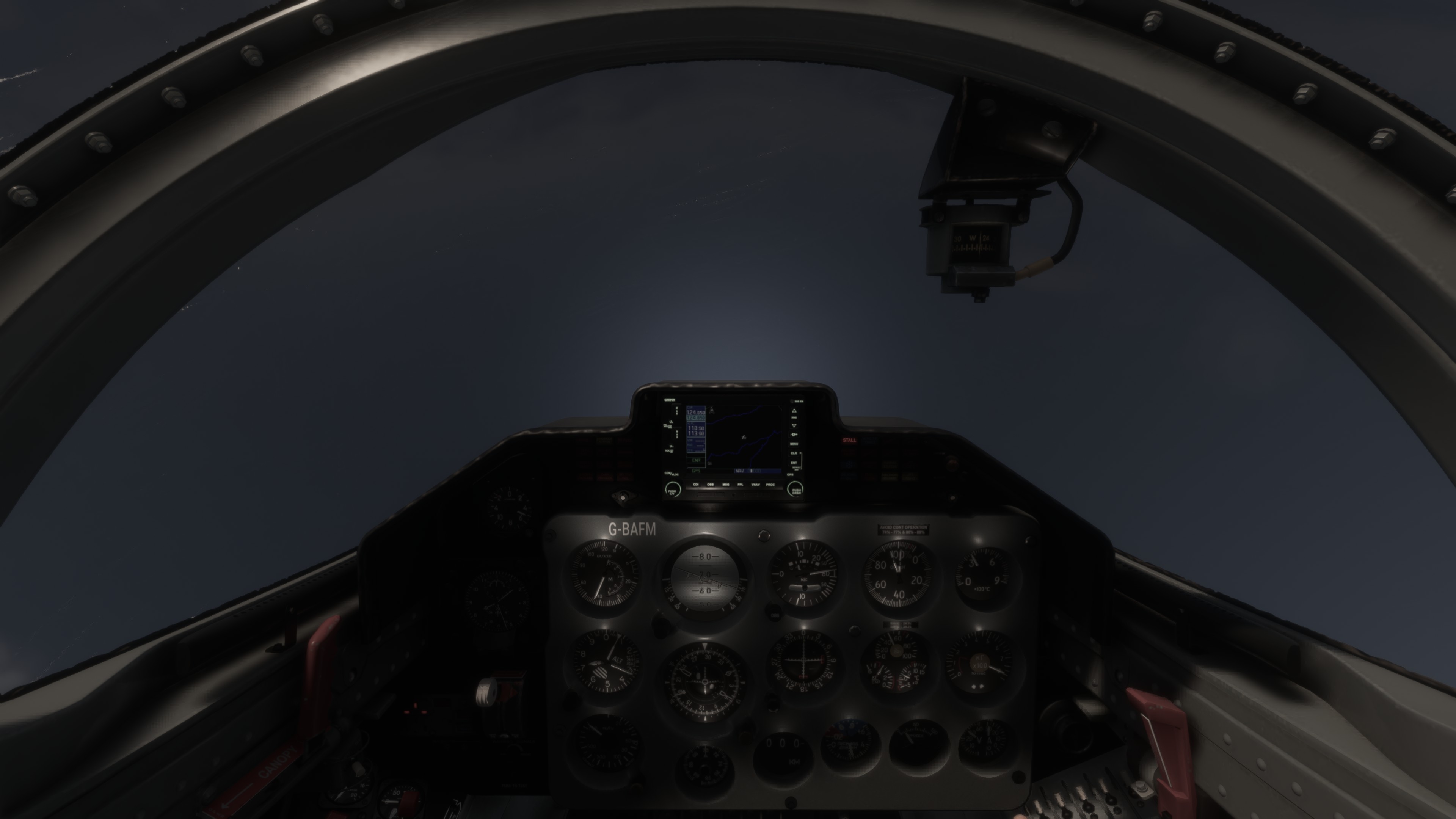
(I do not post a complete black out - it is a black screen, the pilot also starts breathing heavily)
Negative G
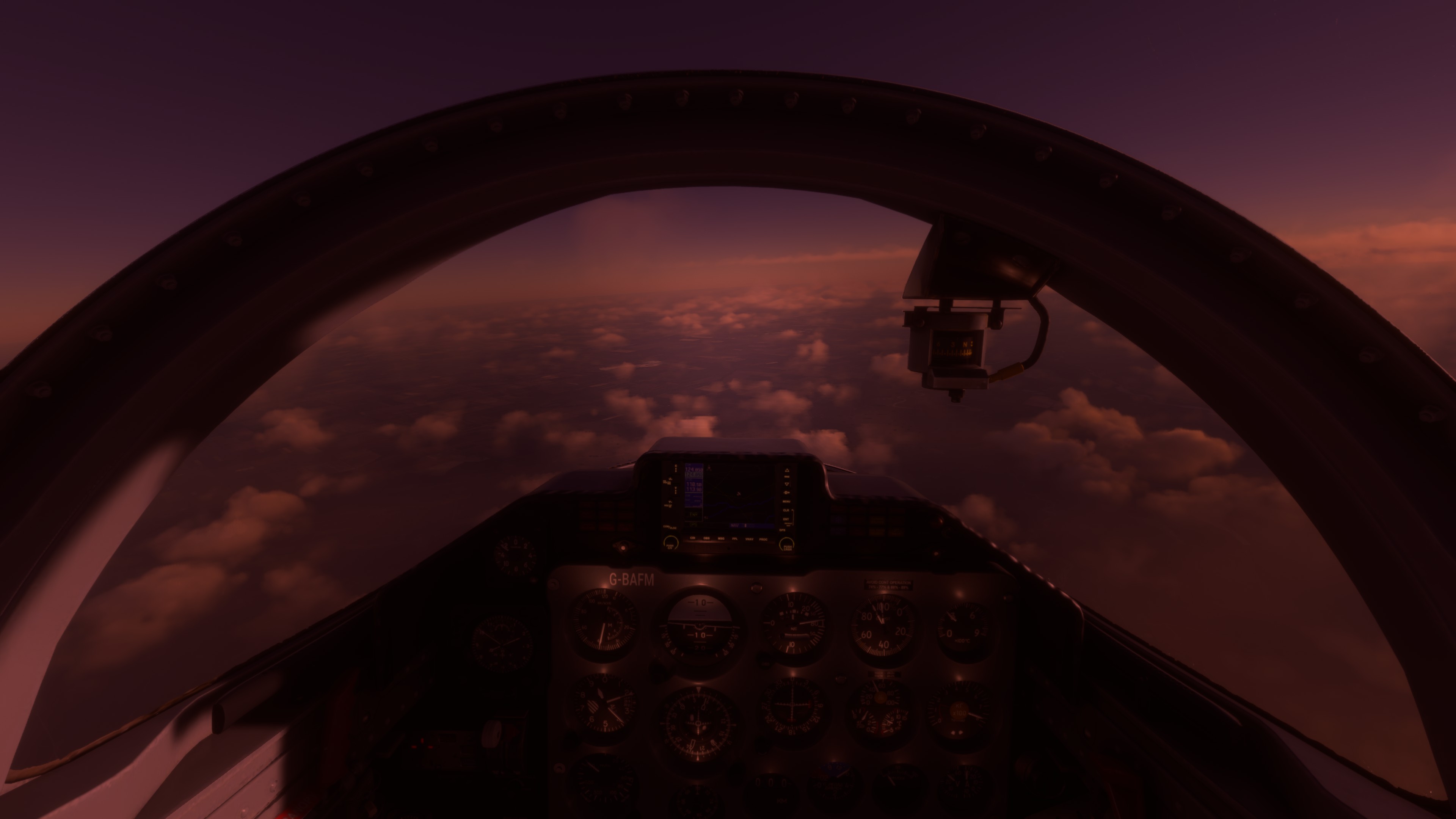
Actually, because we access the aircraft via a virtual cockpit it would be far easier in MSFS than a full scale simulator.
I would design it so that you would have an inbuilt ‘error’ probability of increasing severity - so that when you click a switch or tune a dial, it either doesn’t fire the event, fires something else or uses the wrong value.
Hypoxia is insidious - the initial effects are hard to spot and the victim is often unaware even as it gets worse. Only at the final stages should you then get camera effects like fade and blackout.