Hi there, I was wondering what your cruising speed and what aircraft do you guys fly? Any info is greatly appreciated. TIA
Speed varies with different planes, but generally I try to fly as the plane was intended to fly. With piston props, I generally set power to 85-90%, then try increasing prop pitch if that’s available. Sometimes it just slows me down and I set the prop back to fine, other times I get a few more knots out of it. And of course, I lean the mix for best fuel flow, or max EGT if that’s available.
With most turboprops, I’ll run the power turbine at about 98% or max max throttle, whichever is greater depending on altitude. Coarse prop pitch definitely makes a difference in cabin noise on these, but it can still trade off on speed. The TBM is a different animal though. Take-off and climb require monitoring torque, but after a certain altitude, you get the power lever to the max and leave it.
The only jets I fly are the Cirrus and Honda. For those, since I can’t remember their speeds at the moment, I just look up their cruise performance and get somewhere close - usually a little over, because I want to get there.
Usually the CJ4 and cruising at 200 KIAS.
Flaps at 15 and throttle at 90%.
Cruise speed, which is usually measured in true airspeed and/or Mach number, is going to vary greatly, mostly dependent on aircraft type, cruise altitude, and temperature aloft, plus other factors like aircraft weight and balance. Winds aloft then contribute to the overall groundspeed.
I generally fly mostly General Aviation (GA) aircraft to small-medium turboprops and business jets. So I cruise generally from 120 to 250 knots true airspeed, depending.
Jets ( legacy military, not airliners ) : 250 - 300 knots
Turboprops : 170 - 230 knots
Small GA : 100 - 170 knots
I am not sure if you are serious or not. I have only flown the CJ4 a few times some time ago but I have some really basic concerns here for advice to a new simmer.
First off: do you really cruise with 15 degree flaps? That is really a major no-no for numerous reasons. If you are really doing it: why? That is contrary to any logical - or permitted - setting. Note that max flap speed is like 200KIAS. If you do a normal climb you are already over the max permitted flap speed. On top of that, why would you add the drag?
And I am also unsure of 200KIAS you mention as this would be very altitude-dependent. Typical climb setting is 240KIAS and that automatically changes to the Mach limit (around M0.64) from around FL320. Because I do not fly the aircraft regularly I cannot recall the actual numbers, but the max permitted cruise at FL320 is certainly in the very high 200KIAS range: perhaps 280KIAS? I know it is around 220KIAS at say FL420.
For the original poster: you would be best served if you refer to the appropriate manuals for any aircraft you fly to find out what the correct cruise setting range would be.
Most aircraft have a range of cruise speeds at different throttle/torque settings. The faster cruise settings are … faster … but use more fuel which in the real world is a serious consideration. Note that turbo props tend to have a single recommended prop RPM you stick with regardless of torque etc, with piston engines recommended prop rpm can vary a bit. With a fixed prop of course you get no choice it is what it is.
In terms of the current aircraft I personally fly in game:
High speed: Vision jet (over 200 kts)
Medium High speeds: Comanche (over 150 kts)
medium low speeds: Sting S4 ( 90-100 knots)
low speed: Tiger moth (under 60 kts)
STOL: Wilga ( as slow as you can go)
and
These two statements in many ways and cases are really contradictory. I fear that this might be misleading to a new simmer. When it comes to cruising, most private GA-type piston engine aircraft would have acceptable/approved cruise settings listed at different altitudes. The power settings are defined by
-
manifold pressure (how wide are you opening the throttle plus what air pressure is available at the altitude you are flying). This is generally given in pressure in inches of mercury with the maximum available at sea level being around 30" for normally aspirated engines
-
Engine speed in RPM. The maximum for a variable pitch/constant speed prop is generally around 2,700RPM. The higher the RPM, the higher the horsepower generated for a given manifold pressure
-
When it comes to cruising, I really do not think any civilian aviation GA aircraft engine manufacturer would condone running the engine at manifold pressures and RPMs that equate to 85 - 90% of the maximum rated power of the engine. Typical numbers are in the 55% to 75% range.
I am not sure how you got to the 85 - 90% number that you quoted. Maybe you mean you have your throttle set at 85 - 90% of the travel? If that is so: with a variable pitch propeller this is not a real indication of power. Even with a fixed pitch prop, full throttle will only be like 55% of maximum rated horsepower of a naturally aspirated engine at say 12,000ft.
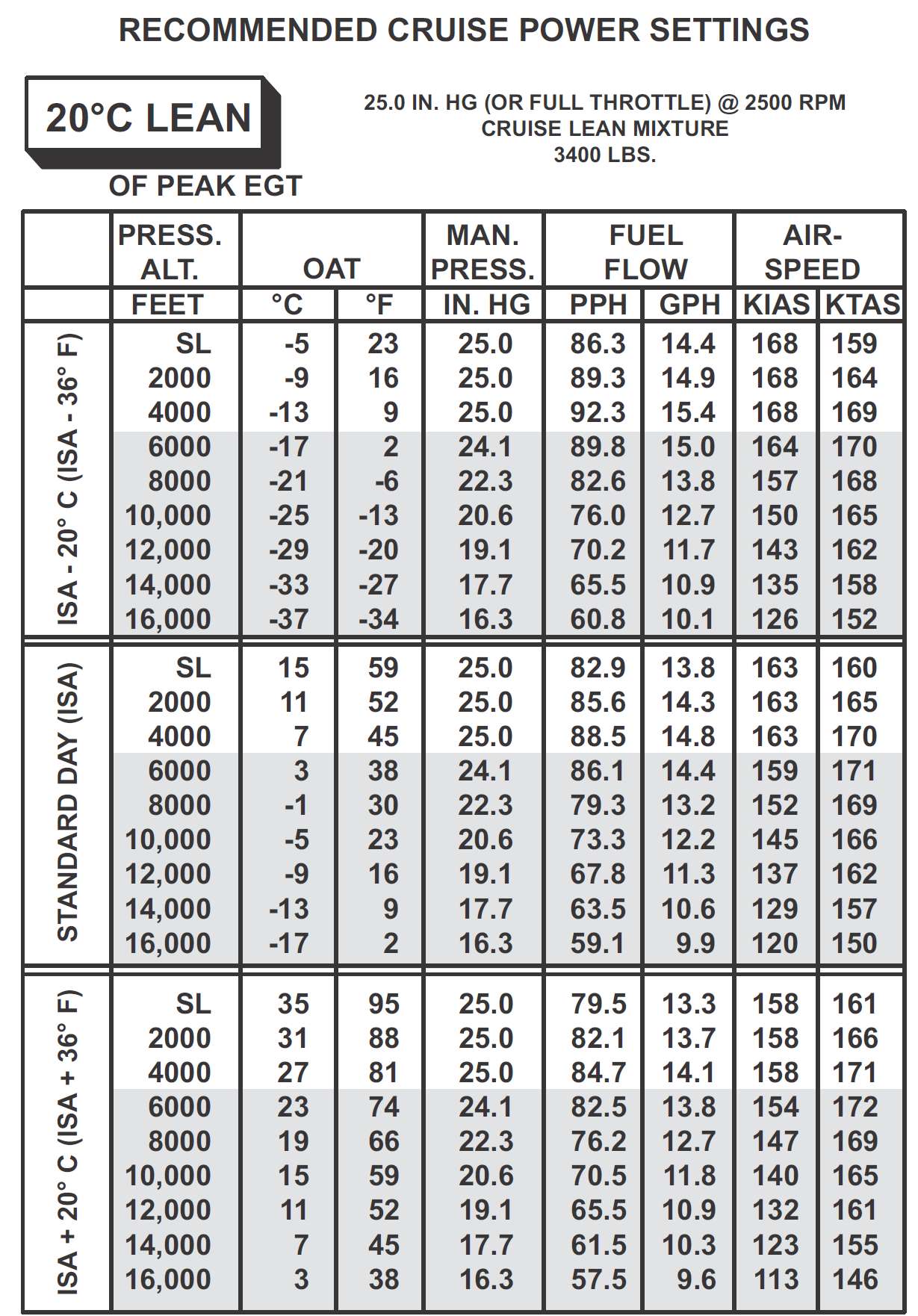
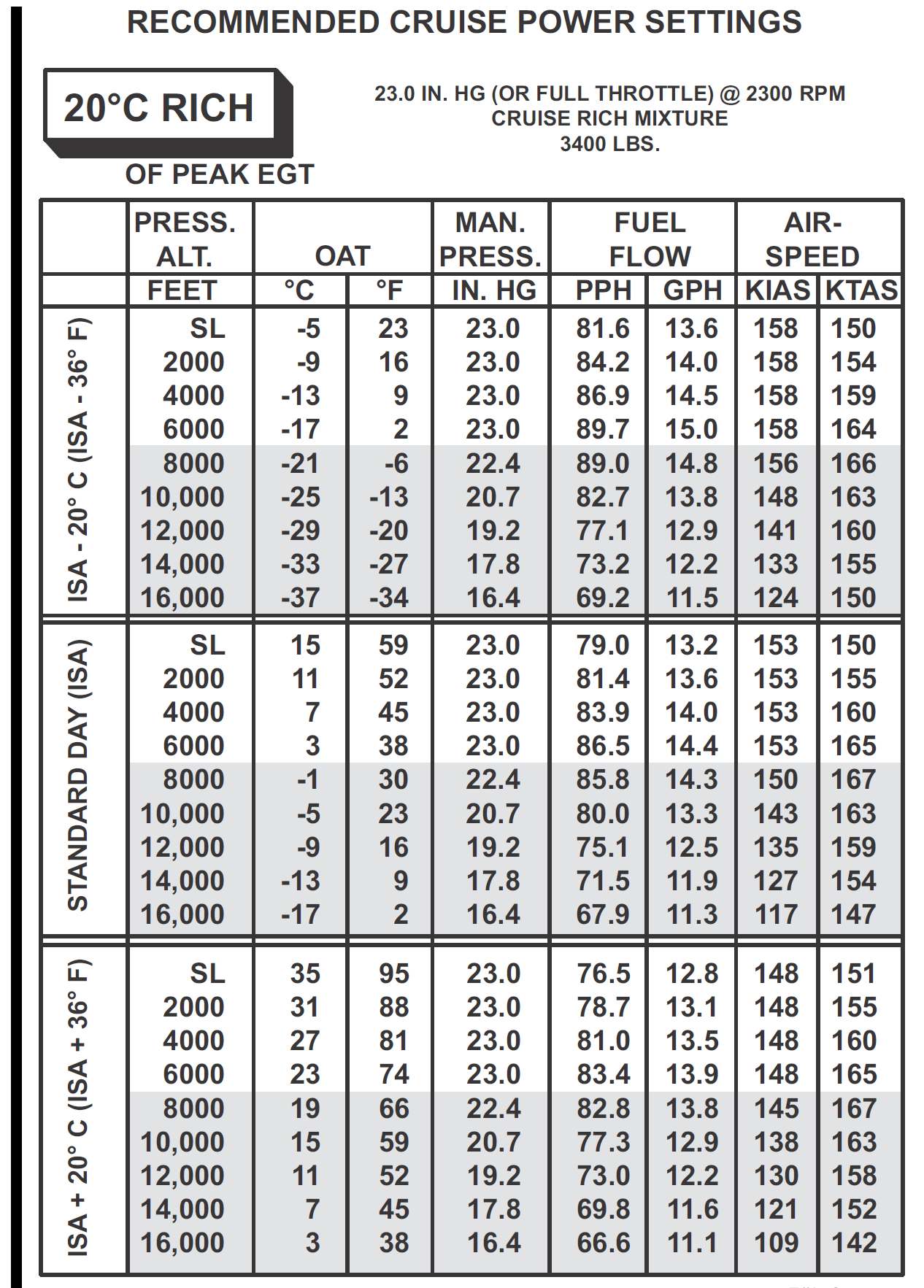
FWIW: here are two tables for cruise settings for a Bonanza G36. one at maximum of 25"MP, 2,500RPM and the other for 23"MP and 2,300RPM, Note that at 25/2500, this specific engine is developing around 75% of maximum rated horsepower. If you were truly flying the aircraft as it was intended to fly, this is what you would be using.
I usually flies base on numbers.
Baron 2500rpm, 24-23 inHG, mixture on the limit on EGT is giving me around 185-190kts on 5000
Kodiak 2200rpm, fb 1800ish or egt (haven’t flown for a while so don’t fully remember) around 155kts
737 whatever my CI16 allows me to do but mostly 0.78
What do I know?
Not much because I am an armchair pilot.
I read somewhere that for the CJ4, Flaps at 15 was normal except for
an unusual condition. Don’t remember what.
Something like heavy load or something.
I fly scenery. Never over 3,000 feet.
Why in a CJ4. Because it is so easy to fly.
Speed listed, 200 KIAS, is what is displayed on the
PFD speed tape.
Throttle at 90% is what is displayed on the CJ4 instrument and
also on the Heads UP Display.
Max indicated speed allowed with 15 degree flaps is about 200 kts on the CJ4.
However staying below 200kts IAS at altitude puts you below the power curve, not an optimal place to be.
Hence you would need to stick exactly at 200kts to avoid going below the power curve or exceeding safe flap speeds.
I am not sure who recommended 15 degree flap for normal operations but I doubt it was a real world CJ4 endorsed pilot.
ALSO with aircraft like the CJ4 always be really clear on the difference between IAS and TAS .
He apparently did not realise this was referring to takeoff flap setting. And is unfamiliar with some basic aviation practices and concepts. In my post I did try to touch on some of these basic parameters with the CJ4 (including the 200kt limit with flaps) but it really is impossible to cover even the rudimentary basics of flying a CJ4 (or really any aircraft) in a thread like this.
In his defence: he was only referring to IAS in his post and did not mix IAS and TAS.
Personal Comments and Observations
Vision Jet - 300 true (there’s no real savings gained for going slower in this jet)
SR-22 Turbo Normalized - 190 true
Cessna JT-A (Turbo Diesel 172) - 120 true
I guess I should restate/clarify/whatever. The one piston plane I’ve flown most in recent months has been FADEC (the twin Diamond), so it’s basically push it to the firewall until end of climb at 12,000 - max for unpressurized. Then I pull back a bit so that I don’t push into the yellow band on the speedo. In the DA62 with the “X” mod, that ends up somewhere in the low 90% range. Just about every other piston I fly stays around 8,000’ max.
In those that require manual leaning, I still lean for either fuel flow or EGT, depending on available gauges. Prop and pressure both max at 2500/25, or less MAP once I get higher. And yes, that does mean that the throttle is firewalled near or above 8,000’
As I said, I fly for scenery.
Select IFR/ILS flight plan.
Start on runway. No cold & dark.
Set Altitude to 3000.
Set VS to 2000.
Correct Legs if needed in FMS.
Turn on AP.
Activate NAV.
Throttle to max.
Release Parking Brake.
AP rotates.
I don’t raise the Flaps.
I don’t trim. Auto trim is set.
I don’t turn off landing lights.
I don’t raise the gears.
AP does its thing.
Lower Throttle when overspeed alarm sounds.
Set Approach when applicable.
Lower altitude if needed.
Follow GS.
AP off & land.
I love flying the PMDG Douglas DC-6 in and out of smaller dirt-strips. Cruising speed (in high power cruise) is roughly 280 Knots True Airspeed (KTAS), depending on how heavy I am or what altitude I’m at!
It’s great because you get to see a lot more detailed scenery when flying at only ~8,000 feet and ~280KTAS 

As other have said speeds vary greatly depending on temp,winds, weights etc.
I enjoy flying the A320neo a lot and generally find myself cruising at around 850-870kmh.
That is perfectly fine, so long as your aware that would break a real aircraft or even a study level CJ4 in the sim.
If your happy to fly that way, no problems, it is your sim.
Indicated airspeed, not true.
Cruise speed is measured in true airspeed most of the time in GA aircraft. If you go up to 10,000 feet, your indicated airspeed will be pretty much the same as at sea level, but your true airspeed will go up by about 15% due to the less dense air, which makes a huge difference in range, ETE, etc. It also, of course, has a negative effect in takeoff and landing distances. This is all assuming you’re not operating at the edge of the power/thrust available for the aircraft, a standard atmosphere, and several other things being equal.
In the POHs for most GA aircraft, cruise speed is given in KTAS (true). You base all your flight planning calculations on that, then correct for wind aloft. Your flight plan is given in true airspeed, not indicated.
In a more extreme example, let’s say you’re in a 737 at FL350. You’re indicating 250 knots because the air is so thin, but you’re actually doing closer to 430 true or Mach .74, before figuring in wind. Nobody cares about the indicated at that point, other than to not exceed limitations.