I’m Andrew. You’re right that I kind of got drug into his response to Marc’s post, but he did include me in being miserable and having a monocular view of things… Which really isn’t fair. I enjoy the PMDG forums and have made a lot of posts there over the years praising the products. I really just asked a question, and apparently it’s a sore spot.
I appreciate it is a bit generic and will depend on weather, runway length and altitude but I would be interested to know IRL what would be a typical approach of a 737-800 with reference to distance from the runway, speed, altitude, gear down ( I guess around 2500 Feet? ) and how the various flap settings are deployed at each stage?
I was /am a dinasour, started out flying a Supercub around the arctic with only a map and a compass that pointed East. First trip across the Atlantic was in a C-130 with a navigator taking star shots, landed on Arctic pack ice, flew 737’s with LORAN, flew every 747 except SP, used Carosel INS with real gyros and Hand entered Lat long waypoints and finished up in the 747-8.
Flight sim isn’t real aviation but it’s a good learning tool. That said I don’t claim to know everything about sim flying, it has its own quirks and thanks to those who ferret these out for us!
Any number of times in real world aviation a broad base of mechanical and systems knowledge proved invaluable. As a test pilot friend said, 'stuff happens". Maybe the biggest thing missing are is the necessary crew coordination and management.
When I was flying the 747 I used the PMDG version to prepare for check rides and also familiarize with new to me airports.
We do low drag approaches so unless there’s something non-standard about the sequence or other associated threats like tailwind or steep glide slopes it would go something like this:
-220kts in the terminal area (around 15nm from touchdown)
-Flaps 1 mandatory by 10nm (Usually at around 11-13nm) to provide a good speed to intercept the localizer (200-180kts)
-Flaps 5 sometime between 11nm and 9nm. This is to be able to fly 180kts on intercept or by 8nm for sequence. On light loads Flaps 2 will be enough to maintain 180kts.
-Flaps 10 optionally if you need extra drag on the glide slope to keep the airspeed in line (The 737 is slippery and has a hard time slowing down on the glideslope). Speedbrake with flaps higher than F10 is allowed but not recommended.
-Gear down Flaps 15 at 4nm (VMC) or at 5nm (IMC) and read landing checklist down to flaps.
-Finish configuring and be stabilized at the landing gate (in our case 500ft in VMC or 1000ft in IMC).
For situational awareness we draw 2 rings in the FIX page around the landing runway (RW point).
-10nm for latest F1
-4nm (VMC) or 5nm (IMC) for Gear Down F15.
It works out very nicely. Of course we can deviate from this whenever required. If there’s slow traffic ahead of us (a320 or a turboprop) we’ll configure earlier. If there’s heavy tailwind on approach too. If the glideslope is steeper than the usual 3º we may even configure fully before GS capture (eg. Marseille). This happens on certain steep RNP approaches as well.
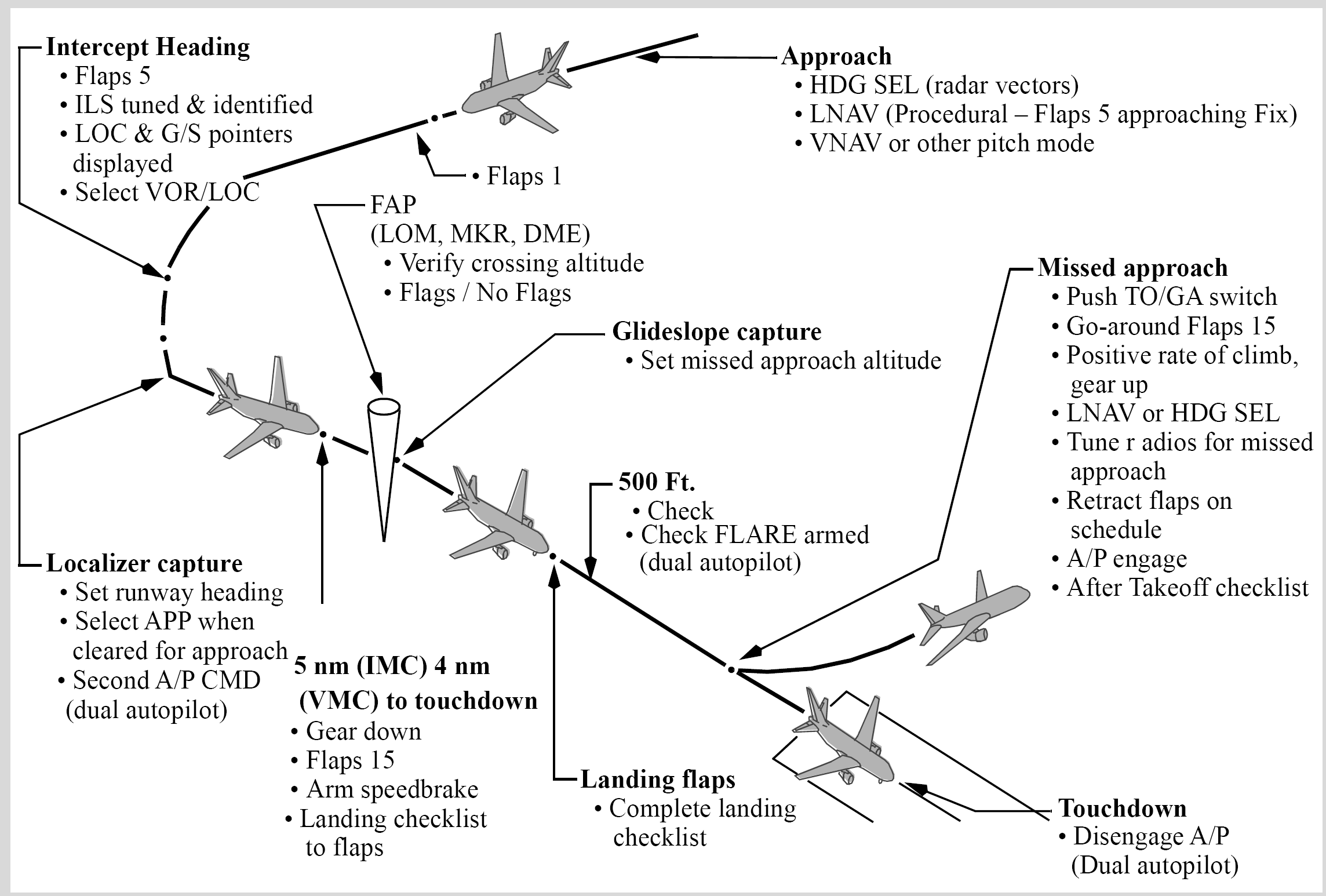
This is a diagram from the QRH. It contains some stuff for the dual channel approach (autoland) like disconnecting the autopilot on touchdown. Ignore that part if you want.
Interesting, but all that’s going to be a huge handful for the single sim pilot at the landing gate, as you say. Jet fuel is free in MSFS so no need for a low drag approach; I want final config by the 2,500 call so I have the time and space to transition from A/P & A/T to hand flying, taking any crosswind component into consideration. Especially as MSFS sometimes changes the wind abruptly on short final. This happens too sometimes IRL? Anyway, single pilot IFR in the Boeing favors the conservative pilot, by that I mean to conserve margin between me and the ground rather than conserving free fuel. Cheers!
For the sim pilot it is useful to fly a lot of the approaches by hand and for that being stabilized at glide slope capture is a good procedure. I flew the 737’s ages ago and for the 747’s we stabilized much earlier. It was an easy airplane to fly as long as you stayed within tight parameters. It’s also good practice to fly with the auto throttle off once you have stabilized hand flying. As mentioned fuel costs are diminimus in MSFS and a fully stabilized approach perhaps easier to do well. With the underslung engines thrust changes cause pitch changes and say a pitch change will cause a thrust setting change which will cause a pitch change which… on and on… Listen to the pitch of the engines, it’s a great aid in power setting.
I have asked two days ago to stay on topic. This thread is a discussion of PMDG’s 737 not about what was posted in the PMDG forum. Posts will be removed that are off topic.
Establish a standard seating position (Point of View). Many Boeings have either lined up balls or in the case of the 747 a black cross on the side window post. Whatever make it the same every time. I was often asked if I had been a fighter pilot as I liked to sit high in the cockpit. Make a lot of approaches and you get the sight picture for 3 deg glide slope firmly entrenched. I an interview sim check I was flying an old 737-200 sim I had flown before and the guy had me do a black hole approach. His surprised comment was “that was better than your ILS”. Turn off the stuff and do some visual approaches. A useful skill and for many airlines, especially ones without a gen av presence, it’s almost an emergency procedure. It’s also good to do approaches without the auto throttle on though begin by getting everything stable with power and pitch helps you get a finer touch with only small corrections.
I had a similar problem yesterday. Flying the Alaska Airlines 737-900 N309AS from KSEA-KONT. At cruise altitude just prior to decent near Bakersfield, suddenly a CTD. I wasn’t even interacting with the sim at the time. I have not had a CTD for over a year and rarely fly the PMDG 737 (about once per month) because something usually happens. previous flight one thrust reverser activated on landing causing me to do a figure 8 on the runway, before that the controls locked up on final following pause of flight. I get very frustrated with it.
I will give the same Alaska fldight another go today.
Indeed, a careful examination of the exterior does demonstrate the presence of the plug door on the 737-900 and ER. Speaking of door issues I sometimes get a nuisance door warning at spool up? Only freezes I get are with loading a saved flight, sometimes…
I started out commercial flying at 36 as a second career, flying small planes for an Alaska bush carrier. Pretty good stick training. A lot of an airline career is due to happenstance combined with persistence. I was lucky and spent 15 of my 32 years flying as a 747 Captain. One thing I had going for me was I never lost the love of flying the airplane and never wished I wasn’t on a trip. The bush flying developed a feel for flying that was invaluable one several occasions. Somebody need to be able to fly the plane!
It’s a transient caution for the overwing exits. It shouldn’t be there, but is intentionally modeled by PMDG. The background: on the 737 NG family (and now the Maxs), the overwing exits mechanically lock with thrust lever advancement (and a few other conditions.). Early on when the NG family came out, if those latches were just a little bit slow to engage, the PSEU would sense an open proximity switch and throw a doors caution. The caution would then clear after a second or two as the latches finally closed all the way, the prox switch closed, and the PSEU was happy.
Early on, it caused many low-speed aborts. Boeing corrected it pretty quickly by adding a few seconds of delay logic to the PSEU. PMDG has chosen to model it as a “clever” inclusion in their products, but unless you’re simulating the operation of an NG within the first few months of live flights, it really shouldn’t be there.
The real kicker is that it shouldn’t happen in the -900ER at all, as that variant did not even exist until long after this transient doors caution had been corrected. I wish there were a way to turn it off.
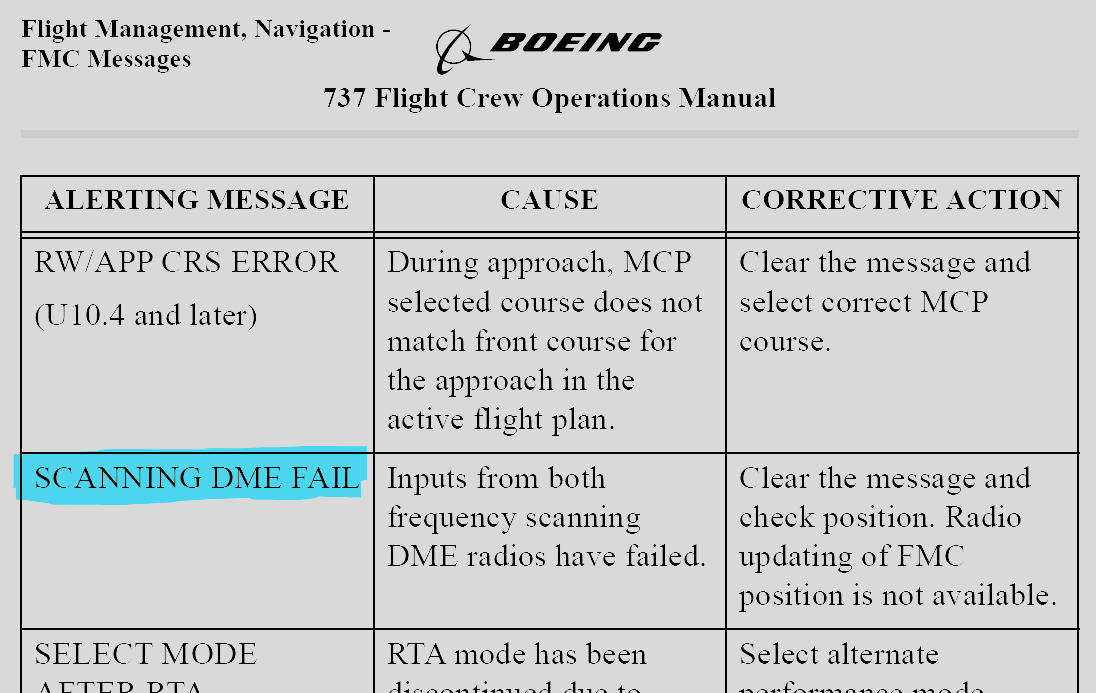
Was doing a flight in the Caribbean, while out over the open ocean, got a “Scanning DME Fail” notice on the FMC? Never seen that before, any idea what it is / what I did wrong?
Wow, this thread is getting close to 10.000 posts! Great to read input from real world pilots and experienced airline simmers.
I normally fly helicopters and small GA props. But after hearing so much praise of the PMDG 737, I decided to buy the -600. Like many others before me, I spent the first hour sitting in the cold and dark cockpit, simply admiring the wonderful modeling and trying to find out where everything is located.
A few days later, and I have performed some short flights without wrecking the plane. I am not even trying to do everything perfectly, instead relying heavily on the saved cockpit states. Simbrief is a big help as well, uploading the route and the performance data into the FMC without much manual input.
I just wanted to write this to encourage others to gives this plane a try. The learning curve is not as steep as I thought But mastering this plane can probably take a while
IMO all the Pmdg airraft are excellent. Heres a link to a Real world pilot who is also a member of the PMDG TECH TEAM. Definitely check out his numerous youtube videos on the 737. All excellent! This is just onie example so subsctribe to his channel and you will definitely find it a great help with the 737.

 But mastering this plane can probably take a while