Realistic Dangerous Weather - Physics Simulation

Dangerous weather physics is more than just a strong crosswind.

For example thunderstorm:

An aircraft can potentially break up in mid-air when flying through a severe thunderstorm, although such occurrences are extremely rare and typically involve a combination of severe factors. Here are some reasons why this might happen:

  1. Extreme Turbulence: Severe turbulence associated with thunderstorms, especially in areas like microbursts, can exert extreme forces on an aircraft. If the turbulence is strong enough, it can exceed the structural limits of the aircraft.

  2. Wind Shear: Rapid changes in wind direction and speed can create significant stress on the airframe. If an aircraft encounters severe wind shear, especially at low altitudes during takeoff or landing, it can lead to loss of control or structural failure.

  3. Hail Damage: Large hailstones can cause significant damage to an aircraft’s structure, including the wings, engines, and windscreen. Severe damage could compromise the aircraft’s integrity.

  4. Icing: Accumulation of ice on wings or control surfaces can significantly degrade performance and control. In extreme conditions, this could lead to aerodynamic failure.

  5. Operational Limits: Aircraft are designed to withstand a wide range of stresses, but there are limits. If an aircraft is operated beyond these limits, particularly in severe weather conditions, structural failure can occur.

  6. Type of Aircraft: Some aircraft may be more susceptible to structural failure in severe weather conditions than others, particularly if they are smaller or not designed for turbulent conditions.

Historical incidents, such as the loss of certain aircraft in severe weather, have underscored the importance of avoiding thunderstorms whenever possible. Pilots are trained to recognize and navigate around thunderstorms to minimize these risks. The vast majority of flights operate safely, even in challenging weather, due to stringent safety protocols and aircraft design standards.

11 Likes

I don’t know if they chose to omit those, directly, versus how difficult it is to capture them and render them in a realistic manner using the existing weather generation system.

I’ve talked about this at length elsewhere: individual thunderstorm cells are fairly ephemeral phenomena. They exist for a relatively short period of time, and are caused by a fairly particular set of circumstances (moist air, lift, and a steep, unstable lapse rate). They might be individual “airmass”-type cells, they might be embedded in a larger area of rain, they might be longer-lived multicells or supercells or they might be organized into a larger-scale process like a mesoscale convective system (MCS) or a squall line. The difficulty is each of these behaves differently in terms of size, shape, structure, intensity, longevity, and general behavior. You couldn’t plop down an airmass-type cell to realistically represent a supercell or squall line, for example.

We don’t know for sure, but based on things that have been said by the dev team over the years and my observations, my understanding is that the sim’s weather system uses a blend of numerical models (forecasts) and augments this with current observations like satellite and METAR (and possibly radar) to generate weather. The numerical models are good at saying “this area might have some storms at this time of the day,” but the exact timing, location, size, etc, is fairly unpredictable until those storms actually initiate. This usually happens late in the afternoon, when the low-level capping inversion is broken by surface heating. At that point, storms are basically “free” to initiate.

However, remember the forecast models that are the source of all of this can’t predict exactly where this will happen, just a general time and place. So they’re kind of waiting for the storms to kick off so they can receive input from radar, satellite, and surface observations (basically METAR), which feeds back into the model and refines it. If the storms are of the long-duration type, they become more predictable and the models will now definitely reflect this. It’s at this point where we might actually start to see them in the sim. I’ve seen strong long-duration squall lines or MCS type storms rendered in 2020 (might not see them in 2024 yet because there really haven’t been a lot of storms where I fly this time of year).

Because they don’t last long enough to get a “bead” on their nature, and their relatively small size, the exact location of shorter-lived storms really never show up in the models, which don’t have the spatial or temporal resolution to depict them. The most rapid-refresh models are hourly at best, and have a resolution that is larger than most individual storms - remember, this is being done by some of the most powerful supercomputers in the world, taking a relatively long time to do so and they can’t even get it exactly right. So instead, they are usually depicted as an area of randomly-drawn cells as a best guess.

Now, these could be thrown into the sim as such, but is problematic to the way pilots gather and use information (radar, METAR, etc) to avoid them. It’s one thing to have an isolated storm surrounded by clear air and is visible and easy to avoid - we don’t need it to be exact for that. But when they’re embedded in other clouds and otherwise not visible, we have to use on-board radar, or ATC-based radar, or network radar (with the caveat it’s heavily delayed) to see where those cells might be and where they might go. Otherwise their nature and behavior would be anybody’s guess, which is kinda-sorta but not quite how it works in real-life - flying into an area like this definitely gives light aircraft pause, but not so much other planes, who “pick around” individual cells that may or may not be visually seen.

My best guess - I think the sim is probably at the point it could generate a “random” area of storms, but my guess is there are still technical hurdles. Either way, getting it wrong could upset as many or more people than not getting right - you shut down vast swaths of airspace and airports for ghosts that we can’t otherwise observe and avoid.

This is a long way to say the weather info feeding sim really doesn’t know where and when they’ll be, what they’ll look like, or how they’ll behave until they’re observed in real life. And most cells don’t last long enough to feed back into the model used for the sim. So that’s likely why you don’t see a lot of storms in the sim. But that only covers the existence of a storm itself.

When the sim does happen to render a storm, I don’t know what’s holding them back in terms of the hazards in the storm - icing, heavy, often frozen precip, up/down drafts and extreme turbulence, lightning, etc. Maybe they could just do a generic set of parameters - but they’d have to get it right based on the storm type.

And when the sim does happen to render a storm, I don’t know why they look so anemic. The graphical rendering capability is outside my area of expertise.
2 Likes

In the meantime, the best solution is Active Sky from HiFi, you can opt to continue to use MSFS wxr or use their WXR, but the huge advantage is you get very realistic turbulence, including cloud, CAT, random chop, etc

2 Likes

I understand that it is not an easy task for the developers, but can we talk for a little while about the thunderstorms and severe weather physics that were promised since MSFS 2020?

Do you guys find it acceptable that this post has remained on the wishlist for a few years and yet MSFS 2024 still doesn’t have it?

10 Likes

It’s a question of priorities, and after all these years I’ve come to the conclusion that after SU7, Jorg Neumann has moved away from considering weather and atmosphere simulation as a key element in the simulator game in general.
I can only guess, but I suspect a mix of financial (better data = higher costs) and technical (more details = increased performance hit) limitations, if the current implementation of live weather isn’t possibly maxed out already in the first place.
What is certain is that up until SU7 he literally promised heaven on earth and then only responded to inquiries and was generally evasive about weather related topics.

In addition, he unfortunately also pursues a “more of the same” approach by giving additional content a high priority.

When I consider that and take the increased workload for bug fixing in MSFS24 into account I don’t even need to hear rumors that indicate the possible implementation of the game on other console platforms in order to not be surprised that there are few ressources for fine-tuning the simulation aspect of the game.

14 Likes

I completely agree. It does seem like weather and atmosphere simulation have taken a backseat in the development priorities since SU7. If more users voice their concerns, it could potentially bring this issue to the forefront and encourage the developers to pay more attention to it.

Financial and technical limitations are understandable, but the initial promises created high expectations, and it’s frustrating to see such a crucial aspect of the simulation not receiving the attention it deserves.

The focus on additional content over core simulation improvements is disappointing, especially when we consider the potential impact on the overall experience. I believe that if more of us express our concerns and highlight the importance of weather dynamics, it might motivate the team to reconsider their priorities and allocate more resources to enhancing this aspect of the simulator. Let’s continue to advocate for what we believe will make MSFS even better!

12 Likes

A2A has its own turbulence implementation in the Acusim engine.

I fully agree with that!
You could also leave out the word “dangerous” from the title of the article.
It concerns the entire weather simulation and visualization.

Regards

With the little that was still left for us, Ironically MSFS2024 wiped the word danger and it’s variations out of the vocabulary completely.
With the notorious “back on track” glamouring “feature”… you will never crash or overstress anymore! so why would you worry about useless things such as dangerous weather…“problem solved!!”… and hey, you can now create dirt marks on the tires, that’s realism!

2 Likes

I suppose I’d like to hear from them why the physics of severe icing and turbulence are loosely implemented, at best. During livestreams, questions regarding weather are often brushed off as if they’re annoying. Sometimes I get the feeling the message is not being received in the way the questions are intended. It’s hard to discern whether that’s a knowledge gap, a language barrier, or some other communication issue.

Frankly, weather is so complex and dynamic that it could almost use the resources of an entire simulator on its own - the impact to aviation only being a subset. Many of us who post in these types of threads are deeply invested in weather and have a decent understanding of it, but you have to keep in mind that many people in the world are simply not exposed to the three-dimensional physics of various kinds of weather, nor their implications to aircraft. The vast majority of people’s exposure to weather is from the ground, within a few miles of their home. An even narrower amount of people have actually flown in or near severe conditions, and the majority of those would have been passengers of transport-category jet aircraft, where the exposure is brief and visualized through a tiny window, accessible to 1/3 or fewer of the people on the plane who care to observe. And even then, the weather and its effects are not always visible to them. They don’t know that their flight is one of hundreds that picked their way through a 40 mile gap in a 1,000-mile long squall line, or why that was even necessary other than “we’re going around weather.” And that’s before you get to the technical understanding that goes beyond what we observe.

From what I’ve seen, it’s hard to say whether the devs are at a high level of understanding as to how weather applies to and effects big-picture aeronautical decision-making on a global scale and all the regional variations and iterations thereof. That, or it’s a data problem, or it’s a (computer) performance problem… perhaps all three. But our understanding of what they’re seeing has to begin with acknowledgement and communication. At this point, we simply don’t have a lot of common ground because we don’t know any of the “whys.”

13 Likes

So well written!
I wonder how these discussions would evolve if there hadn’t been a one-year period before SU5 of MSFS when the weather actually had a decent resemblance to reality, with occasional divergence from observations.

1 Like

I would be really interested to know what percentage of people use the FS intensively and are really interested in realistic weather. For me, the introduction of the games and ratings section was a clear sign that they were concentrating more on technology and control skills than on the overall subject of flying.

I don’t want to blame anyone for being interested in all the buttons and switches in their Axxx, but that’s not how flying starts in reality. Assessing the weather correctly means staying alive, so to speak.

Even if you are very dependent on the weather as a glider pilot, the weather also plays a very important role for the really big ones, only to a greater extent as you mentioned.

But this topic has always been left out and I don’t think it’s due to a lack of information or money, but rather a lack of will.

Mr. Wloch once said, “where air goes up, it has to go down somewhere”. And that’s exactly how it felt. The air was still going down 20 meters above the ground at 5 m/s. A lot of things have been corrected in the meantime and I don’t want to badmouth everything here. But to deal with it intensively and to improve the situation, that’s something else.
Mr. Neumann probably didn’t have the complexity in mind when he was asked about gliding and said, “We will make the best gliding simulator”.
In any case, this topic was quickly put aside and the gliders from MS/AS do not work properly today.

Unfortunately, and now we’re back to the beginning, I don’t think the community here is putting enough pressure in this direction. The issue should actually be of concern to every serious glider pilot. If only those here would vote for it, the issue would be right at the top of the list.
Unfortunately, this is not the case.

So it continues with what the majority wants:
Gaming.

Regards

17 Likes

I agree with what you said regarding the importance of weather. We just don’t know whether the barrier in implementing that is will, technology, or something else - as I said before, I have a feeling it’s a little bit of everything. We know the solution is not simple, we know it requires a lot of data, we know it requires a lot of post-processing. Then it becomes a matter of trial and error to see if it all interacts with the aircraft in a realistic manner that also looks realistic while not sacrificing performance.

The funny thing is we had a lot of the stuff, as @ConsularBuckle4 said, in the earliest iterations of FS2020. The problem was it was implemented very ham-fistedly: Lightning all over the place, including clear skies, icing that occurred when you were within a few miles of a cloud, clouds that were very out of place (not behaving as clouds would in a particular weather pattern and/or geographic location), and more. We had gorgeous weather aesthetics but with often poor accuracy/behavior. It seems that since, the baby was thrown out with the bathwater and now it’s all, as my kids might say, “mid.”

Part of that has to be due to the uncanny valley effect - we see it with aircraft, too. A strange paradox that enhancing detail requires ever-increasing enhancement of detail. There is such a high degree of visual fidelity in the sim that it makes all the little things that are wrong or aren’t there very apparent to those with technical knowledge. This attracts people with (or just as often without) expertise who then turn around and blast every little detail, regardless of whether they’re technically feasible under the hood (or in the latter case, accurate). I’ve certainly been part of the crowd that pushes for improvement.

But at some point, I’m sure devs have asked whether the diminishing returns on investment into perfecting every little detail are worth it - so many tradeoffs from which to choose. If they’re reading this, I hope they know that getting weather right is worth it.

And to be fair, for the most part, I’m fine with what we currently have - I accept the trade-off of some aesthetics for performance, things like that. But folks are right when they decry the lack of hazards that certain weather imparts, and the general lack of Cb (and associated hazards) in live weather. I think I know why this is the case, and I’ve discussed it multiple times in multiple threads, but the discussion just hits a wall because we don’t really know what the barriers are behind the curtain and they’re not very keen on talking about any of it, giving us a peek behind the curtain.

6 Likes

Im glad to see this topic is being discussed again. I feel like there hasn’t been a significant improvment in weather between MSFS 2020 and MSFS 2024. Its such a big part of aviation and its dissapointing to see that no noticable progress has been made in this area.

11 Likes

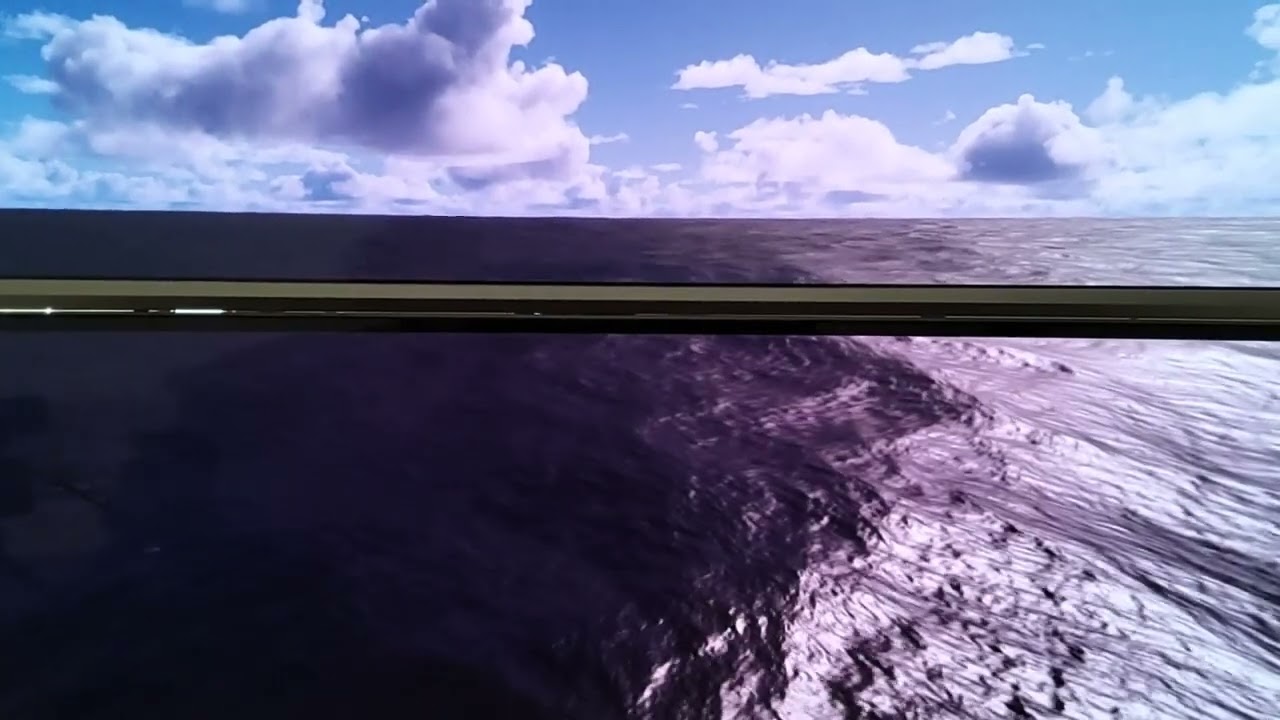
This is 3 layers of wind 1st two layer are one at ground level and one under ground level 3th layer is a 1000ft on top of them created in own weather with some extremes
And what t does to the waves i was suprised to what it does (see the video)

it make me want to buy a boat. Just to see how it handles

1 Like

I think you should always remain fair in such assessments and we sometimes forget what the 2020 was at the beginning and what the 2024 is today. Even with the restart problems.

I’m prepared to invest a lot of money in the hobby. I don’t care about the cost of switching to '24. Only my graphics card already costs 15 times as much.
Often I just find the consequences of how different things are approached and then dropped again incomprehensible. I don’t want to keep repeating examples here. Work is invested in something that is half finished and then something worse comes out than before and does not change anymore or for a long time.

Professionally, I used to optimize work processes in the past. That’s why I’d like to go to Bordeaux and take a look at the team there.
FS is certainly one of the most complex challenges when it comes to PC games. They may also be overwhelmed with certain things and then swim back and forth to somehow get ahead, whereby the balance between function and possibility (computing power) is the biggest challenge. When I hear the discussions about all the things people want and then people complain that they absolutely need over 50FPS without spending more than 1KEUR on the PC. :frowning:

I’ve been through all the PCs before the 286 era and I know the performance of the “boxes” I have in front of me. So I don’t need to think that my old 2080 is the right one to handle 2x4k on my Pimax.
When it comes to such complex things as weather, etc., I don’t demand flawless miracles, but consistent further development, albeit with temporary setbacks.

The guys do a great job with public relations, but if they do, then with honesty. I have no problem hearing about changes of direction, problems and mistakes. There are enough people here who are experts in whatever field and who would give tips. That’s the great advantage of today’s communication, which didn’t exist 20-30 years ago.
However, I sometimes have the suspicion that in a developer stream only prepared questions are answered that they want to answer. Certainly better than doing nothing, but still far from satisfactory. At least for me.

But as you mentioned, I’m not dissatisfied with the FS either.
For me, it serves its purpose well: most days I put on VR from 6 p.m., get on the glider and go somewhere in the world where the live weather is good to see the world from above and look for updrafts or thermals. After 2 hours I’m already much more relaxed and then the rest of the evening comes with family ;-).

Keep up happy flights.

Ralf

6 Likes

I talked about this a lot on my stream last night, with real-world and in-sim examples of the importance of and difficulties in generating accurate, aesthetically pleasing, and timely weather. You can’t just use numerical models, but you also can’t just use hourly observations. Many weather phenomena are too ephemeral and interconnected for the fairly low spatiotemporal resolution we seem to get. And it absolutely matters, as I explained on the stream (much easier to do with a telestrator and a mic/camera than via text in a forum).

As we all seem to agree - we just don’t know what they’re doing under the hood: what data it’s all based on, how the problem is approached, what the goal is, what the barriers are, and what kinds of experts are making the decisions. Thus, these threads are all kind of circular, examples are shown here and there, we speculate as to why, then something changes (maybe or maybe not for the better), and we start over again. The competing sims are not a panacea, nor are the older versions of this sim.

So it’s back to the question - who is driving this thing, what are their intentions, and what is their (or the team’s) understanding of aviation weather?

9 Likes

Hello everyone,
Now I have watched the last developer live stream on YT and was very pleased that almost before the end there was a question regarding weather improvement and cloud visualisation (1:05).
After a noticeable pause, Mr Wloch said that the topic could certainly be addressed when most of the other bugs have been fixed and the approval in the wish list is correspondingly high.
After that, however, only operating problems when changing weather situations were described.
The physics of clouds or weather itself was not discussed in any way.

Please don’t misunderstand, I see the fundamental problems in FS’24 and that with SU1 and SU2 the whole thing first had to be made to work properly.
But the nature of the answer suggests that the topic of weather is not being addressed at all at the moment. In addition, as already mentioned here, the situation depends on demand.

This leads me to believe that even if this request for improved weather and clouds is not very high on the list (on the contrary), nothing will happen in this direction. Precisely because the situation is very complex.
For a game you can add or change a few parameters, but for a simulation you need physical know-how. You can’t avoid involving experts for teamwork to steer the whole thing in the right direction.

A good example of this is the work of Gotfriends, who have now brought Mr Stefan Langer on board for the AS 33 (Glider). A gliding world champion who has a lot of experience with this aircraft and can make realistic statements about how the model behaves in reality.
I would be interested to know what he thinks about the weather in FS.

In any case, it’s probably not just me who needs a lot of patience until an improvement is realised in my favour.

I can’t emphasise this often enough. Even if there is a lot of criticism here, I still enjoy flying in FS as a Glider pilot who only flies with real weather. From the point of view of FSX, the further development is awesome.

Nevertheless, I have one wish that can be fulfilled very quickly and that goes to Mr Wloch:
Please have a description made of how weather is laid out in the FS. How thermals are triggered, how clouds are formed, how lightning is generated during thunderstorms, etc. .

So that we get to know the preconditions.

Many people here who know about the weather will be interested. Maybe it will motivate gamers to learn more about the important topic of weather here.

Please don’t push the theme to the wayside.

Regards
Ralf

2 Likes

FYI, this topic is now #21 on the Wishlist chart:

1 Like

The 4 weather-related “wishes” in the top 20 are essentially all about the same issue, and have together 5713 “votes”!

7 Likes