Just go to the main menu and back in flight. It should reset. How did you break it?
Not sure how I broke it  I wasn’t watching it after landing due to something happening, and the next thing I noticed was en error (chip detected I think).
The issue is that in a bush trip, it saves the airplane state and you can’t reset it. That’s why I wondered if there would be an option to reset it while loaded. I might try flying the previous leg again to see what happens then.
Thx.
You definitely overstressed the engine, maybe your prop went in the red too much. The code will reset failures on esch flight regardless of state. If it doesnt work, it will be interesting to know.
1 Like
I have not been able to fly the Kodiak yet, I have been trying for a week. Everything is setup right, I have been in and out of the Sim and even uninstalled and reinstalled the Kodiak but right when I switch the starter on the ITT jumps to 1200 and the engine is gone. If anyone has any ideas please let me know.
Thanks,
UnbrandedDog990
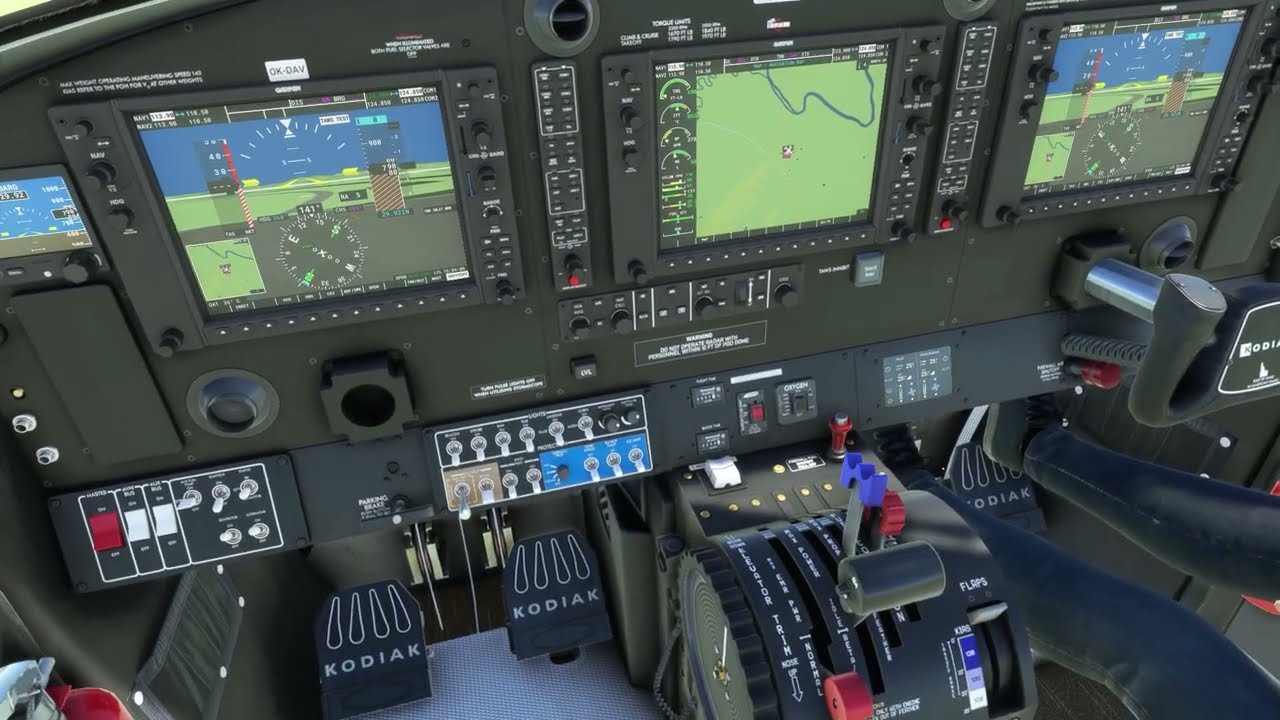
You’re getting a “hot start.” The more realistic and complicated the aircraft, the more important it is that you operate it according to the POH instructions. This video shows one way to start the engine.
1 Like
Thanks a lot SamuraiSax I got it running on the first try. I had the mixture and condition levers in the wrong place. Good Job Man !
Thanks Again,
UnbrandedDog990
1 Like
Make sure the Condition lever, (Fuel), is on cut-off before you turn on the starter. Move it to low idle when the Ng is higher than 14% and watch closely to make sure it’s starting properly. A hot start will happen when the starting sequence is wrong. Just make sure you follow the startup instructions in the right order. If the temp is heading past the redline, quickly put the condition lever back to cut-off. Hope that helps!
1 Like
Avoiding excessive hot section temps is pretty straight forward.
-
Do not introduce fuel (move the condition lever from cut-off to low idle) before Ng is high enough.
-
With a lo start (used for battery starts) you turn on the igniters manually (this allows you to delay the igniters until the compressor spools up to save battery). Do not introduce fuel until after you have the igniters switched on.
2 Likes
I’m not realy happy with the sound. Is there any mod?
1 Like
I am surprised. I personally find Kodiak to be the best-sounding turboprop in the game. I have never seen any sound mod for Kodiak. I do not think there is any.
6 Likes
I agree. The sound package is one of the best in the sim.
3 Likes
I recently started flying the Kodiak more often. I bought it when it came out but always had trouble handling her and I haven’t flown it ever since the Cessna 310 from MilViz came out. After reading recent posts in this forum that all praised the Kodiak as still one of the best GA planes out there for MSFS, I challenged myself to finally master the Kodiak.
But so far, the process has been frustrating. The last couple of days I’ve probably spend 20+ hours in the Kodiak, flying short hops and doing traffic patterns to get a hang of flying her again. But I couldn’t get a single acceptable landing in. I mostly stall on short final or crash before the landing threshold.
Basically, I see two problems with my landungs:
-
Fully configured on short final, I need to have lots of power in order to even have a chance to make it to the runway, whereas in reality you would only need 500-700 pounds of torque with a nose pitch up of about 2.5° and an approach speed of 70-80 KIAS after turning final. When I have that power setting and nose attitude, the Kodiak literally drops out of the sky at 1600 fpm. So I need to have at least 1000 - 1200 lbs of torque in to get that nice 600 fpm descent with pretty high nose up attitude of about 5-10°. Needless to say that this is all wrong, but it’s the only power setting that get me the gliding path to the runway. Of course with that thrust power, I have to feed in a lot of right rudder which completely throws me off. No chance to get a stable approach that way.
-
Independently of the first points, my second big problem is that the plane yaws heavily left and right with the slightest roll movement. I use rudder pedals but I can’t get a feeling for when and how hard to press the rudder pedals. I’m constantly chasing coordination. I just feels like the Kodiak has a mind of it’s own. Even when trying to establish a roll angle of 5° with the smoothest control inputs possible, the coordination bar of the PFD immediately jumps to one side. I never had this with any other good 3rd party airplane. This feels all wrong.
Overall I struggle mightily with the Kodiak. I’m really invested into mastering her, but so far it has not been a joyful experience. Something feels way of with the Kodiak’s flight model. Is this supposed to be this way? A flight model like no other flight model in MSFS? The most challenging airplane so far in MSFS? The real life Kodiak is supposed to be a very stable airplane. How is everyone loving this plane so much? What am I doing wrong?
(Congratulations if you’ve made it though the whole post)
2 Likes
I have not seen a nose-up approach in a video nor had one mentioned by the Kodiak pilots that tested it. Typical approach profiles are:
Short landings: 2.5 degrees nose down, 70-75kts. Here’s a similar attitude coming in at 85-90: https://www.youtube-nocookie.com/embed/Bt8RieM0Kow High speed approach: 150kts until 1nm out, then slow down and descent: https://www.youtube-nocookie.com/embed/lmIIv9_bAvI Crosswind landing: Similar to short but flaps 20°.
If you can provide some data on these approach patterns, please PM me the source so we can look at it.
We were also told that there is adverse yaw in the plane and tested it, but that is hard to quantify.
Low power settings are hard to fly and we know it, but we don’t have enough control in the flight model. So far we managed to break cruising attitudes in order to fix it -unacceptable and we will retry.
4 Likes
Just curious if SWS will develop the Kodiak 900 A New Era - Introducing the Kodiak 900 from Daher | Feature Film - YouTube
3 Likes
I’d not heard of that. If the cockpit, and exterior have little difference, then the changes might just be on the systems side, engine performance etc.
ah .. no
Different shaped nose. Almost four foot longer stretched fuselage, integrated cargo pod and a PT6A-140A and a five blade prop for an extra 200 or so HP with a 210ish knot cruise.
At 12,500 feet it trued out at 205 knots while burning about 430 pounds of jet fuel per hour. Mark Brown, chief demo pilot and sales and marketing director for Kodiak at Daher, said he expects the final airplane without the optional radar antenna to cruise at about 210 KTAS, about 35 knots faster than the 100. In addition to the change from the 700-shp Pratt & Whitney PT6A-34 to the 900-shp PT6A-140, the new model includes a new composite Hartzell five-blade propeller, wheel fairings, flap track fairings, and a host of airframe changes to increase the speed.
In addition to the wheel fairings, which are pilot removable and add about seven knots to the speed, the most obvious airframe change is to the nose section, which is all new and made of composite material. It tapers below the engine compartment to completely fair in the cargo pod, which is now an integral part of the airframe. The cargo pod is the same volume as the optional one on the Kodiak 100, but bays two and three are open to one another, allowing for the hauling of larger pieces of gear. In addition, a hatch on the bottom aft end of the pod can be opened to slide in long items, such as fly-fishing rods and lumber.
The speed increases come about even though the fuselage is 37 inches longer. The company installed airframe plugs just aft of the flight deck and just ahead of the empennage to increase cabin volume. While longer, the fuselage is the same width and height as the original model. The wings and tail section are primarily the same between the two. However, the new model comfortably accommodates a double-club cabin configuration or up to 12 in a commuter setup in countries where that many can be carried in an aircraft in this category. Ten seats is the max allowed in the United States. Taking a nod from the luxurious TBM line, each seat position includes a LEMO headset jack, conventional headset jacks, two USB ports, a phone holder, and a cup holder. Overhead, each has a gasper air vent and a light. Cargo tiedowns are embedded in the floor, walls, and ceiling throughout, providing lots of flexibility for hauling gear.
Just to lighten up a bit…
https://cdn.discordapp.com/attachments/922548494319878204/1001544185087787098/Microsoft_Flight_Simulator_Super-Resolution_2022.07.26_-_00.56.41.23.png
12 Likes
So the engine, and performance can be tweaked in the configs, but then prop, and fuselage would require some external modelling.
If you weren’t bothered with the exterior model changes, and just wanted it to fly by the numbers you could still mod it I guess. Modders often change things like the wing span, prop length etc. without touching the exterior model.
1 Like
Before I start, I want to say that Kodiak is one of my favorite airplanes in MSFS, and in terms of sound, graphics and overall package, it is truly exceptional. The flight model feels ok if operated from normal runways. One thing, however, makes me feel strange each time I try to fly it in and out of a short field.
We talked a lot in this and the other thread about the jerkiness of the controls. That is not such a big issue by itself, but it does affect some other aspects. The more important problem for me is the flight model at take-off. It is not possible to rotate the nose and wait for the airplane to take off. That is the standard technique with Kodiak you have all seen probably (missionary bush pilot). This is also in the POH. At max weight, for STOL operations, POH states that you should rotate at 50kts, but as soon as I try it, nothing happens until around 60kts and then suddenly the airplane lunches itself with STALL warning and you have to be quick to somehow save it from crashing (yes I can do it but it is not pretty). I use honeycomb yoke.
Obviously, if you let it roll to 70-80 kts, it takes off quite normally. The faster you go, the easiest it gets. The default Caravan takes off normally, first nose wheel even at relatively low speed (45-50kts) and then when enough speed is reached, the plane takes off.
Another issue is the takeoff distance. The shortest distance under which I managed to safely take off at max weight was about 1400ft, according to POH and available info on the internet, 1000ft should be enough. In many ways, Kodiak currently accelerates slower than Caravan and needs more distance to take off. I think this longer takeoff distance required is also caused by the fact that it needs more speed than POH states and it is not very controllable at close to stall speeds (which is another issue). I really hope that this will be revised someday.
I still love to fly Kodiak, just not operate from places the real plane was designed to operate.
3 Likes
I’ve now got maybe 300 hours in the Kodiak and follow POH procedure (including careful trim for weight/wind and observance of torque and prop rpm limits). I still find smooth take off and landings a bit of a challenge - the Caravan is like flying on rails in comparison.
I think the most noticeable thing (on approach) is the amount of prop drag at low power settings. This was after an update or two ago. Also it seems very nose heavy at landing - I have to really hold the yoke back to stop the nosewheel thumping down.
On take off it still seems like it wants to stay on the ground…until it doesn’t and then you are up and away…perhaps with the dreaded left wing dip.
Still my fav plane in the SIM. After a few weeks of flying the PMDG 737 it was rather nice getting back into the Kodiak!
1 Like