You can be doing 250kts at 5 miles out & still make Vapp when you have to make it ( I do not advise this as a new pilot! ) - I’d suggest approaching at a speed you’re comfortable at rather than trying to configure for landing that far out, you can dump speed very quickly if you have to. That being said, it shouldn’t be struggling unless you’re overweight and didn’t set the bugs properly. Also you didn’t mention which model.
Yes, exactly. Give or take, touchdown speed for a 146 should be between 125 and 140kts. Losing speed and altitude at the last second isn’t particularly realistic.
I’ll watch a few tutorials tomorrow, see if I can figure it out…
Watch the tutorials from the JustFlight channel.
All you need to know to become an expert in no time.
Out of all the airliners we currently have, I find the 146 to be one of the easier ones to land. No idea if I’m doing it right or wrong, but for me it has a tendency to float a bit. I just use that “floatyness” to my advantage, throw out the air brake and let it settle down pretty much by itself. As mentioned above, just watch the tutorials and you’ll get the hang of it.
Yes, I agree about it being a bit ‘floaty’, especially after flying the PMDG 738 for so long. In real-life the flare is very late and gentle so I guess it’s pretty close to reality. But unlike other airliners it seems not to like a gentle glideslope - if I try to emulate the approach typical of the 737 I just lose altitude and speed too quickly and end up going around.
It’s also shorter than a 737 so a flare is less dramatic -I actually have a vid of one lying around, it’s just a gentle tug at 15 fto ro so. I think the camera position &FOV actually exaggerates the movement significantly here.
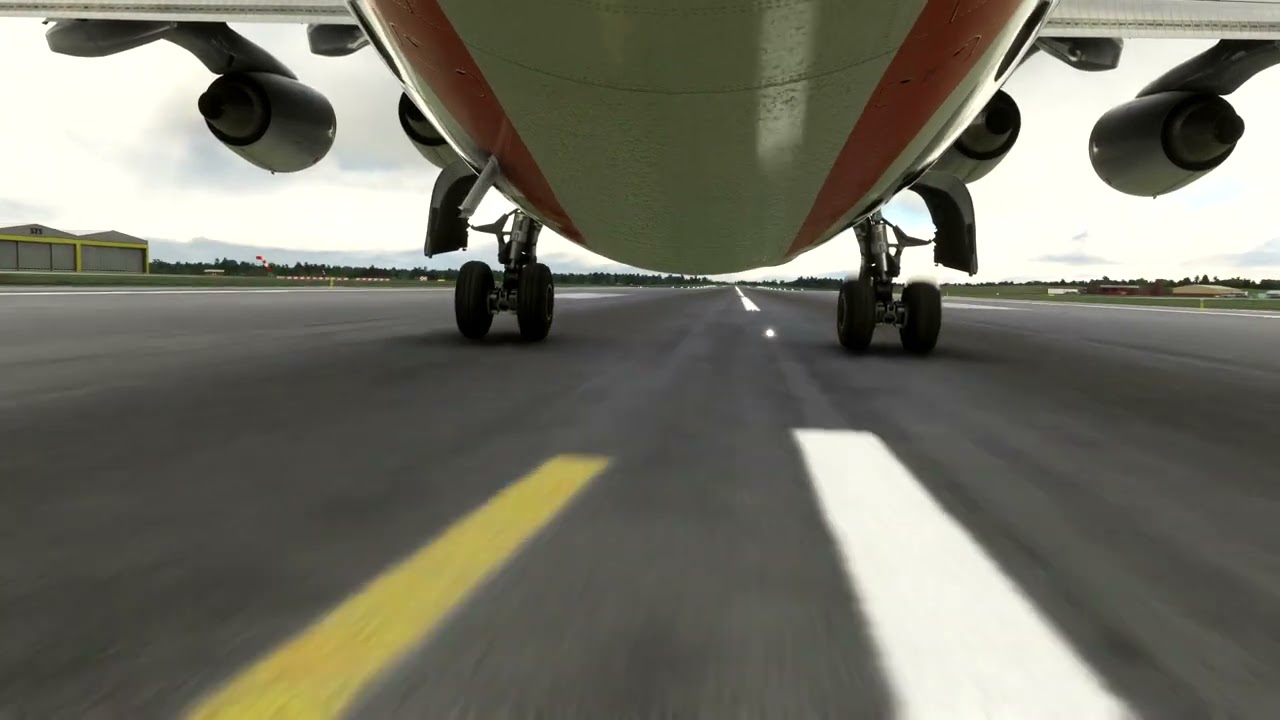
Yes, I too typically get a bounce before it settles. But the late flare and my current tendency to lift the nose too much during that flare I can work on. Of more concern at the moment is the need for a steep glideslope when landing - obviously this was necessary at LCY but does the aircraft inherently require this? In my experience watching them land they always come in nose-down in the final stages but I’m unsure if that’s characteristic of the entire final approach? I just feel like I’m missing something really simple…
Obviously I could negate much of this with automation but that defeats the purpose of my buying an analogue airliner. Conversely, it could simply be that I’ve become so accustomed to the 737 that I’m trying to fly it like a 737 when it’s a completely different aircraft.
I’m still enjoying the airliner, and given that everyone seems to love it, I’m largely convinced it’s just me expecting it to behave like something it’s not.
2 Likes
No, the a/c can handle normal 3 deg gs just fine. TBH I probably landed too soft in that vid ( I had an engine out too just for extra fun! ), a little firmer would have settled it & there would probably have been no bounce ( the runway dips there too, so maybe not ). The nose-down attitude is them coming down faster than you’re trying to with the same level of flaps out - stick full flaps out & come down the GS a bit faster & you’ll find it nosing down just to stop drifting high. You’ll see more extreme versions of the same sort of thing in tactical airlifters doing rapid descents, or some small STOL aircraft. Somewhere up thread is a backseat vid of landing at St Marys ( which is way too small for jets! ) where I went from no flaps to 33 deg in one go, because the aircraft slowed down faster than the flaps deployed - provided you’re stable all the way down, there’s a lot of wiggle room with this aircraft.
2 Likes
Figured it out! I think…
Elevators seem stuck at full upward deflection so I’ll have to succumb to watching a tutorial.
Sounds like a pressurisation issue???
Coming down the approach? it’s possible there’s enough pitch moment from excess flap deflection that it’s naturally pitching forwards & running out of deflection. Or it could be something else… if you’re on the ground, then they’ll just tip by themselves because they’re deflected by trim tabs, not directly.
Would like to add that I hardly ever land it at flaps 35 if not specifically required. Especially when new to the aircraft, try with one notch less and you won’t have to wrestle it so much.
Also really important on this aircraft (as mentioned in the video): deploy spoilers when crossing the runway treshold to settle into that flare nicely.
Also also important, make sure the engine anti ice is off, and toga is pressed once (for TOGA) or twice (for TMA disconnect, which I prefer myself), it allows for full throttle control. When engine anti ice is engaged, the TMA will maintain a minimum of 60 N² to send enough heat through the engines and personally I don’t care much for such subtle automations during a busy approach; full manual throttle was easier for me to get used to.
Thanks, been spending more time with it and I’m beginning to learn how to effectively fly her, however I’m going to have to watch some tutorials to better understand the systems and their quirks.
First step as we’ve said before is not to come down the entire approach on full flaps…just extend them as you need them. Secondly set the enignes & control speed with the airbrake.
1 Like
Yes, that’s what I’m learning. I never did the full approach with maximum flaps but tended to extend them fully at around 2,000-1,500ft. Wonder if full-flaps are never (or rarely) used for landing in reality?
The airbrake thing I adopted almost right away as I’ve seen the rear airbrake deployed just before flare so many times in the real world.
Does anyone know why AP panel has LNAV and VNAV buttons, even if FMS is disabled? I thought JF was lazy and didn’t bother to remove them, but they are present even on real planes without FMS. Do they have any functionality in VOR to VOR navigation?

Those seats could do with a bit of a restoration. They are knackered!
1 Like
VNAV - manual p.32
L NAV - manual p.34
It does not answer my question. LNAV requires INS or GPS to work, does not it?. BAe 146 in original configuration (without FMC) does not have any of these. So how LNAV knows where to fly?
For the L NAV button functionality to be available, the captains HSI must be switched to R NAV instead of NAV in order to display distance and course information of the FMS which in turn will be used by the AP.
See also p.133